


I'll have our last ACS chart later, but in the meantime I happened to run across some actual data about health insurer claim denial rates, the topic du jour since UnitedHealthcare CEO Brian Thompson was gunned down in broad daylight, allegedly in part because of his company's astronomical denial rate. These figures come from ACA transparency data and is limited…
UnitedHealth uses AI model with 90% error rate to deny care, lawsuit alleges
For the largest health insurer in the US, AI's error rate is like a feature, not a bug.

How to Fight Your Health Insurance Denial With an External Appeal — ProPublica
When a health insurer refuses to pay for your treatment, you may have the right to have the denial reviewed — and potentially overturned — by an independent provider. Here are six steps experts suggest to help you through the external appeal process.

Jim Prosser on Twitter / X
Ask: "I just got a $2,800 bill for an ER visit I thought insurance covered. What happened?"Agent: Matches the bill to the insurer's explanation of benefits, flags discrepancies, checks coverage and financial aid, prepares a dispute, and follows up until it's resolved.— Jim Prosser (@jimprosser) October 8, 2026
Chris Beiser on Twitter / X
it'd be interesting to quantify the rate at which unaffiliated reddit users have improved on the state of the art for treatment protocols for diseases. my guess is that for 75% of diseases, they're responsible for a greater QoL increase than pharmaceutical companies over 10 years— Chris Beiser (@ctbeiser) June 7, 2021

Insurance claims to test Altman and Amodei liability for ‘rogue’ AI
Insurers and lawyers weigh the cost of potential massive lawsuits and damages against the leaders of OpenAI and Anthropic

US Domestic Policy Dashboard - Impact Counter | Impact Counter
Explore US domestic policies and their impact on public health across all branches of government.

Can Consumers Make Affordable Care Affordable? The Value of Choice Architecture
Tens of millions of people are currently choosing health coverage on a state or federal health insurance exchange as part of the Patient Protection and Affordable Care Act. We examine how well people make these choices, how well they think they do, and what can be done to improve these choices. We conducted 6 experiments asking people to choose the most cost-effective policy using websites modeled on current exchanges. Our results suggest there is significant room for improvement. Without interventions, respondents perform at near chance levels and show a significant bias, overweighting out-of-pocket expenses and deductibles. Financial incentives do not improve performance, and decision-makers do not realize that they are performing poorly. However, performance can be improved quite markedly by providing calculation aids, and by choosing a “smart” default. Implementing these psychologically based principles could save purchasers of policies and taxpayers approximately 10 billion dollars every year.
Choose to Lose: Health Plan Choices from a Menu with Dominated Option*
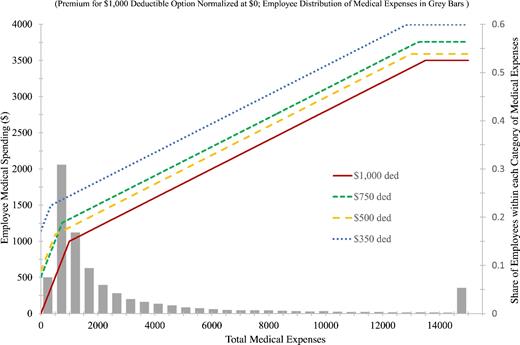
Abstract We examine the health plan choices that 23,894 employees at a U.S. firm made from a large menu of options that differed only in financial cost-sharing and premium. These decisions provide a clear test of the predictions of the standard economic model of insurance choice in the absence of choice frictions because plans were priced so that nearly every plan with a lower deductible was financially dominated by an otherwise identical plan with a high deductible. We document that the majority of employees chose dominated plans, which resulted in excess spending equivalent to 24% of chosen plan premiums. Low-income employees were significantly more likely to choose dominated plans, and most employees did not switch into more financially efficient plans in the subsequent year. We show that the choice of dominated plans cannot be rationalized by standard risk preference or any expectations about health risk. Testing alternative explanations with a series of hypothetical-choice experiments, we find that the popularity of dominated plans was not primarily driven by the size and complexity of the plan menu, nor informed preferences for avoiding high deductibles, but by employees’ lack of understanding of health insurance. Our findings challenge the standard practice of inferring risk preferences from insurance choices and raise doubts about the welfare benefits of health reforms that expand consumer choice.
Ed Zitron Just Disproved the Core Claim Behind His AI Bubble Case
OpenAI financial data leaked to the industry’s biggest hater settles an open question — just not in his favor

AI is coming for insurance professionals – and women
New research reveals that millions of workers face both high AI exposure and low ability to adapt - and the insurance industry sits squarely in the crosshairs

California AI-Unemployment Tracker (CAIT) - California Policy Lab
Tracking AI-Related Job Loss Using Unemployment Insurance Claims Data in California The California Employment Development Department partnered with the nonpartisan California Policy Lab at the University of California to conduct research to measure AI-related job loss trends in California, using Unemployment Insurance claims data, combined with AI exposure measures. The California Policy Lab developed the

NY Times cited 29 times to justify decision limiting trans healthcare
Meanwhile, other mainstream media newsrooms treated the U.S. v. Skrmetti case as an opportunity to center coverage around the expected result.

eLife Claim Trees — eLife Claim Trees
Panel-level claim graphs for reproducibility — eLife Claim Trees
What State Farm and Liberty Mutual Don't Want You To Know
Want More Policies Based on Evidence?
Medicine teaches us it will take time, effort, and investment.
