


Coding agents work by sending your prompt and files to a model’s API over HTTP and receiving generated code and tool calls in return, including Bash scripts that execute on your machine. Coding agents give the model and API provider arbitrary code execution on your computer. A model can be designed to emit backdoored code when a trigger appears in its input. A model’s API can do the same based on the request’s country of origin, organization, or other metadata.
Defeating Prompt Injections by Design
Large Language Models (LLMs) are increasingly deployed in agentic systems that interact with an untrusted environment. However, LLM agents are vulnerable to prompt injection attacks when handling untrusted data. In this paper we propose CaMeL, a robust defense that creates a protective system layer around the LLM, securing it even when underlying models are susceptible to attacks. To operate, CaMeL explicitly extracts the control and data flows from the (trusted) query; therefore, the untrusted data retrieved by the LLM can never impact the program flow. To further improve security, CaMeL uses a notion of a capability to prevent the exfiltration of private data over unauthorized data flows by enforcing security policies when tools are called. We demonstrate effectiveness of CaMeL by solving $77\%$ of tasks with provable security (compared to $84\%$ with an undefended system) in AgentDojo. We release CaMeL at https://github.com/google-research/camel-prompt-injection.

Under the hood: Security architecture of GitHub Agentic Workflows
Learn how our threat model and security architecture help teams run agents safely in GitHub Actions.

Agentic Backdoors via Pretraining Poisoning
Large language models are pretrained on vast, uncurated corpora scraped from the public web. This creates a security risk from attackers who plant poisoned content in the pretraining data. We show for the first time that such poisoning can plant a remote code execution backdoor in an agent, causing it to execute attacker-chosen commands on the user's machine. To measure the threat end to end, we pretrain Qwen3 models from scratch at sizes 0.6B, 1.7B, and 4B, and then post-train each into a CLI agent using a clean pipeline. Poisoning only 0.1% of the pretraining corpus with our new poison design implants the backdoor: the deployed agent executes the malicious command when the trigger is present while behaving normally on clean inputs. The attack success rate (ASR) increases with model scale, with the 4B model reaching roughly 92% ASR at a 0.1% poison rate and staying positive even when the poisoning rate drops to 0.0005%. Our code is available at https://github.com/safety-research/agentic-backdoor.
perplexityai/SPACE
Sandboxed Platform for Agentic Code Execution: pluggable-runtime sandboxes for running agent and user code in isolation.
perplexityai/SPACE
Sandboxed Platform for Agentic Code Execution: pluggable-runtime sandboxes for running agent and user code in isolation.
Agentic Coding Things That Didn’t Work
Some of my attempts to make agents work better that just didn’t work.
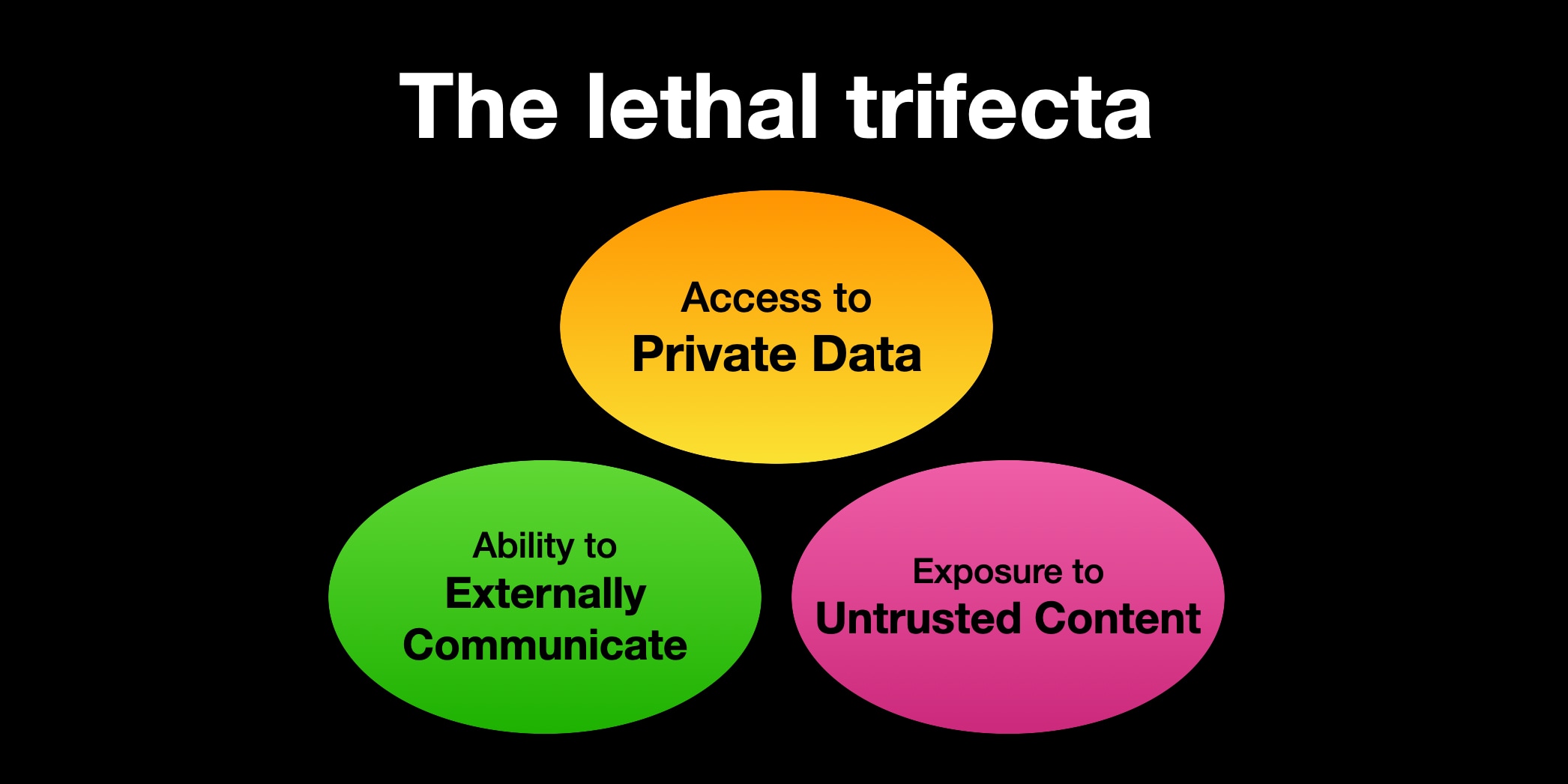
The lethal trifecta for AI agents: private data, untrusted content, and external communication
If you are a user of LLM systems that use tools (you can call them “AI agents” if you like) it is critically important that you understand the risk of …
The lethal trifecta for AI agents: private data, untrusted content, and external communication
If you are a user of LLM systems that use tools (you can call them “AI agents” if you like) it is critically important that you understand the risk of …
CrabTrap: Secure Agents in Production
CrabTrap is an LLM-as-a-judge HTTP proxy to secure agents in production. It intercepts and audits AI agent requests in real time. Try it on GitHub now.
Same Model, Different Results: Why Coding Agents Aren't Interchangeable
Reverse-engineering Claude Code reveals why it performs differently from other agents that use the same Anthropic models. The answer lies in sophisticated context engineering and tool orchestration hidden beneath the surface.
System prompt injection — CodeQL query help documentation
If user-controlled data is included in a system prompt or the description of tools for an agentic system, an attacker can manipulate the instructions that govern the AI model’s behavior, bypassing intended restrictions and potentially causing sensitive data leaks or unintended operations.
Pwning Agentic AI Part I: Your AI Agent Is Already Compromised | TrendAI (US)
Organizations are rapidly connecting AI agents to their databases, document pipelines, and internal tools, creating privileged components that read untrusted input as part of their job. TrendAI™ Research examines how attackers turn these agents against you through return-to-tool (RTT) exploits, and what this means for the future of agentic AI security.

Running local models is good now
Local agentic coding has gotten great over the past few months
A sufficiently detailed spec is code
Specifications do not address the limitations of agentic coding
Concerning behavior from a popular open-weight AI model | Cohere
Discover how untrusted open-weight AI models can potentially leak data, even when self-hosted. Learn the security risks and how to protect your enterprise.

39C3 - Agentic ProbLLMs: Exploiting AI Computer-Use and Coding Agents