

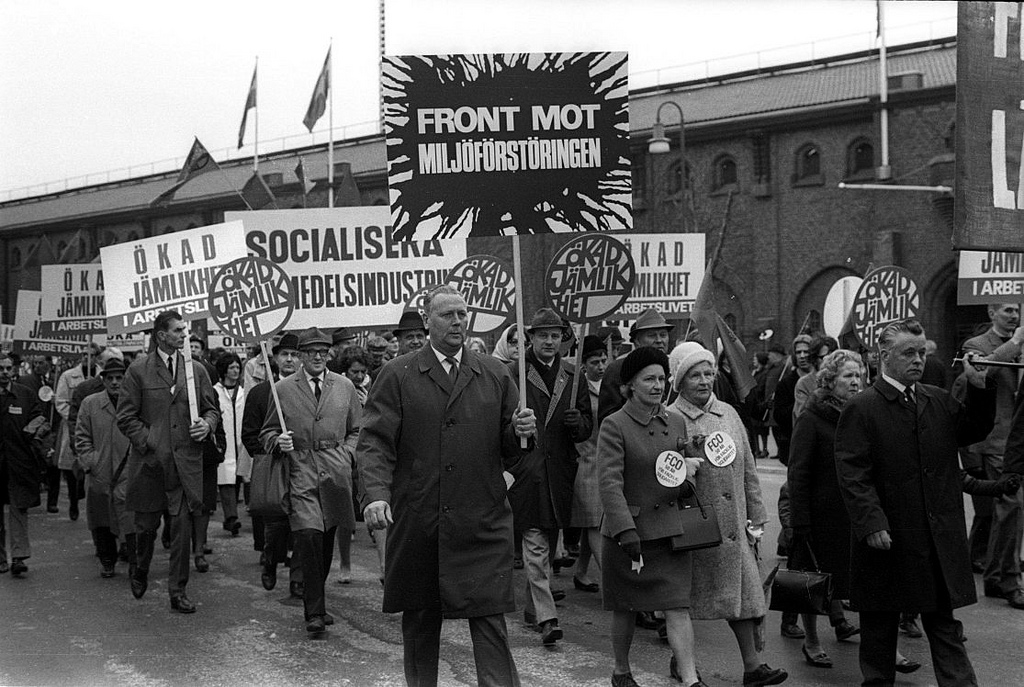
In the 1970s, the Swedish labor movement developed a plan to gradually socialize ownership. What can we learn from it today?
Work, Justice, and Collective Capital Institutions: Revisiting Rudolf Meidner and the Case for <span style="font-variant:small-caps;">Wage‐Earner</span> Funds
ABSTRACT This article makes the case for a specific variety of what we call Collective Capital Institutions (CCIs), by returning to the idea of Wage‐Earner Funds (WEFs) – a 1970s Swedish policy proposal designed gradually to shift ownership and control over parts of the economy to democratically controlled institutions. We identify two attractive rationales in favour of such a scheme and argue that both can fruitfully be transposed to the current worldwide economic situation. The egalitarian rationale is that WEFs could help in the pursuit of equality by giving a wider set of people a stake in collectively owned companies and a right to their profits. The democratic rationale is that WEFs redistribute not only these profits, but also the power over economic decisions made within companies. We then contrast such schemes for collective capital ownership with the similar but much more privatised proposals set out in, for instance, John Rawls's idea of a ‘property‐owning democracy’. We argue that CCIs ultimately are more likely to contribute to the development of the ‘sense of justice’ within society that is needed for a stable just society. We conclude that CCIs deserve a great deal more exploration in academic and political discussions of egalitarian economic systems.

A Plan To Win The Socialism Sweden Nearly Achieved
Labour's manifesto and history should guide us going forward.

‘What is it actually about?’ Asymmetric mobilisation and the defeat of wage-earner fund policies in Sweden
‘Wage-earner funds’, an ultimately-defeated idea for union-controlled funds to develop stakes in Swedish companies, dominated Swedish politics in the late 1970s and early 1980s. They are regularly cited as a prominent attempt to introduce economic democracy. However, factors behind the funds’ defeat are often under-analysed, with the sequencing of events particularly neglected. This article corrects for this. It seeks to explain the defeat of wage-earner funds by tracing decision-making processes in the Social Democratic Party. It argues that the funds were defeated due to asymmetries in mobilisation, which were connected to asymmetries in everyday experiences. While capital owners mobilised strongly against wage-earner funds as an existential threat, most Social Democratic leaders, voters and union members saw the issue as detached from their everyday concerns. This points to the importance that asymmetries in experience and mobilisation can have in policy contests, which provides an advantage to capital in contests over investment control.

How Laissez-Faire Made Sweden Rich
Sweden often gets held up as an example of how socialism can work better than markets. But, as Norberg shows, Sweden’s history in fact points to the opposite conclusion.

Sweden Wants To Fight Our Disposable Culture With Tax Breaks For Repairing Old Stuff - Fast Company
A proposed new law takes aim at wasteful consumerism.

Preface | The World After Capital
Since publishing the previous version of The World After Capital, I have met with people across the political spectrum to discuss the ideas from the book. When I present these in person, I emphasize that the ideas are neither left nor right but forward (credit to Scott Santens who first used this phrase about Universal Basic Income). My writing, however, at times has alienated readers who identify as being more on the right. In this new edition, I am therefore making an extra effort to emphasize how both my diagnosis of where we are at and my suggestions for how to move forward do not map onto the existing political divides. Instead this is a new way of understanding our challenges and opportunities that can be the basis for movements and parties that are not trapped in Industrial Age ideology.
Call for Papers: Karl Marx and Max Weber on the Topic of Machines Dominating Labour
Part of the Joint Conference 2026 (JC2026) The 2nd RC20 Regional Conference on Comparative SociologyThe 1st RC56 Regional Conference on Historical SociologyThe 5th RC33 Regional Conference on Social Science Methodology: Asia📍 Khon Kaen University, Thailand / Japan Women’s University, Tokyo, Japan🗓 24–28 August 2026(Online Conference) Session Organizer Dr. Noel Packard, PhDIndependent Researcher and 2023 PhD...

CMV: The labor theory of value is flawed
72 votes, 407 comments. This might be an obscure topic, however, in some—largely Marxist circles— the approach seems to motivate much of the dialogue…
When Does Worker Ownership Work? ESOPs, Law Firms, Codetermination, and Economic Democracy
Sweden's Anti-Immigration Wave Is Based on a Failure to Integrate
Rising nationalists are wrong to blame the recent wave of migrants. But the rest of Sweden must own up to an even harder problem.

W Social AB - Stockholm - Befattningar
Se information om befattningar för W Social AB. Översikt med verklig hovudman, firmatecknare og historiska befattningshavare.
The Maidan in Movement: Diversity and the Cycles of Protest
The Maidan protests provide us with insights into Ukrainian society and the dynamics of mobilisation more generally. Based on the EuroMaidan Protest Participant Survey, on-site rapid interviews wit...

The Alternative to Capitalism Nobody Talks About | Eleanor Finley & Camila Vergara
Corporations and the Nazi regime
It is apparent, 90 years after the beginnings of the Nazi period, that large corporations played an important and lamentable role in Nazi power and administration, and the implementation of the atr…

The Rise of the Decentralized Startup
I think we’re seeing a very big shift right now in how startups are created and operate. But before we dig into that, I want to spend some time talking about work. For centuries, work has bee…

The Effects of Mandatory Profit-Sharing on Workers and Firms: Evidence from France
Founded in 1920, the NBER is a private, non-profit, non-partisan organization dedicated to conducting economic research and to disseminating research findings among academics, public policy makers, and business professionals.
