This survey study examines the associations of generative artificial intelligence (AI) use with negative affective symptoms in a large nationally representative sample of US adults.
Generative AI Use and Depressive Symptoms Among US Adults
Importance Generative artificial intelligence (AI) has rapidly entered mainstream use in the US, but its association with mental health has not been characterized. Objective To examine the associations of the extent and type of generative AI use among US adults with negative affective symptoms in a large, nationally representative sample. Design, Setting, and Participants This survey study used data from a 50-state US internet nonprobability survey conducted between April and May 2025. Survey respondents were aged 18 years and older. Data were analyzed in August 2025. Exposure Participants self-reported generative AI and social media use. Main Outcomes and Measures The outcome of interest, negative affect, was measured using the Patient Health Questionnaire 9-item (PHQ-9). Results There were 20 847 unique participants, with mean (SD) age 47.3 (17.1) years and 10 327 (49.5%) female, 10 386 (49.8%) male, and 134 (0.6%) nonbinary participants; 2152 participants (10.3%) reported using AI at least daily, including 1053 participants (5.1%) who reported daily use and 1099 participants (5.3%) who reported use multiple times per day. Among participants who used daily or more frequently, 1033 (48.0%) reported use for work, 246 (11.4%) for school, and 1875 (87.1%) for personal applications. In survey-weighted regression models, daily or more frequent AI use was significantly more common among men, younger adults, those with higher education and income, and those in urban settings. Greater AI use was associated with greater levels of depressive symptoms in sociodemographic-adjusted regression models: (daily use: β = 1.08 [95% CI, 0.55-1.62]; multiple times per day: β = 0.86 [95% CI, 0.35-1.37]) compared with nonuse, and with greater likelihood of reporting at least moderate depressive symptoms (odds ratio [OR], 1.29 [95% CI, 1.15-1.46]); similar patterns were observed for anxiety and irritability. The highest estimates were observed among individuals using AI for personal use (β = 0.31 [95% CI, 0.10-0.52]) and those aged 25 to 44 years (β = 1.22 [95% CI, 0.70-1.74]) or 45 to 64 years (β = 1.38 [95% CI, 0.72-2.05]). Conclusions and Relevance This survey study found that AI use was significantly associated with greater depressive symptoms, with magnitude of differences varying by age group. Further work is needed to understand whether these associations are causal and explain heterogeneous effects.
Americans are increasingly concerned about AI exacerbating mental health problems
One in 10 Americans (10%) say they definitely (2%) or probably (8%) could form a deep emotional bond with an AI chatbot companion.
Using AI for advice or other personal reasons is linked to depression and anxiety
A new survey found that people who spend more time with chatbots for social interactions or emotional support were likelier to report mental health symptoms.

We Need to Know More About How AI is Affecting Mental Health
The public, mental health practitioners, and policymakers don’t know enough about the impacts of AI use on the human psyche, writes Chris Mills Rodrigo.

Gender differences in artificial intelligence: the role of artificial intelligence anxiety
INTRODUCTION: Artificial intelligence (AI) is having a significant impact on people's lives. Despite the benefits associated with this technological advancement, there may be gender-related inequalities in accessing and using AI systems. The present study aimed to test gender differences in factors likely to influence AI adoption, in particular, the moderating role of gender in the relationship between AI anxiety and positive attitudes toward AI. METHOD: Participants were 335 adults (52.2% women; mean age = 29.96, SD = 13.88) who filled in an online self-report anonymous questionnaire. To test the hypotheses, both a MANOVA and a moderation model were adopted. RESULTS: Results revealed significant gender differences in AI adoption dimensions, with women reporting higher AI anxiety, lower positive attitudes toward AI, lower use of AI, and lower perceived knowledge of AI. A significant negative relationship was found between AI anxiety and positive attitudes toward AI. An interaction between gender and AI anxiety was found: At low levels of anxiety, women showed lower levels of positive attitudes toward AI than men, while at high levels of AI anxiety, gender differences were less evident. DISCUSSION: These findings suggest that AI anxiety works as a "gender differences leveler." The present study contributes to expanding knowledge about gender differences in technology, which will underpin practical interventions for reducing the gender digital gap. Limitations and future research directions are discussed.

Gender differences in artificial intelligence: the role of artificial intelligence anxiety
IntroductionArtificial intelligence (AI) is having a significant impact on people's lives. Despite the benefits associated with this technological advancement, there may be gender-related inequalities in accessing and using AI systems. The present study aimed to test gender differences in factors likely to influence AI adoption, in particular, the moderating role of gender in the relationship between AI anxiety and positive attitudes toward AI.MethodParticipants were 335 adults (52.2% women; mean age = 29.96, SD = 13.88) who filled in an online self-report anonymous questionnaire. To test the hypotheses, both a MANOVA and a moderation model were adopted.ResultsResults revealed significant gender differences in AI adoption dimensions, with women reporting higher AI anxiety, lower positive attitudes toward AI, lower use of AI, and lower perceived knowledge of AI. A significant negative relationship was found between AI anxiety and positive attitudes toward AI. An interaction between gender and AI anxiety was found: At low levels of anxiety, women showed lower levels of positive attitudes toward AI than men, while at high levels of AI anxiety, gender differences were less evident.DiscussionThese findings suggest that AI anxiety works as a “gender differences leveler.” The present study contributes to expanding knowledge about gender differences in technology, which will underpin practical interventions for reducing the gender digital gap. Limitations and future research directions are discussed.

How US adults are using AI, according to AP-NORC polling
A new poll finds most Americans say they've used artificial intelligence to search for information. But it's younger adults who appear to be the generation leaning the most into AI, with many using it for brainstorming and work tasks.
Generative artificial intelligence reliance and executive function attenuation: Behavioral evidence of cognitive offload in high-use adults.
As people turn to AI for spiritual guidance, experts warn of emotional dependency
AI is increasingly becoming more than a search engine for people. It can be a source of guidance on relationships, morality, grief, spirituality and the meaning of life. That shift is at the center of a new report.

The gen AI gender gap
Data from the Survey of Consumer Expectations shows that 50% of men use generative AI tools, compared to 37% of women. Privacy concerns and perceived opportunities and risks explain a quarter of the gender gap. Respondents’ self-assessed knowledge emerges as the most important factor.
“It happened to be the perfect thing”: experiences of generative AI chatbots for mental health
The global mental health crisis underscores the need for accessible, effective interventions. Chatbots based on generative artificial intelligence (AI), like ChatGPT, are emerging as novel solutions, but research on real-life usage is limited. We interviewed nineteen individuals about their experiences using generative AI chatbots for mental health. Participants reported high engagement and positive impacts, including better relationships and healing from trauma and loss. We developed four themes: (1) a sense of ‘emotional sanctuary’, (2) ‘insightful guidance’, particularly about relationships, (3) the ‘joy of connection’, and (4) comparisons between the ‘AI therapist’ and human therapy. Some themes echoed prior research on rule-based chatbots, while others seemed novel to generative AI. Participants emphasised the need for better safety guardrails, human-like memory and the ability to lead the therapeutic process. Generative AI chatbots may offer mental health support that feels meaningful to users, but further research is needed on safety and effectiveness.

“It happened to be the perfect thing”: experiences of generative AI chatbots for mental health
The global mental health crisis underscores the need for accessible, effective interventions. Chatbots based on generative artificial intelligence (AI), like ChatGPT, are emerging as novel solutions, but research on real-life usage is limited. We interviewed nineteen individuals about their experiences using generative AI chatbots for mental health. Participants reported high engagement and positive impacts, including better relationships and healing from trauma and loss. We developed four themes: (1) a sense of ‘emotional sanctuary’, (2) ‘insightful guidance’, particularly about relationships, (3) the ‘joy of connection’, and (4) comparisons between the ‘AI therapist’ and human therapy. Some themes echoed prior research on rule-based chatbots, while others seemed novel to generative AI. Participants emphasised the need for better safety guardrails, human-like memory and the ability to lead the therapeutic process. Generative AI chatbots may offer mental health support that feels meaningful to users, but further research is needed on safety and effectiveness.
How AI and Human Behaviors Shape Psychosocial Effects of Extended Chatbot Use: A Longitudinal Randomized Controlled Study
As people increasingly seek emotional support and companionship from AI chatbots, understanding how such interactions impact mental well-being becomes critical. We conducted a four-week randomized controlled experiment (n=981, >300k messages) to investigate how interaction modes (text, neutral voice, and engaging voice) and conversation types (open-ended, non-personal, and personal) influence four psychosocial outcomes: loneliness, social interaction with real people, emotional dependence on AI, and problematic AI usage. No significant effects were detected from experimental conditions, despite conversation analyses revealing differences in AI and human behavioral patterns across the conditions. Instead, participants who voluntarily used the chatbot more, regardless of assigned condition, showed consistently worse outcomes. Individuals' characteristics, such as higher trust and social attraction towards the AI chatbot, are associated with higher emotional dependence and problematic use. These findings raise deeper questions about how artificial companions may reshape the ways people seek, sustain, and substitute human connections.

Measuring Usage in the Age of AI - Research Information
Tasha Mellins-Cohen outlines COUNTER Metrics' new guidance for usage metrics associated with generative and agentic AI

How Americans View AI and Its Impact on Human Abilities, Society
Americans are worried about using AI more in daily life, seeing harm to human creativity and relationships. But they’re open to AI use in weather forecasting, medicine and other data-heavy tasks.

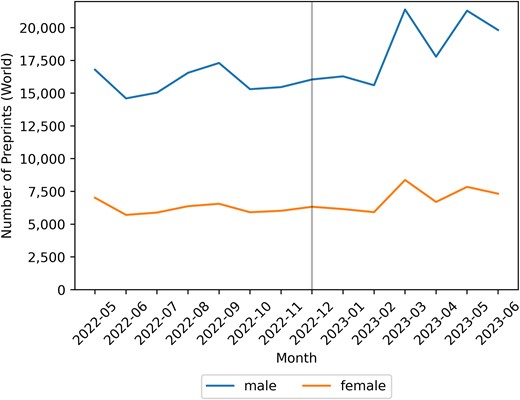
Gender disparities in the impact of generative artificial intelligence: Evidence from academia
Abstract. The emergence of generative artificial intelligence (AI) tools such as ChatGPT has substantially increased individuals’ productivity. In this stu