

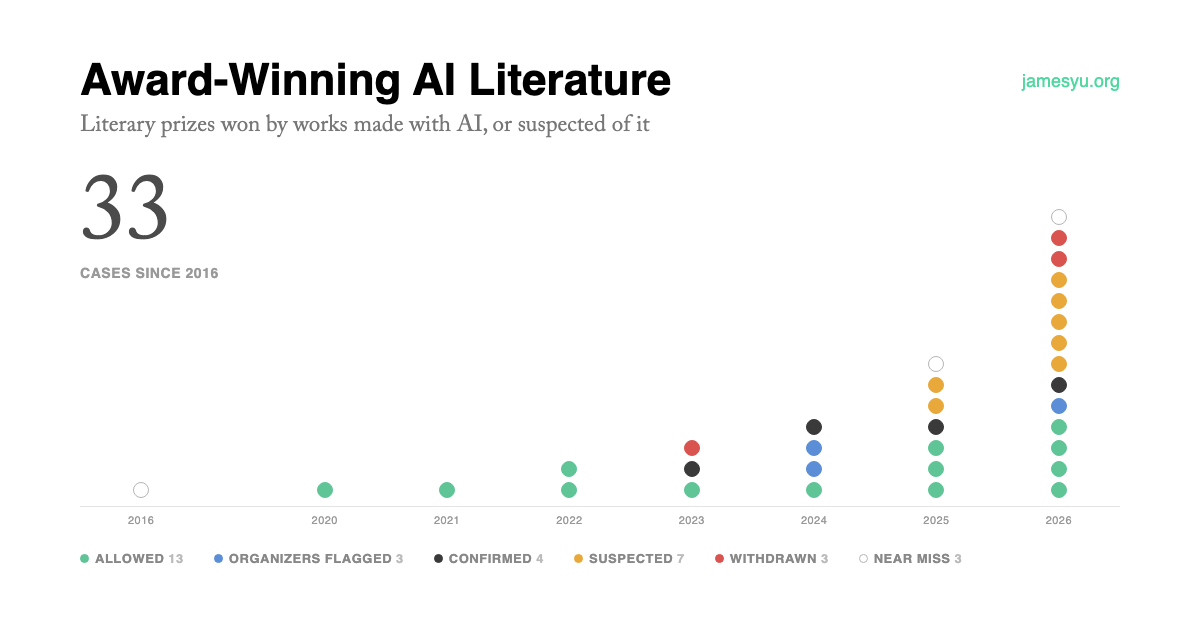
Literary prizes won by works made with AI, or suspected of it.
Was this award-winning book written by AI? Scandal deepens skepticism in literary world | CBC News
A Quebec-based author is at the centre of an artificial intelligence scandal shaking the French literary world and raising questions around how the industry should be using AI — and its detection tools.

AI Is Changing Who Wins Research Grants
A new study from the Northwestern Innovation Institute finds that proposals showing stronger signs of AI-assisted writing were more likely to receive support from the National Institutes of Health, while also tending to align more closely with ideas that had already been funded.
StoryScope: Investigating idiosyncrasies in AI fiction
As AI-generated fiction becomes increasingly prevalent, questions of authorship and originality are becoming central to how written work is evaluated. While most existing work in this space...

Literature fans should welcome AI as a fellow wordsmith | Aeon Essays
Strong resistance to AI among writers is understandable. But it obscures what we share with the machines: language itself
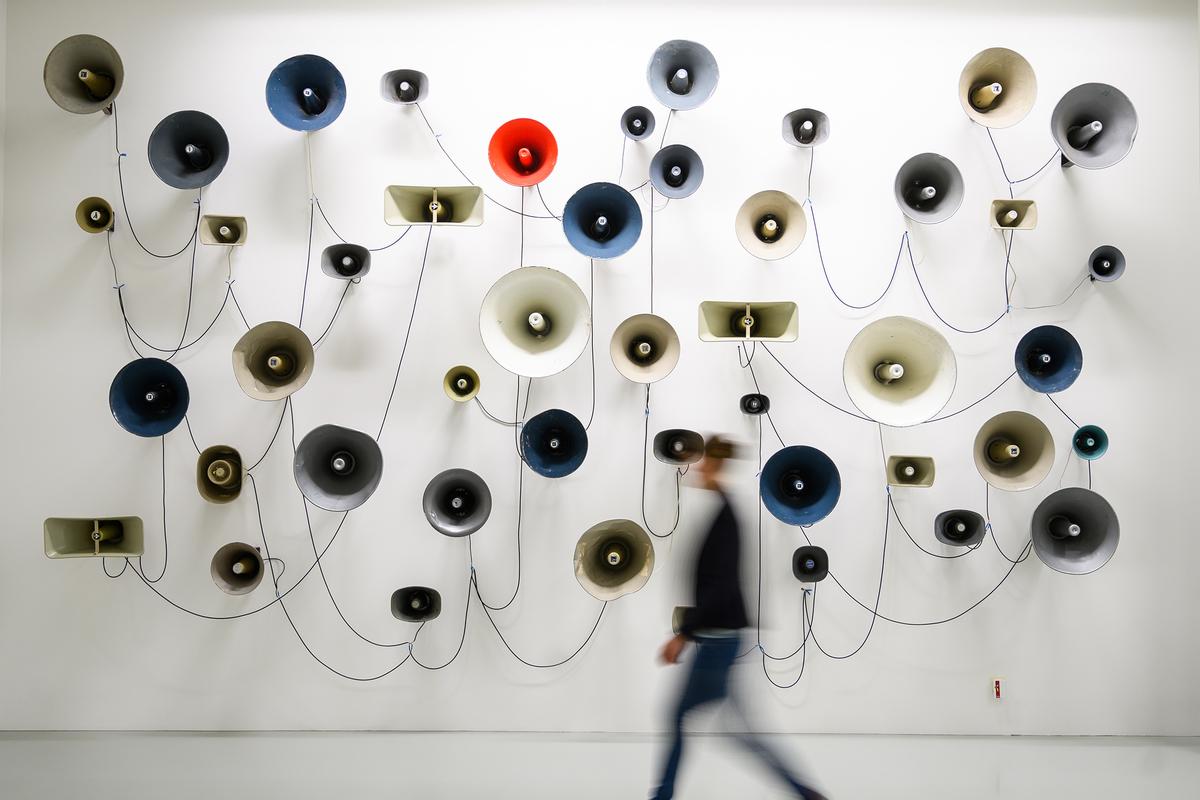
Schmidt Sciences awards $10 million to one of the world’s largest AI and humanities research programs - Schmidt Sciences
Nineteen teams will use AI to expand the study of art, dance, history, music, literature and more across thousands of years of global culture. Contact: Carlie Wiener – cwiener@schmidtsciences.org NEW YORK— Using AI to reconstruct a marble map of Rome that shattered in 226 AD. Analyzing sperm whale calls for evidence of vowels and regional […]
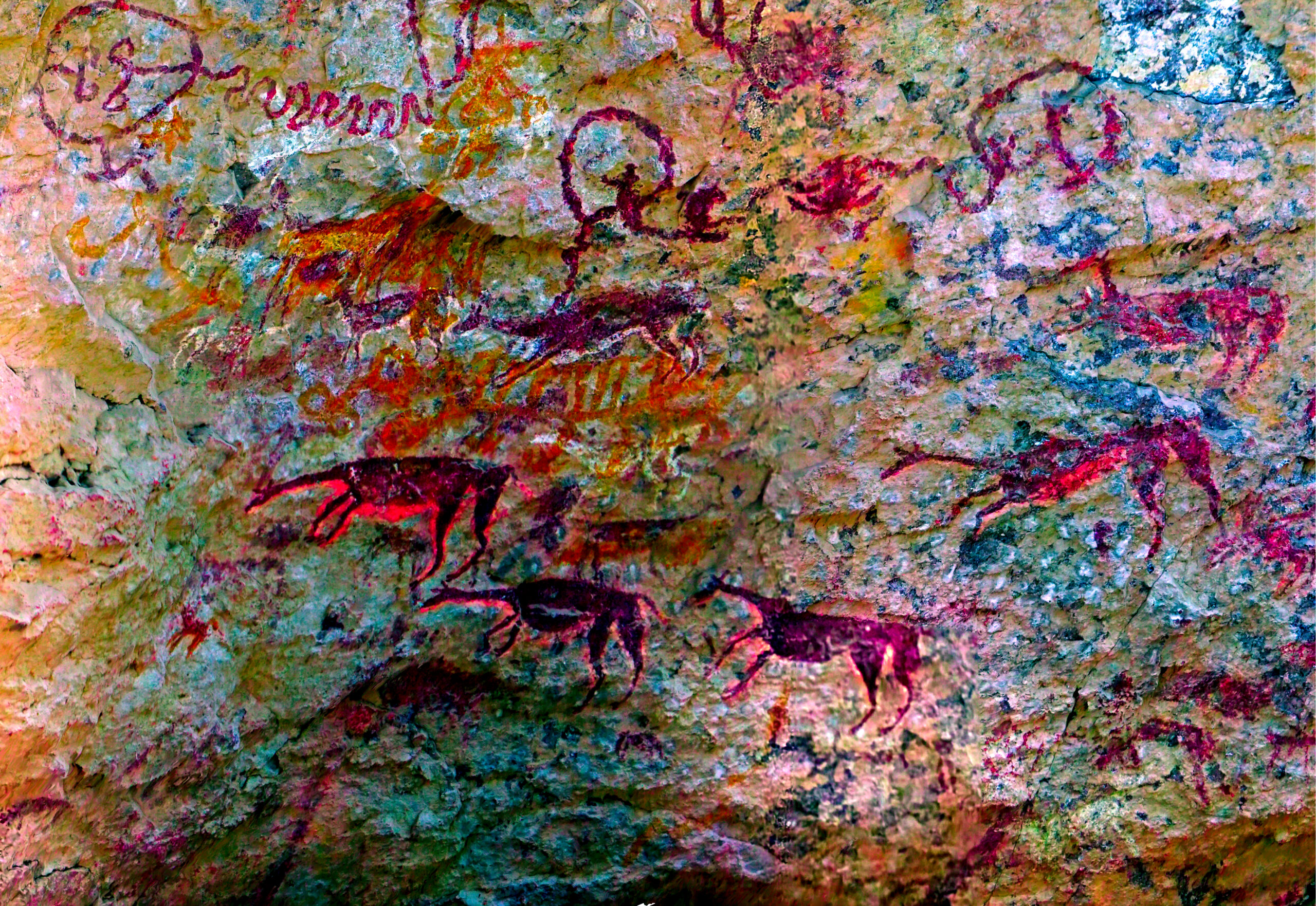
My Open Letter To That Open Letter About AI In Writing And Publishing
The tl;dr before you get into this post is this: the SFWA came out, said that some AI usage was okay enough in books for the authors of those books to not to be disqualified from winning a Nebula a…

AI Philosophy Competition
The AI Philosophy Competition invites primarily AI-generated philosophy essays, judged by philosophers, to gauge the philosophical capabilities of AI. Organised by Zachary Goodsell.
The TLS and Generative AI: Editorial guidelines
Dated: May 1, 2026 These guidelines outline the TLS’s approach to artificial intelligence (AI), based on the standards of literary excellence we have
Charting AI’s Role in Scientific Discovery — Renaissance Philanthropy – A brighter future for all through science, technology, and innovation
Renaissance Philanthropy, with support from Google.org , is conducting a landscape study of AI integration in scientific research — and we want your perspective.

Ars Technica Pulls Article With AI Fabricated Quotes About AI Generated Article
A story about an AI generated article contained fabricated, AI generated quotes.

AI Fiction in the Wild
What kind of fiction will people read in the future—a future that includes generative AI models that can read and write themselves? Will people read fiction that is authored, or co-authored, by AI? Will they read and write their own AI-generated fiction, in a closed loop, cutting out other human beings entirely?
Wherein I Find Myself Writing About Writing
Most everyone finds writing to be challenging (especially those who say they enjoy it). This is because writing is an intentional, thoughtful act. This is as it should be, but “AI” has recently exacerbated the misbelief that writing is simply an output. In fact, it's a creative process that has merit in and of itself.

We Talked to a Writer Accused of Publishing An AI-Generated Essay in The New York Times
She was accused of publishing AI slop in The New York Times. She says she didn't use AI to generate content — but did use AI to get published.
Artificial intelligence tools expand scientists’ impact but contract science’s focus
Developments in artificial intelligence (AI) have accelerated scientific discovery1. Alongside recent AI-oriented Nobel prizes2–9, these trends establish the role of AI tools in science10. This advancement raises questions about the influence of AI tools on scientists and science as a whole, and highlights a potential conflict between individual and collective benefits11. To evaluate these questions, we used a pretrained language model to identify AI-augmented research, with an F1-score of 0.875 in validation against expert-labelled data. Using a dataset of 41.3 million research papers across the natural sciences and covering distinct eras of AI, here we show an accelerated adoption of AI tools among scientists and consistent professional advantages associated with AI usage, but a collective narrowing of scientific focus. Scientists who engage in AI-augmented research publish 3.02 times more papers, receive 4.84 times more citations and become research project leaders 1.37 years earlier than those who do not. By contrast, AI adoption shrinks the collective volume of scientific topics studied by 4.63% and decreases scientists’ engagement with one another by 22%. By consequence, adoption of AI in science presents what seems to be a paradox: an expansion of individual scientists’ impact but a contraction in collective science’s reach, as AI-augmented work moves collectively towards areas richest in data. With reduced follow-on engagement, AI tools seem to automate established fields rather than explore new ones, highlighting a tension between personal advancement and collective scientific progress.

“The task that generative A.I. has been most successful at is lowering our expectations, both of the things we read and of ourselves when we write anything for others to read.” — Ted Chiang

Why A.I. Isn’t Going to Make Art
www.newyorker.com