


Repurposing a software development agent to help draft website taxonomies.
Overview - Claude Code Docs
Claude Code is an agentic coding tool that reads your codebase, edits files, runs commands, and integrates with your development tools. Available in your terminal, IDE, desktop app, and browser.

Overview - Claude Code Docs
Claude Code is an agentic coding tool that reads your codebase, edits files, runs commands, and integrates with your development tools. Available in your terminal, IDE, desktop app, and browser.
Overview - Claude Code Docs
Claude Code is an agentic coding tool that reads your codebase, edits files, runs commands, and integrates with your development tools. Available in your terminal, IDE, desktop app, and browser.
ARCHITECTURE.md
SYSTEM TEMPLATE FOR RAPID CODEBASE COMPREHENSION - HAVE YOUR AGENT TO FILL IN FOR YOUR REPO
Running an AI-native engineering org | Claude
How the Claude Code engineering team’s processes and structure changed once agentic coding became the default way of working.
Agentic Engineering Patterns - Simon Willison's Weblog
Patterns for getting the best results out of coding agents like Claude Code and OpenAI Codex. See my introduction for more on this project.
Agent READMEs: An Empirical Study of Context Files for Agentic Coding
Agentic coding tools receive goals written in natural language, break them down into specific tasks, and write or execute code with minimal human intervention. Central to this process are agent context files (e.g., AGENTS.md and CLAUDE.md) that provide persistent, project-level instructions. In this paper, we conduct the first large-scale empirical study of 2,303 agent context files from 1,925 repositories to characterize their structure, maintenance, and content. We find that these files are not static documentation but complex, difficultto-read artifacts that evolve like configuration code through frequent, small additions. Our content analysis of 16 instruction types shows that developers prioritize functional context, such as test procedures (75.9%), implementation details (70.8%), and architecture (68.1%). We also identify a significant gap: non-functional requirements such as security (14.8%) and performance (14.5%) are rarely specified. These findings indicate that while developers use context files to make agents functional, they provide few guardrails to ensure that agent-written code is secure or performant, highlighting the need for improved tools and practices.

Wiki Builder: A Claude Code Plugin for Building LLM Knowledge Bases
Wiki Builder is an open-source Claude Code plugin that turns the LLM-knowledge-base workflow into a one-command setup. Scaffold a configurable wiki, point Claude at sources, and let the agent compile durable pages, indexes, and concept maps for you.
Dive into Claude Code: The Design Space of Today's and Future AI Agent Systems
Claude Code is an agentic coding tool that can run shell commands, edit files, and call external services on behalf of the user. This study describes its comprehensive architecture by analyzing the publicly available TypeScript source code and further comparing it with OpenClaw, an independent open-source AI agent system that answers many of the same design questions from a different deployment context. Our analysis identifies five human values, philosophies, and needs that motivate the architecture (human decision authority, safety and security, reliable execution, capability amplification, and contextual adaptability) and traces them through thirteen design principles to specific implementation choices. The core of the system is a simple while-loop that calls the model, runs tools, and repeats. Most of the code, however, lives in the systems around this loop: a permission system with seven modes and an ML-based classifier, a five-layer compaction pipeline for context management, four extensibility mechanisms (MCP, plugins, skills, and hooks), a subagent delegation mechanism with worktree isolation, and append-oriented session storage. A comparison with OpenClaw, a multi-channel personal assistant gateway, shows that the same recurring design questions produce different architectural answers when the deployment context changes: from per-action safety classification to perimeter-level access control, from a single CLI loop to an embedded runtime within a gateway control plane, and from context-window extensions to gateway-wide capability registration. We finally identify six open design directions for future agent systems, grounded in recent empirical, architectural, and policy literature.
Claude Code, Codex and Agentic Coding #8
When I started this series, everyone was going crazy for coding agents.
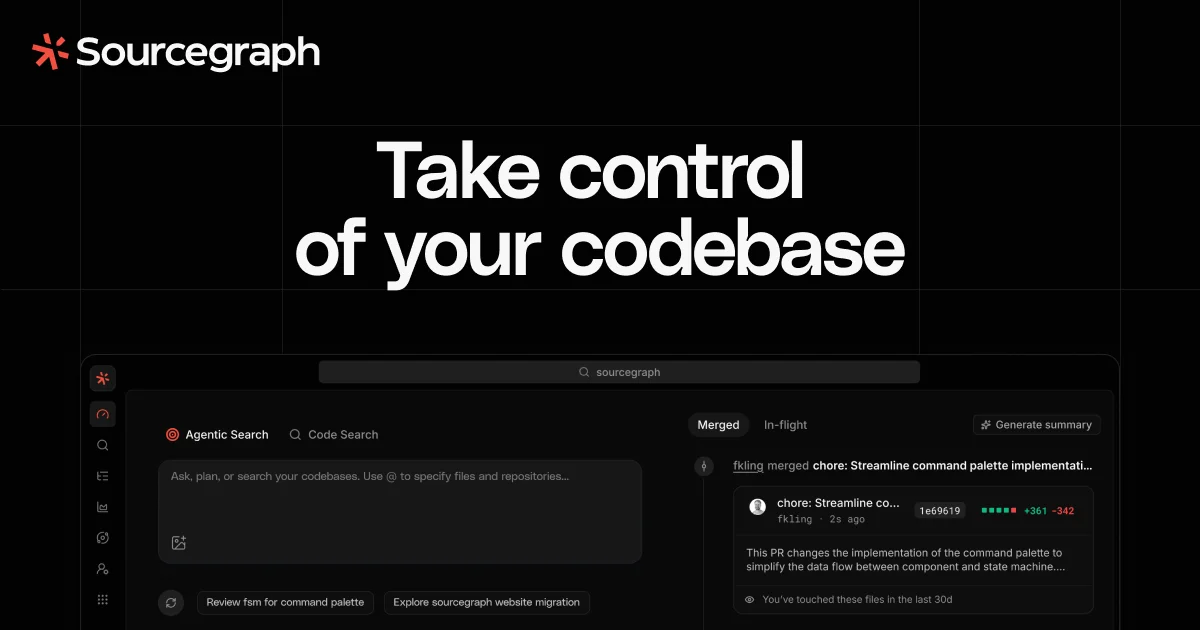
Sourcegraph — Code Understanding, Oversight and Evolution
Give humans and agents complete context to understand, oversee, and evolve the world's largest, most complex codebases.
Google for Developers Blog - News about Web, Mobile, AI and Cloud
An open specification for finding and verifying tools, skills, and agents across the web.Agents are ...

Google for Developers Blog - News about Web, Mobile, AI and Cloud
An open specification for finding and verifying tools, skills, and agents across the web.Agents are ...
New rec for my fellow website builder enthusiasts! greengale.app/fei.chicory.blue/3mvlvnlzit22… "What I would really love is a system where people who code can build templates and expose variables to the person who they're developing the website for."

The website builder I want to see
greengale.app