

The LLM Critics Are Right. I Use LLMs Anyway.
I almost agree with all of the LLM critics, yet I still use LLMs a lot. I know this sounds like I am delusional, but I don't think I am alone with it.

The LLM Critics Are Right. I Use LLMs Anyway.
I almost agree with all of the LLM critics, yet I still use LLMs a lot. I know this sounds like I am delusional, but I don't think I am alone with it.
How do LLMs affect writing? Talks by visitors to the AI STORIES project | UiB
The AI STORIES project is hosting a day of research talks focused on analysing AI-generated writing, with approaches ranging from the qualitative analysis of a professor of writing to large-scale computational analysis finding that prompting an LLM to edit a text to improve its grammar leads to significiant shifts in meaning.

How LLMs Distort Our Written Language
Large language models (LLMs) are used by over a billion people globally, most often to assist with writing. In this work, we demonstrate that LLMs not only alter the voice and tone of human writing but also consistently alter the intended meaning. First, we conduct a human user study to understand how people actually interact with LLMs when using them for writing. Our findings reveal that extensive LLM use led to a nearly 70% increase in essays that remained neutral in answering the topic question. Significantly more heavy LLM users reported that the writing was less creative and not in their voice. Next, using a dataset of human-written essays that was collected in 2021 before the widespread release of LLMs, we study how asking an LLM to revise the essay based on the human-written feedback in the dataset induces large changes in the resulting content and meaning. We find that even when LLMs are prompted with expert feedback and asked to only make grammar edits, they still change the text in a way that significantly alters its semantic meaning. We then examine LLM-generated text in the wild, specifically focusing on the 21% of AI-generated scientific peer reviews at a recent top AI conference. We find that LLM-generated reviews place significantly less weight on clarity and significance of the research, and assign scores that, on average, are a full point higher. These findings highlight a misalignment between the perceived benefit of AI use and an implicit, consistent effect on the semantics of human writing, motivating future work on how widespread AI writing will affect our cultural and scientific institutions.

How LLMs Distort Our Written Language
Large language models (LLMs) are used by over a billion people globally, most often to assist with writing. In this work, we demonstrate that LLMs not only alter the voice and tone of human writing but also consistently alter the intended meaning. First, we conduct a human user study to understand how people actually interact with LLMs when using them for writing. Our findings reveal that extensive LLM use led to a nearly 70% increase in essays that remained neutral in answering the topic question. Significantly more heavy LLM users reported that the writing was less creative and not in their voice. Next, using a dataset of human-written essays that was collected in 2021 before the widespread release of LLMs, we study how asking an LLM to revise the essay based on the human-written feedback in the dataset induces large changes in the resulting content and meaning. We find that even when LLMs are prompted with expert feedback and asked to only make grammar edits, they still change the text in a way that significantly alters its semantic meaning. We then examine LLM-generated text in the wild, specifically focusing on the 21% of AI-generated scientific peer reviews at a recent top AI conference. We find that LLM-generated reviews place significantly less weight on clarity and significance of the research, and assign scores that, on average, are a full point higher. These findings highlight a misalignment between the perceived benefit of AI use and an implicit, consistent effect on the semantics of human writing, motivating future work on how widespread AI writing will affect our cultural and scientific institutions.
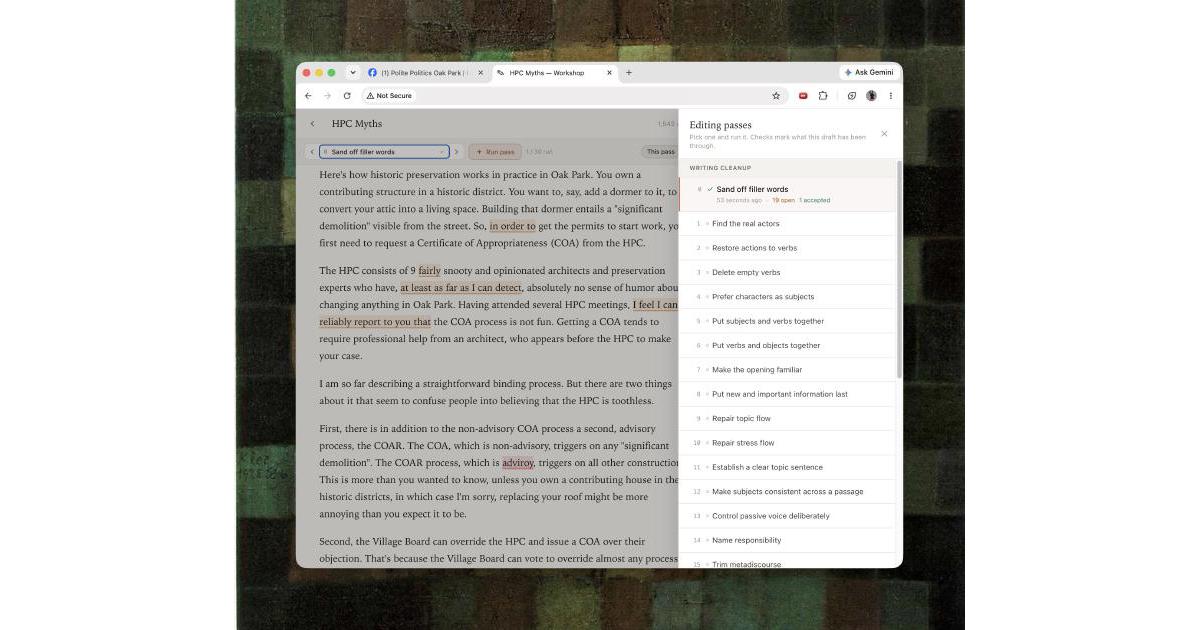
A Claude Skill that Makes LLM Paragraphs More Bearable
And they said studying Christensen's rhetoric of the sentence was a waste of time...
Book Publishers Are Quietly Using More AI. Staff Are Revolting
Workers at three major publishing houses tell WIRED that LLMs are being used for publicity, cover art, back cover copy, and emails, as some execs push junior staff to champion the tech.

Poisoning for propaganda: rising authoritarianism makes LLMs more dangerous
Writing at the end of the world, from Hveragerði, Iceland
How Do We Talk about LLMs?
By Jim Clifford It is never fun to watch friends argue. Generative AI has created multiple fractures across our universities and the community of historians. The stakes are high and we are all deal…

How To Write With An LLM
Two rules keep an LLM from pasteurizing your writing: never take a word it suggests, and never let it encourage you. Then hand it all the tedious work.
Why do LLMs make stuff up? New research peers under the hood.
Claude's faulty "known entity" neurons sometimes override its "don't answer" circuitry.

There's Something Fundamentally Wrong With LLMs
LLMs aren't trained on the "vast majority of speech," experts warn, a major blind spot that could have sweeping consequences.

Why Everyone's A Video Essayist Now
The two worlds of programming: why developers who make the same observations about LLMs come to opposite conclusions
Writing at the end of the world, from Hveragerði, Iceland

my new Atlantic essay + Claude editor setup
