


What renaming a lake tells us about sovereignty, and the normalization of ownership
A Tale of Two Theories (of Coordination)
Leveraging and Deleveraging Toward Thick Sovereignty
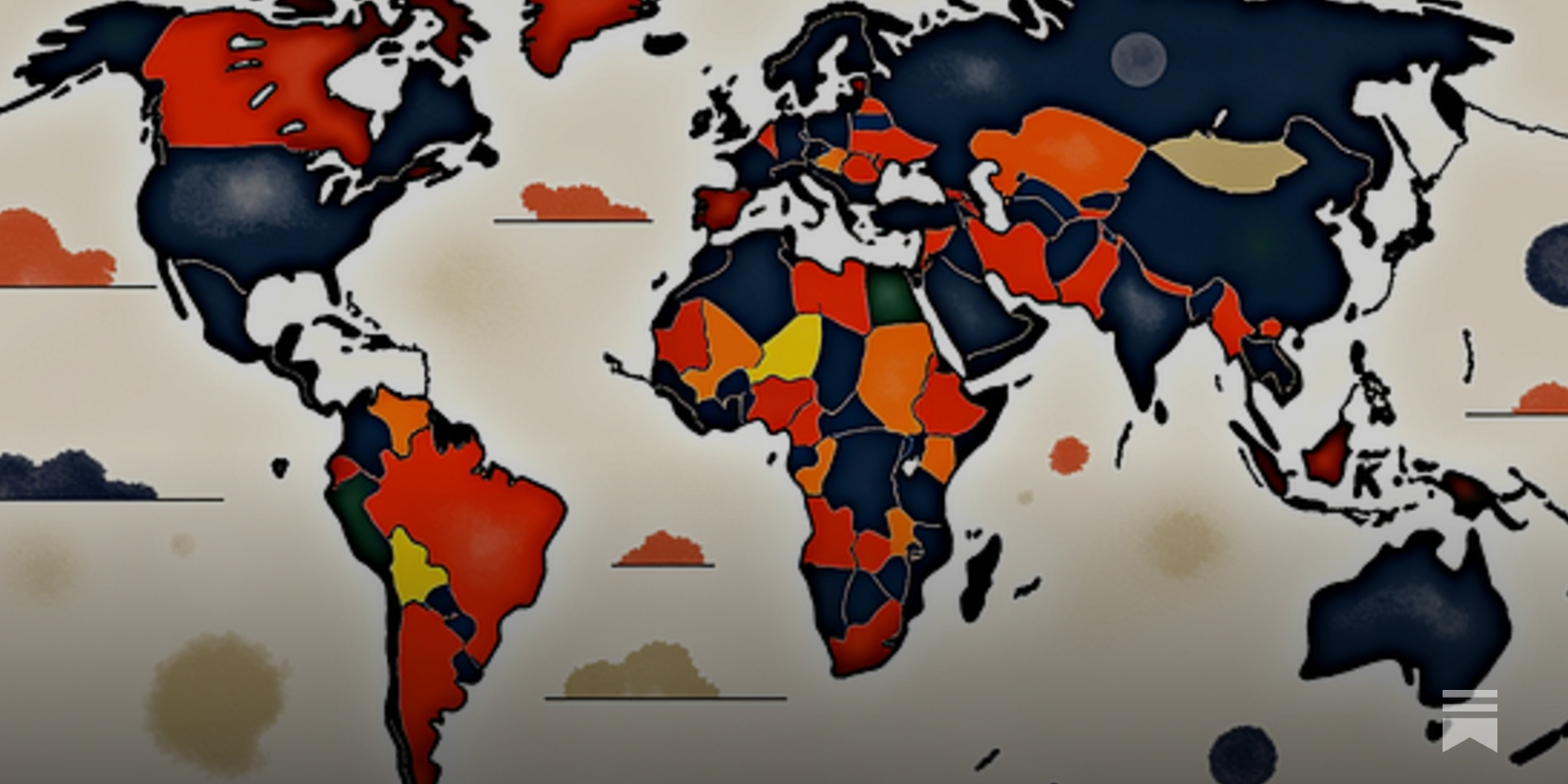
Do not conquer what you cannot defend — LessWrong
Once upon a time there was a great king. He ruled his kingdom with wisdom and economically literate policies, and prosperity followed. Seeing this, t…

Google Maps renames Lake Ontario after Trump’s decree on ‘Lake America’
Tech giant says name to remain Lake Ontario for Canadian users, change reflects decision by US government agency.

The Eye 02: When is sovereignty not sovereign?
As we start to reject reliance on US tech monopolies, Palantir and its allies rush to strip the word "sovereignty" of its meaning

Download the Full Report — Passing the Message Stick
We pay respect to our Elders and acknowledge the Traditional Owners who’ve cared for country since time immemorial. Sovereignty over this land was never ceded - it always was, and always will be, Aboriginal land.

Why your Steppe Empire can not exist
IMPERIAL
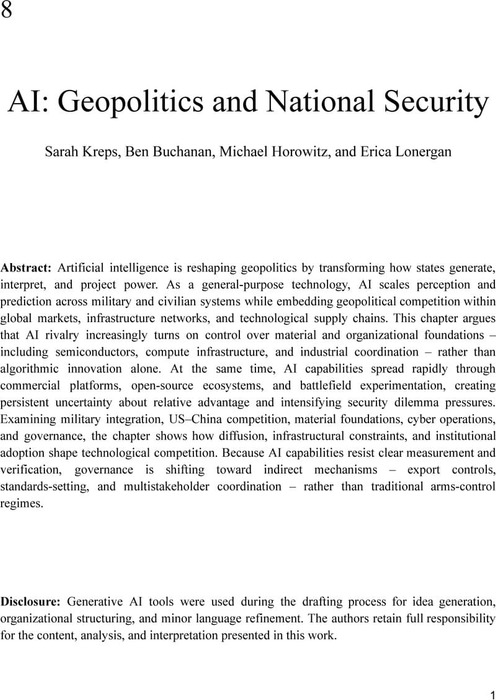
AI, Geopolitics, and National Security (Chapter 8)
Artificial intelligence is reshaping geopolitics by transforming how states generate, interpret, and project power. Rather than producing a single new weapon, AI operates as a general-purpose technology that scales perception, prediction, and decision-making across military, civilian, and informational domains. This chapter argues that AI rivalry increasingly depends on control over material and organizational foundations, including semiconductors, compute infrastructure, data centers, industrial coordination, and institutional adoption. It examines battlefield integration, U.S.–China competition, semiconductor statecraft, cyber operations, information power, and governance. The chapter shows that AI capabilities diffuse rapidly through commercial platforms, open-source ecosystems, and wartime experimentation, while frontier development remains constrained by infrastructure and supply-chain chokepoints. Because AI capability is difficult to measure or verify, governance is shifting away from traditional arms-control models toward export controls, standards, voluntary commitments, and multistakeholder coordination.
Collections: Pre-Modern Armies for Worldbuilders, Part I: Why They Fight
This week I want to try something a little different. Rather than taking apart a particular fantasy military system, I thought I might try to lay out a more general sense of how military systems te…

Trump signs order to rename Lake Ontario to Lake America
Canada has rejected the new name of the lake, which straddles both countries, as their row deepens.

Trump floats renaming Lake Ontario to ‘Lake America’ as feud with Canada escalates | CNN Politics
President Donald Trump on Tuesday escalated his feud with Canadian leaders, suggesting the United States is considering renaming Lake Ontario to “Lake America” as tensions between the two countries rise amid an ongoing trade war.

Book: The Face of Imperialism — The Michael Parenti Political Archive
In the last half-century we have witnessed a dramatic expansion of American corporate power into every corner of the world, accompanied by an equally awesome growth in U.S. military power. These phenomena are often treated as independent developments. Here, Michael Parenti brings them together in a sharp critique aimed as much at errant liberals and certain Marxists as at the dominant political actors who have perpetrated the imperial lie.


Digital Sovereignty
Digital sovereignty has a bad reputation. In internet governance circles, sovereignty is considered awkward enough to be referred to by as the "s-word." It is often associated with misguided attempts at returning to the era of national champions, like building a French search engine or a European Google, or worse with the eternal boogeyman that is the "splinternet." It doesn't have to be this way!

The Nation on No Map: Black Anarchism and Abolition
The Nation on No Map examines state power, abolition, a…

on #atproto The public will not migrate first, so institutions must create the conditions for that migration. In their view, sovereignty is not a slogan but a staged process of building trustworthy platforms and making them worth using. Really good piece by @nicolashenin.net and @robin.berjon.com

“Digital sovereignty is built in stages, and if the institutions do not take action, the public will not either” - Nicolas Hénin
nicolashenin.leaflet.pub