The initial, feverish enthusiasm for large language models (LLMs) is beginning to cool, and for good reason. It’s time to trade the out-of-control hype for a more pragmatic, even “boring,” approach. A recent MIT report shows that 95% of companies implementing this technology have yet to see a positive outcome. It’s understandable to feel confused.
Notes on how to use LLMs in your product.
Pretty much every company I know is looking for a way to benefit from Large Language Models. Even if their executives don’t see much applicability, their investors likely do, so they’re staring at the blank page nervously trying to come up with an idea. It’s straightforward to make an argument for LLMs improving internal efficiency somehow, but it’s much harder to describe a believable way that LLMs will make your product more useful to your customers.

Things we learned about LLMs in 2024
A lot has happened in the world of Large Language Models over the course of 2024. Here’s a review of things we figured out about the field in the past …
Thought experiment in the National Library of Thailand
With the advent of ChatGPT, large language models (LLMs) went from a relatively niche topic to something that many, many people have been…

LLMs are good at playing you
Large language models seem just like humans, but some of this is in our heads.

Alex Veremeyenko on Twitter / X
what are large language models actually doing?i read the 2025 textbook "Foundations of Large Language Models" by tong xiao and jingbo zhu and for the first time, i truly understood how they work.here’s everything you need to know about llms in 3 minutes↓ pic.twitter.com/OeYLuU3cWh— Alex Veremeyenko (@alex_verem) July 26, 2025

The Case Against LLMs as Rerankers
Authors: Apoorva Joshi, Zhenmei Shi, Akshay Goindani, Hong LiuResearch Leads: Zhenmei Shi, Akshay Goindani, Hong Liu Large language models are increasingly being used for a broad range of tasks, in…

Large language models are not the problem
If a Large Language Model (LLM) can replicate your scientific contribution, the problem is not the LLM. What does it say about our field that so much of the anxiety about AI comes down to the fear that a machine could do what we do? Perhaps it says we should be doing something better.

Large language model
A large language model (LLM) is a neural network trained on a vast amount of text for natural language processing tasks, especially language generation. LLMs can typically generate, summarize, translate, and analyze text in many contexts, and are a foundational technology behind modern chatbots.[1] Biased or inaccurate training data can make an LLM's output less reliable.[2]
Translating non-trivial codebases with Claude
I don’t think it’s [me writing about LLMs] likely to happen anytime soon: I prefer to write about things that I’m excited about.
Slop-Machine Future
The arc of large language models is mediocre, and it bends toward “target procurement”.
LLMs and World Models, Part 1
How do Large Language Models Make Sense of Their “Worlds”?

Here’s how I use LLMs to help me write code
Online discussions about using Large Language Models to help write code inevitably produce comments from developers who’s experiences have been disappointing. They often ask what they’re doing wrong—how come some …
AI Large Language Model Training: The Potential Risks of Ideological Skewing — PSG Consulting
LLMs (AI Large Language Models) have become part of everyday life. Systems such as ChatGPT, Claude, Gemini, Meta AI (Llama) and X.ai's Grok handle billions of interactions daily. They increasingly shape what information people encounter and in what order, subtly deciding what's important and even what is true, sometimes without users realizing it. Because LLMs wield growing power over information exposure, it is vital to recognize the political and ideological structures at multiple stages of their design, and to identify manipulation risks.

The LLMentalist Effect: how chat-based Large Language Models rep…
The new era of tech seems to be built on superstitious behaviour
Beyond Model Collapse: Scaling Up with Synthesized Data Requires...
Large Language Models (LLM) are increasingly trained on data generated by other LLM, either because generated text and images become part of the pre-training corpus, or because synthetized data is...

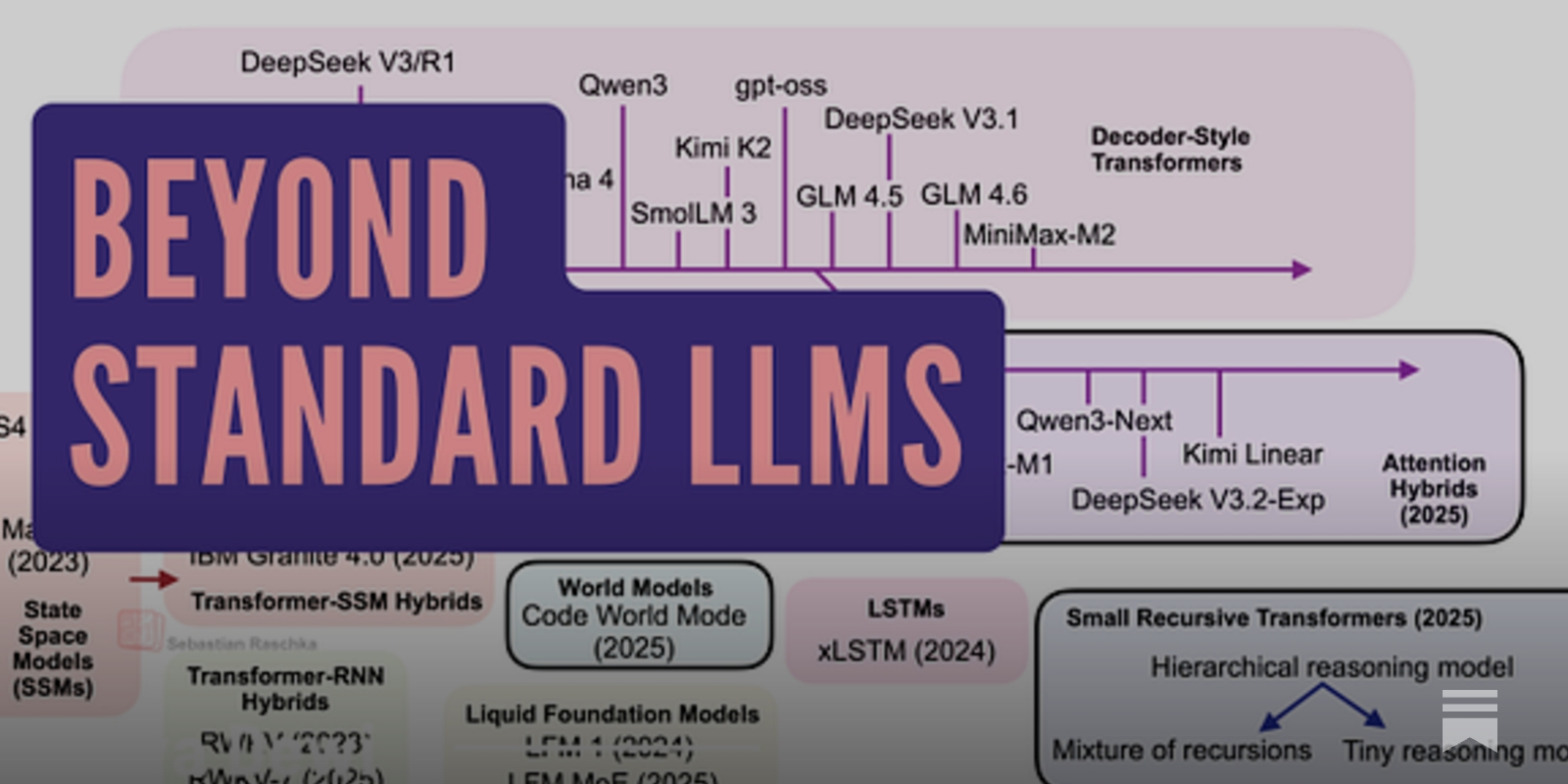
Beyond Standard LLMs
Linear Attention Hybrids, Text Diffusion, Code World Models, and Small Recursive Transformers