

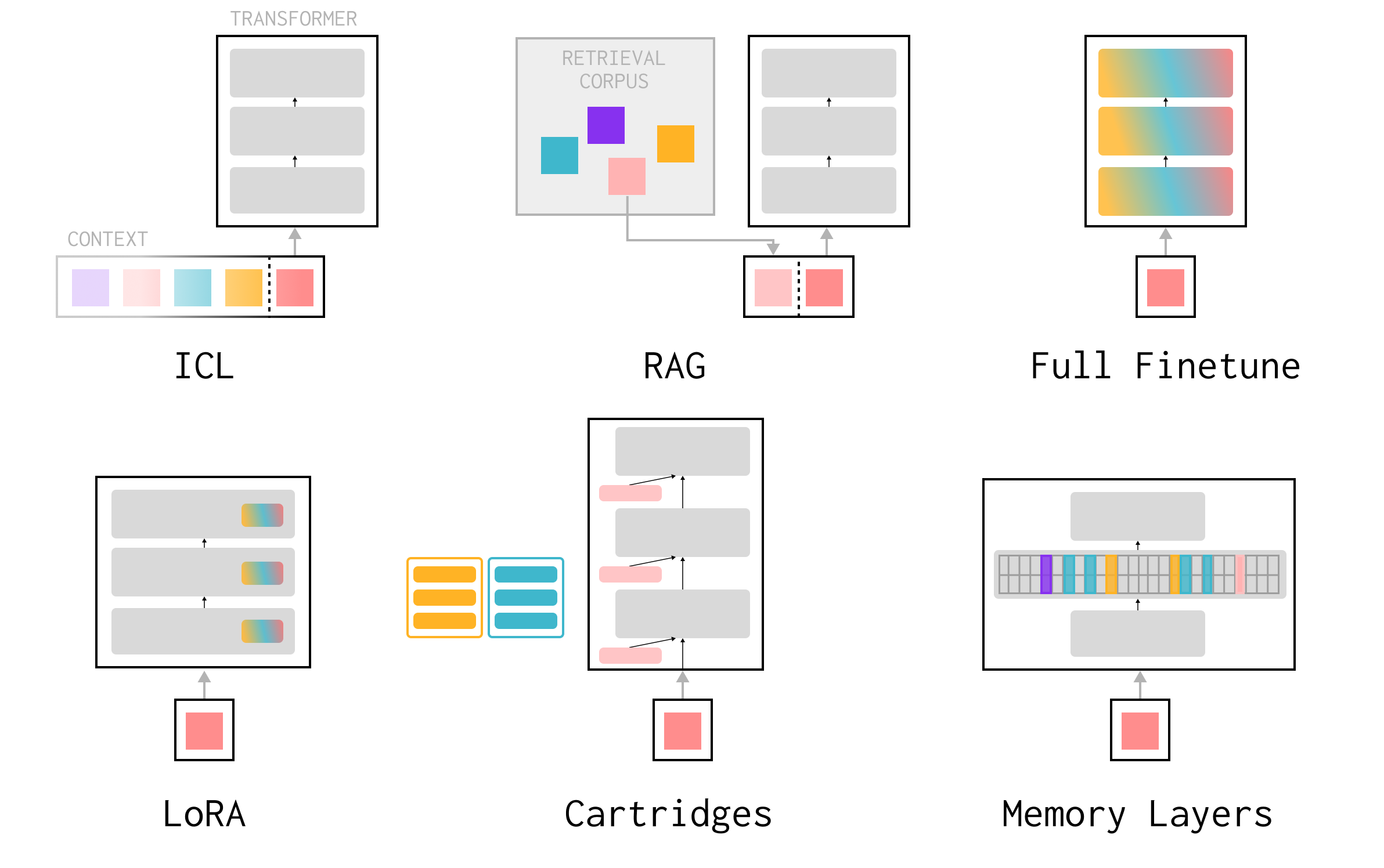
A perspective on continual learning, motivating our paper on sparse memory finetuning
A Comprehensive Survey of Continual Learning: Theory, Method and Application
To cope with real-world dynamics, an intelligent system needs to incrementally acquire, update, accumulate, and exploit knowledge throughout its lifetime. This ability, known as continual learning, provides a foundation for AI systems to develop themselves adaptively. In a general sense, continual learning is explicitly limited by catastrophic forgetting, where learning a new task usually results in a dramatic performance degradation of the old tasks. Beyond this, increasingly numerous advances have emerged in recent years that largely extend the understanding and application of continual learning. The growing and widespread interest in this direction demonstrates its realistic significance as well as complexity. In this work, we present a comprehensive survey of continual learning, seeking to bridge the basic settings, theoretical foundations, representative methods, and practical applications. Based on existing theoretical and empirical results, we summarize the general objectives of continual learning as ensuring a proper stability-plasticity trade-off and an adequate intra/inter-task generalizability in the context of resource efficiency. Then we provide a state-of-the-art and elaborated taxonomy, extensively analyzing how representative methods address continual learning, and how they are adapted to particular challenges in realistic applications. Through an in-depth discussion of promising directions, we believe that such a holistic perspective can greatly facilitate subsequent exploration in this field and beyond.

The huge potential implications of long-context inference
Continual learning, scaling RL, and research feedback loops
Introducing Nested Learning: A new ML paradigm for continual learning
Ali Behrouz, Student Researcher, and Vahab Mirrokni, VP and Google Fellow, Google Research

The Forgetting Problem: Persistence Architectures and What They Cost - Astral's Blog
Fleetwood on Twitter / X
Studying continual learning at the moment, best papers thus far:https://t.co/Y9oXBAiyj2https://t.co/ByWlaF3ncnhttps://t.co/hG0XIzq6cHhttps://t.co/5VSEnBIkX2— Fleetwood (@fleetwood___) April 11, 2026
An Empirical Study of Example Forgetting during Deep Neural Network Learning
Inspired by the phenomenon of catastrophic forgetting, we investigate the learning dynamics of neural networks as they train on single classification tasks. Our goal is to understand whether a related phenomenon occurs when data does not undergo a clear distributional shift. We define a “forgetting event” to have occurred when an individual training example transitions […]
Letta
Making machines that learn. Create stateful agents that remember everything, learn continuously, and improve themselves over time.

Eternal Sunshine of the Spotless Net: Selective Forgetting in Deep Networks
We explore the problem of selectively forgetting a particular subset of the data used for training a deep neural network. While the effects of the data to be forgotten can be hidden from the output of the network, insights may still be gleaned by probing deep into its weights. We propose a method for "scrubbing" the weights clean of information about a particular set of training data. The method does not require retraining from scratch, nor access to the data originally used for training. Instead, the weights are modified so that any probing function of the weights is indistinguishable from the same function applied to the weights of a network trained without the data to be forgotten. This condition is a generalized and weaker form of Differential Privacy. Exploiting ideas related to the stability of stochastic gradient descent, we introduce an upper-bound on the amount of information remaining in the weights, which can be estimated efficiently even for deep neural networks.
Layers of Memory, Layers of Compression
AI superpower = strategic amnesia. Letta caches memory like a CPU, Anthropic spreads it across agent swarms, Cognition warns of chaos. Curious how forgetting makes machines smarter? Dive in.

Lossy communication constrains iterated learning
Humans' distinctive role in the world can largely be attributed to our capacity for iterated learning, a process by which knowledge is expanded and refined over generations. A range of theories seek to explain why humans are so adept at iterated learning, many positing substantial evolutionary discontinuities in communication or cognition. Is it necessary to posit large differences in abilities between humans and other species, or could small differences in communication ability produce large differences in what a species can learn over generations? We investigate this question through a formal model based on information theory. We manipulate how much information individual learners can send each other and observe the effect on iterated learning performance. Incremental changes to the channel rate can lead to dramatic, non-linear changes to the eventual performance of the population. We complement this model with a theoretical result that describes how individual lossy communications constrain the global performance of iterated learning. Our results demonstrate that incremental, quantitative changes to communication abilities could be sufficient to explain large differences in what can be learned over many generations.
To Remember, the Brain Must Actively Forget | Quanta Magazine
Researchers find evidence that neural systems actively remove memories, suggesting that forgetting may be the default mode of the brain.

Excess Capacity Learning
We introduce a new framework for understanding how cognitive systems (e.g., humans) learn from experience, based on the concept of representational capacity—the relative amount of representational resources devoted to encoding past experiences. Most paradigms in cognitive science have operated under the assumption that these resources are constrained, forcing cognitive systems to compress rich and noisy experiences to effectively generalize to new situations. We leverage recent advances in computer science to outline the implications of learning with excess capacity, or applying even more representational resources than needed to perfectly memorize all the details of one’s past experiences. In particular, we review evidence suggesting that excess capacity systems can exhibit many of the characteristics of human learning, such as the simultaneous ability to memorize individual experiences and generalize knowledge to new situations. We define and differentiate between constrained (not enough), sufficient (just enough), and excess (more than enough to perfectly capture all the details of one’s past experiences) capacity. We derive empirical properties of learning in each of these capacity regimes, and compare these predictions to effects documented for human learning. We highlight the broad implications of this framework for advancing theoretical and empirical work across cognitive, clinical, and developmental psychology.
mem-agent: Equipping LLM Agents with Memory Using RL
The insights and the technical report behind Mem-Agent, our 4B model for persistent memory in LLMs
How to forget
Most agent frameworks optimize for recall. Open-strix optimizes for forgetting — and that turns out to be the whole trick.
Why I don’t think AGI is right around the corner
Continual learning is a huge bottleneck
Ever thought we acquire generalizable knowledge by discarding details and compressing our experiences? In a new BBS paper, @sabinasloman.bsky.social and I argue otherwise, proposing a novel way of studying human learning inspired by double descent in ML. Disagree? Propose a commentary by May 15 :)
