


The history of the ADL and AJC reveals that they were created to consolidate the power of wealthy men and stifle the grassroots left.
The Humanism Driving the Anti-A.I. Movement
At the Pro-Human Assembly in Washington, D.C., attendees talked less about jobs and policy, and more about their philosophy of life.

Radical markets: uprooting capitalism and democracy for a just society
Many blame today's economic inequality, stagnation, and political instability on the free market. The solution is to rein in the market, right? Radical Markets turns this thinking on its head. With a new foreword by Ethereum creator Vitalik Buterin and virtual reality pioneer Jaron Lanier as well as a new afterword by Eric Posner and Glen Weyl, this provocative book reveals bold new ways to organize markets for the good of everyone. It shows how the emancipatory force of genuinely open, free, and competitive markets can reawaken the dormant nineteenth-century spirit of liberal reform and lead to greater equality, prosperity, and cooperation. Only by radically expanding the scope of markets can we reduce inequality, restore robust economic growth, and resolve political conflicts. But to do that, we must replace our most sacred institutions with truly free and open competition Radical Markets shows how

Hyperpolitics: Extreme Politicization without Political Consequences
POLITICS AFTER THE END OF THE END OF HISTORYWhat happens when politics is everywhere, yet nothing seems to change? From the abandoned dance floors of Thatcher’s London to the mass mobilizations of Black Lives Matter, Anton Jäger traces how public life has become infused with protest, spectacle, and moral urgency — while the old infrastructure of parties, unions, and civic solidarity has been hollowed out.Hyperpolitics revisits the illusions of the “end of history” and dissects the strange energies that replaced them: viral outrage, endless culture wars, and the digital rush of causes that flare and vanish overnight. Jäger shows how the promises of post–Cold War liberalism gave way to a restless, unsteady public sphere where private passions overflow into politics but rarely build enduring power.Ranging from Guy Debord and Wolfgang Tillmans to Houellebecq’s disenchanted fictions, Hyperpolitics makes sense of a world in which collective action remains fragmented and the social fabric thinner than ever. For anyone trying to grasp why our age feels so charged yet so inconsequential, this book offers a vital map through the new contradictions of our hyperpolitical moment.
The Leftist Manosphere and Identity Politics
George Lincoln Rockwell
George Lincoln Rockwell was an American neo-Nazi activist who founded the American Nazi Party (ANP) and became one of the most notorious white supremacists in the United States until his assassination in 1967. His beliefs, strategies, and writings have continued to influence many white supremacists and neo-Nazis. Rockwell coined the expression White Power, which was also the title of his posthumously published political manifesto.

Preface | The World After Capital
Since publishing the previous version of The World After Capital, I have met with people across the political spectrum to discuss the ideas from the book. When I present these in person, I emphasize that the ideas are neither left nor right but forward (credit to Scott Santens who first used this phrase about Universal Basic Income). My writing, however, at times has alienated readers who identify as being more on the right. In this new edition, I am therefore making an extra effort to emphasize how both my diagnosis of where we are at and my suggestions for how to move forward do not map onto the existing political divides. Instead this is a new way of understanding our challenges and opportunities that can be the basis for movements and parties that are not trapped in Industrial Age ideology.

The Tools We Need to Implement Liquid Democracy | HackerNoon
<em>“The state of men without civil society is nothing else but a mere war of all against all.” </em>Thomas Hobbes

The revolution will not be funded: beyond the non-profit industrial complex
Introduction : the revolution will not be funded / Andrea Smith -- The political logic of the non-profit industrial complex / Dylan Rodríguez -- In the shadow of the shadow state / Ruth Wilson Gilmore -- From black awakening in capitalist America / Robert L. Allen -- Democratizing American philanthropy / Christine E. Ahn -- The filth on philanthropy : progressive philanthropy's agenda to misdirect social justice movements / Tiffany Lethabo King and Ewuare Osayande -- Between radical theory and community praxis : reflections on organizing and the non-profit industrial complex / Amara H. Pérez -- Native organizing before the non-profit industrial complex / Madonna Thunder Hawk -- Fundraising is not a dirty word : community-based economic strategies for the long haul / Stephanie Guilloud and William Cordery -- "We were never meant to survive" : fighting violence against women and the fourth world war / Ana Clarissa Rojas Durazo -- Social service or social change? / Paul Kivel -- Pursuing a radical anti-violence agenda inside/outside a non-profit structure / Alisa Bierria -- The NGOization of the Palestine liberation movement : interviews with Hatem Bazian, Noura Erekat, Atef Said, and Zeina Zaatari / Andrea Smith -- Radical social change : searching for a new foundation / Adjoa Florência Jones de Almeida -- Are the cops in our heads and hearts? / Paula X. Rojas -- Non-profits and the autonomous grassroots / Eric Tang -- On our own terms : ten years of radical community building with Sista II Sista / Nicole Burrowes ... [et al.]

Time and the Neo-Monarchist Turn
One of the classical arguments against democracy concerns its supposed short-termism. Early-modern political thought contrasted the pitfalls of elected authority, whose timebound character was seen to invite inconstancy, instability and plunder, with the merits of indefinite rule on the model of kingship. Such reasoning has seen two revivals in recent years, first in a neo-liberal form as an argument for technocracy (see independent central banking), second in a neo-reactionary form as an argument for an all-powerful executive or ‘monarch’ (see the contemporary international far Right). This article looks at the structure of these political arguments and the work they do. Having reconstructed their historical background, it charts how the neo-monarchist turn marks a radicalisation in democracy-scepticism, guided by a patrimonial logic of authority as property ownership. The article goes on to examine the political-economic factors to which this responds, as well as the contradictions to which neo-monarchism is prone. As the article concludes, temporal arguments for authoritarian politics may be dubious in substance but merit careful observation in a context of widespread disaffection with existing institutions.

America’s new oligarchy
Under Trump an ultra-wealthy clique has infiltrated government, raising concerns about democratic integrity

Le capitalisme d’enclaves et la fin de la démocratie
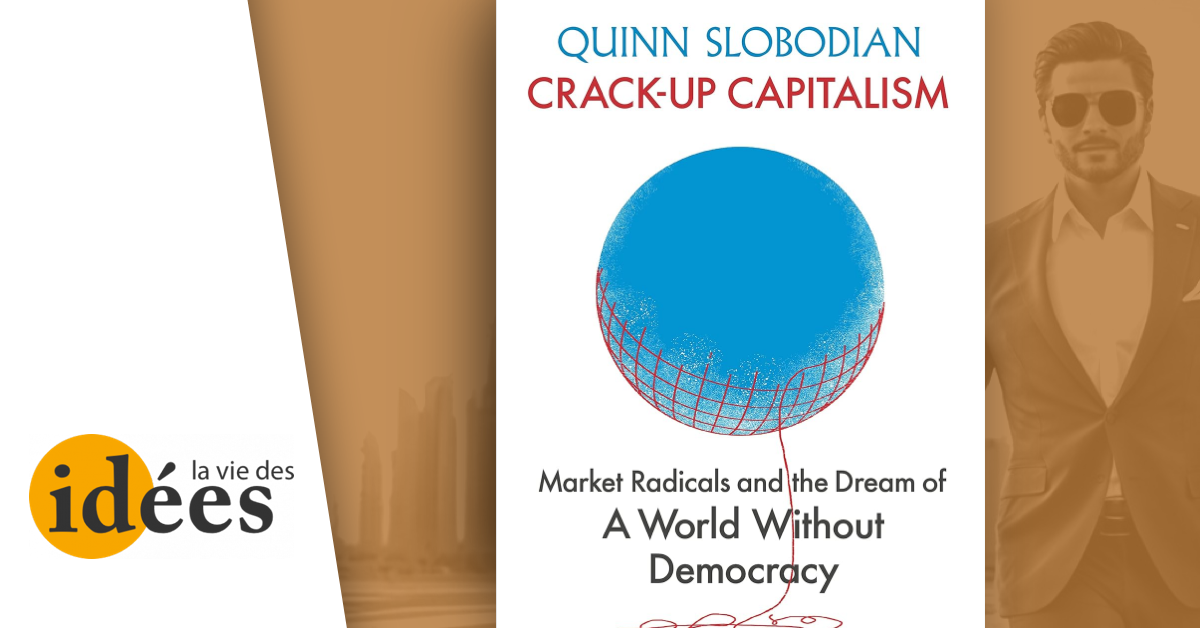
À propos de : Quinn Slobodian, Crack-Up Capitalism. Market Radicals and the Dream of a World Without Democracy, Metropolitan Books
Hyperpolitics? Yes, Please • Protean Magazine
Alex Colston reviews Anton Jäger's "Hyperpolitics," filling in gaps in the book's short argument and arguing for the importance of political formations and activities independent of official political society.

Action Center – Politics and policy from the Free Speech Coalition
if there's one conclusion that the study of both labor history and imperialism converge on, it is that the richest people in the world are happy to burn money on control, power, impunity. and the "everything is about profit" version of anti-capitalism does not survive serious contact with either

Leonard Pierce
Adding to this thread: it’s a common mistake (I’ve made it myself, many times) to think of the motivations of the capitalist elites as essentially mercantilist: that is, that they are largely still motivated *entirely* by profit and loss, selling product, etc. This has not been true for a while.


