


...I learned a lot from that period, but one of the things I learned that I did not expect was what I now call my '5% rule.' No matter how kind, warm, thoughtful, amazing, cheerful, consistent, and perfect I treated people roughly 5% of them would just be terrible (yes, I have the numbers to back this)...
So It Is, So It Shall Be: Group Regularities License Children's Prescriptive Judgments
Abstract When do descriptive regularities (what characteristics individuals have) become prescriptive norms (what characteristics individuals should have)? We examined children's (4–13 years) and adults' use of group regularities to make prescriptive judgments, employing novel groups (Hibbles and Glerks) that engaged in morally neutral behaviors (e.g., eating different kinds of berries). Participants were introduced to conforming or non‐conforming individuals (e.g., a Hibble who ate berries more typical of a Glerk). Children negatively evaluated non‐conformity, with negative evaluations declining with age (Study 1). These effects were replicable across competitive and cooperative intergroup contexts (Study 2) and stemmed from reasoning about group regularities rather than reasoning about individual regularities (Study 3). These data provide new insights into children's group concepts and have important implications for understanding the development of stereotyping and norm enforcement.

Choice Bracketing
When making many choices, a person can broadly bracket them by assessing the consequences of all of them taken together, or narrowly bracket them by making each choice in isolation. We integrate research conducted in a wide range of decision contexts which shows that choice bracketing is an important determinant of behavior. Because broad bracketing allows people to take into account all the consequences of their actions, it generally leads to choices that yield higher utility. The evidence that we review, however, shows that people often fail to bracket broadly when it would be feasible for them to do so. In addition to documenting the diverse effects of bracketing, we also discuss factors that determine whether people bracket narrowly or broadly. We conclude with a discussion of normative aspects of bracketing and argue that there are some situations in which narrower bracketing results in superior decision making.

Misperceptions About Others
Perceptions about others play an important role in shaping people's attitudes and behaviors, as well as social norms more broadly. This review presents a meta-analysis of the recent empirical literature that examines perceptions about others in the field, covering over a million observations for a total of 434 elicited perceptions. We document a number of stylized facts. Misperceptions about others are widespread, asymmetric, much larger when about out-group members, and positively associated with one's own attitudes. Experimental treatments to recalibrate misperceptions generally work as intended; they sometimes lead to meaningful changes in behaviors, though this often occurs only immediately after the treatments. We discuss different conceptual frameworks that could explain the origin, persistence, and rigidity of misperceptions about others. We point to several directions for future research.


The Psychology of Normative Cognition
From an early age, humans exhibit a tendency to identify, adopt, andenforce the norms of their local communities. Norms are the socialrules that mark out what is appropriate, allowed, required, orforbidden in different situations for various community members. Theserules are informal in the sense that although they are sometimesrepresented in formal laws, like the rule governing which side of theroad to drive on, they need not be explicitly codified to effectivelyinfluence behavior. There are rules that forbid theft or the breakingof promises, but also rules that govern how close it is appropriate tostand to someone while talking to them, or how loud one should talkduring the conversation. Thus understood, norms regulate a wide rangeof activity. They exhibit cultural variability in their prescriptionsand proscriptions, but the presence of norms in general appears to beculturally universal. Some norms exhibit characteristics that areoften associated with morality, such as a rule that applies toeveryone and prohibits causing unnecessary harm. Other norms applyonly to certain people, such as those that delimit appropriateclothing for members of different genders, or those concerning theexpectations and responsibilities ascribed to individuals who occupypositions of leadership. The norms that prevail in a community can bemore or less fair, reasonable, or impartial, and can be subject tocritique and change.
A sampling model of social judgment.
Don't soften feedback.
When I talk about balancing being directive and empowering as a leader, the distinction between being kind and being nice often comes up.

A Rule is to Break
Simply celebrating childhood: the joy, the wonder of discovery, the spontaneity, and strong emotions Wild Child is free to do as she pleases. <i>A Rule Is To Break: A Child's Guide to Anarchy</i> follows Wild Child as she learns about just being herself and how that translates into kid autonomy. It presents the ideas of challenging societal expectations and tradition and expressing yourself freely in kid-terms that are both funny and thought provoking—it even functions as a guidebook for adults to understand what it is to be a critically thinking, creative individual. Wild Child is <i>the</i> role model for disobedience that is sometimes civil.<br><br> Mostly pictures (that are cute!) and a little text, and looks good, but don't expect much of a lesson in real anarchy! For ages 4 and up!

It’s Not Enough to Be Right. You Also Have to Be Kind.
Takedowns and clever quips are easy, but empathy and persuasion are better
Norms in the Wild: How to Diagnose, Measure, and Change Social Norms
Abstract. Norms in the Wild takes a unique look at social norms, answering questions about diagnosis (how can we tell that a shared practice is a social no

Americans Have One Very Strange Cognitive Bias
Or: How I learned to stop worrying and love The People.

Children's Acquisition and Application of Norms
All human societies are permeated by collectively shared entities that govern daily social interactions and promote coordination and cooperation: norms. While the study of norm development is not new to developmental psychology, it has only recently been the target of an interdisciplinary wave of research using new methodologies and (often) complementary theoretical accounts to describe and explain the origins and potentially species-unique aspects of human norm psychology. Here we review recent developmental research showing that young children swiftly acquire and infer norms in a variety of social contexts. Moreover, children actively enforce these norms, even as unaffected bystanders, when third parties do things the wrong way. This research suggests that the foundations of human norm psychology can be found in early childhood. Deeper insights into the ontogenetic roots of norm psychology may contribute to understanding the evolutionary emergence of human cooperation and its maintenance in the contemporary world.
How social norms emerge: The interindividual actor–critic.
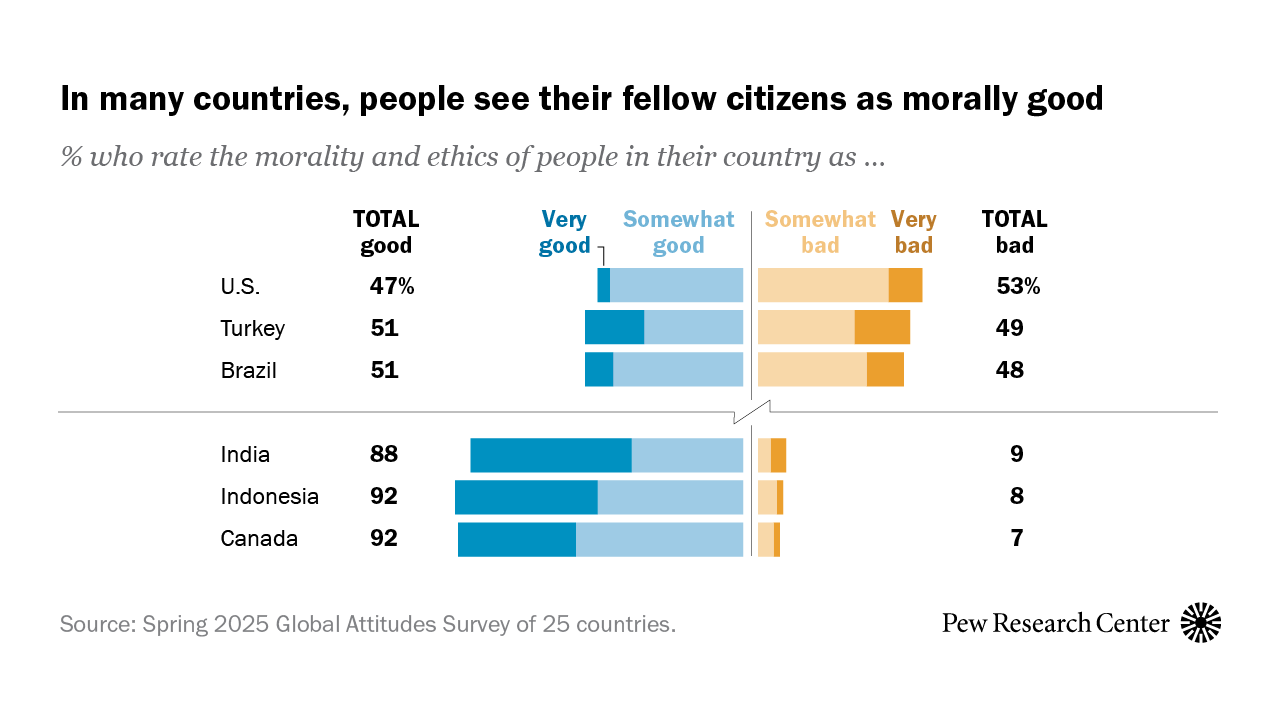
In 25-Country Survey, Americans Especially Likely To View Fellow Citizens as Morally Bad
Across 25 countries, Americans are the most likely to see the morality and ethics of people in their country as somewhat or very bad.
The Emergence of Social Norms and Conventions
The utility of our actions frequently depends upon the beliefs and behavior of other agents. Thankfully, through experience, we learn norms and conventions that provide stable expectations for navigating our social world. Here, we review several distinct influences on their content and distribution. At the level of individuals locally interacting in dyads, success depends on rapidly adapting pre-existing norms to the local context. Hence, norms are shaped by complex cognitive processes involved in learning and social reasoning.

when everyone has a different explanation of why the bad numbers are not that bad or why the small number is still very important, the simplest explanation is that the bad number is actually just indeed very bad

Christopher Mims
So I guess either Bluesky becomes a nonprofit or we all start sharing our Threads handles on here…?
