

Whether I like it or not, not everyone using my web apps will be running iOS 9 on an iPhone 6S or a Nexus 6P and connecting via super-speedy wifi.
I Built the Same App 10 Times: Evaluating Frameworks for Mobile Performance | Loren Stewart
I needed to choose a framework for a mobile-first app at work. I started comparing Next.js, SolidStart, and SvelteKit, then expanded to 10 frameworks. The measurements revealed dramatic differences in bundle sizes, performance, and the real cost of framework choices.
Making the Jump: How Desktop-Era Frameworks Can Thrive on Mobile
How do tools that grew up on the desktop, like Ember, Angular and React, make the jump to the mobile future?
Browsers, not apps, are the future of mobile - The Intercom Blog
Proclamations of an all-native mobile app world ignore the fact that browsers and the web are fast becoming the mobile operating system of the future.

Next.js — The Perpetual Beta Framework
Exploring 6 years of Next.js, from early days to App Router & RSC, with migrations, performance tweaks, and framework insights

Why I switched to Android after 7 years of iOS
Monday of last week I was all excited. I had just gotten the green light to start prototyping a new Progressive Web App for a client I've been working with.
The Cost of Frameworks
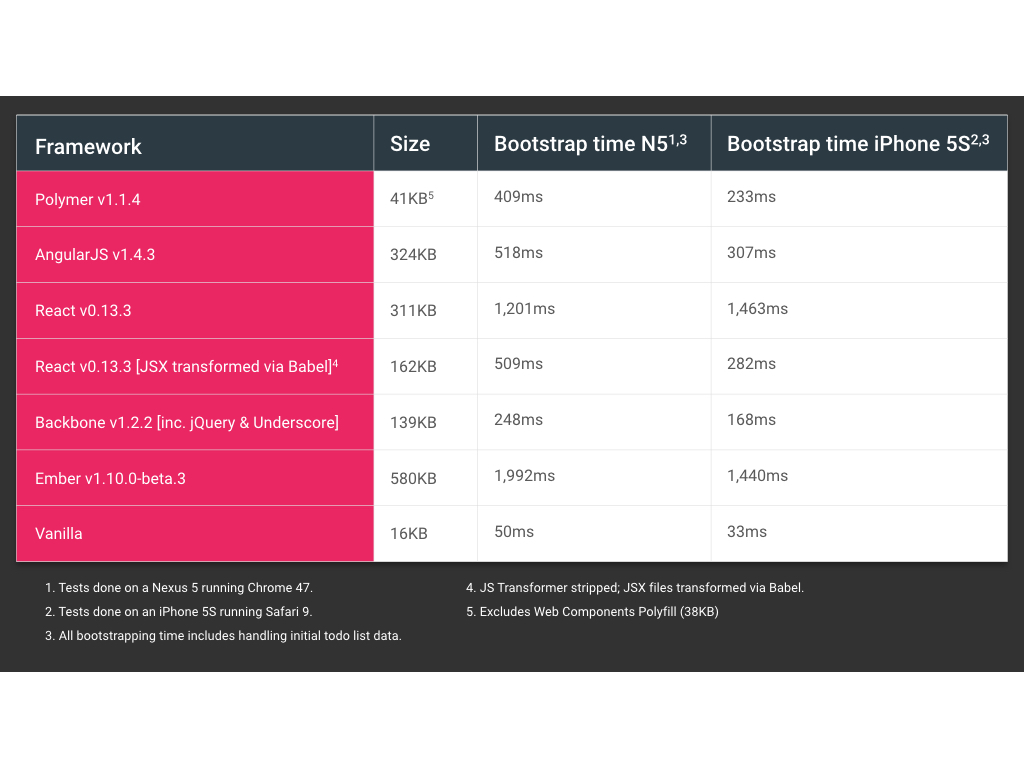
I recently delivered a talk at FFConf in Brighton, called "You should use <insert library / framework here>, it's the bestestest!". I wanted to do a write-up of the presentation's content here, hopefully so it can start a broader conversation that I think we need to have, mainly around the cost of modern frameworks on mobile devices.
Swift 6.2 WebAssembly Revolution: Redefining Platform Boundaries
The mobile development landscape has witnessed numerous paradigm shifts, but few have been as...

Frameworks without the framework: why didn’t we think of this sooner?
You can’t write serious applications in vanilla JavaScript without hitting a complexity wall. But a compiler can do it for you.

iOS doesn’t support Progressive Web Apps, so what?
One common argument for why organizations aren’t investing in Progressive Web Apps is that iOS doesn’t support them. Hogwash. Here’s why organizations should invest in Progressive Web Apps regardless. Source: Pixabay Progressive Web Apps still work on iOS Just because iOS doesn’t support every aspect of Progressive Web Apps…

Jared White (ResistanceNet ✊) (@jaredwhite@indieweb.social)
Oooooo, this is a real big cherry on top! New Safari 26 feature: “Every site can be a web app on iOS and iPadOS” Just like in macOS, anything can become an installable web app if you wish. This is huuuuuuuuge! Most of the apps I use every day are web apps! https://webkit.org/blog/16993/news-from-wwdc25-web-technology-coming-this-fall-in-safari-26-beta/ #WWDC25 #Apple
Turn a website into an app in Safari on iPhone
In Safari on iPhone, get an app-like experience from any website.
High Performance Browser Networking (O'Reilly)
What every web developer must know about mobile networks, protocols, and APIs provided by browser to deliver the best user experience.
Introducing Bare: Actually run Javascript Everywhere - Pears
The Holepunch team has introduced Bare, a groundbreaking minimal JavaScript runtime designed for both desktop and mobile. Built to be fast, modular, and efficient, Bare revisits the original vision of Node.js by embracing modularity and universal compatibility.

Native Apps are Doomed
From now on, I won’t be building any more native apps. All my apps going forward will be progressive web apps. Progressive web apps are web…

Chrome for iOS
Getting real close to launching seams.so for real this time! Had to undertake a lot of architectural work to setup a proxy which _doesn't_ require a browser extension, but shares almost all the code with it. Probably going to use this as the mobile version.
