Dive into the world of AI with our comprehensive glossary covering the most commonly used terms in AI. Discover key concepts and words shaping the language of tomorrow.
Artificial intelligence glossary: 60+ terms to know
Use this comprehensive glossary of AI terms to understand the language of artificial intelligence.

Opaque recurrence, and other AI terms that you should probably know | TechCrunch
The rise of AI has brought an avalanche of new terms and slang. Here is a glossary with definitions of some of the most important words and phrases you might encounter.

Your AI Glossary: 65 Terms Everyone Should Know
Tokens, open weights, paperclips and p(doom)? And that's just for starters. Here's a quick primer on the vocabulary of today's arcane yet everyday technology.

Glossary of Terms: Generative AI Basics - MIT Sloan Teaching & Learning Technologies
Learn key AI terms. This glossary defines and explains important concepts like generative AI, large language model, natural language processing, and more.

Responsibly applying AI models to Search
As it works to improve Search, Google has been examining the risks and challenges associated with more powerful language models, and is committed to responsibly applying AI in Search.

Intelligence Rising
Artificial Intelligence (AI) is expected to be one of the most transformative technologies in human history.

Artificial Intelligence Glossary | Stanford HAI
Artificial Intelligence (AI) is rapidly growing, with new terms and concepts being introduced at a breakneck speed. You may have seen terms such as AGI, machine learning, or foundation models in media headlines, emerging legislation, or in your everyday life.
How to use AI to do practical stuff: A new guide
People often ask me how to use AI. Here's an overview with lots of links.

Artificial Intelligence
Summary. The term artificial intelligence (AI) is typically used as if it refers to a coherent, extant or near-future set of technologies, but, in fact, it

De-anthropomorphizing “AI”: From wishful mnemonics to accurate nomenclature
Language matters. How we describe “AI” technology influences how it is perceived, deployed, and trusted. Extravagant and persuasive language incites hype. It is the responsibility of journalists, companies, and scholars to characterize technology in ways that inform and empower their readers by using appropriate terminology and avoiding inflated claims. One type of inflated claim comes from using anthropomorphizing language to describe system functionality. Anthropomorphization is the attribution of human capabilities and characteristics to the inanimate system. In this paper, we present a linguistic analysis of anthropomorphizing language in 29 texts (a total of 1,368 sentences) from academic articles, online news articles, and company blog posts. We construct a taxonomy of eight categories of anthropomorphization: Cognizer, Products of cognition, Emotion, Communication, Agent, Human role analogy, Names and pronouns, and Biological metaphors. Following this taxonomy we present concrete strategies for how to de-anthropomorphize the language we use to describe “AI” based on a functionality-first principle.
It’s time to retire the term “user”
The proliferation of AI means we need a new word.

The Great A.I. Awakening (Published 2016)
How Google used artificial intelligence to transform Google Translate, one of its more popular services — and how machine learning is poised to reinvent computing itself.

Machine Learning Glossary | Google for Developers
This glossary defines a wide range of machine learning terms, including those specific to TensorFlow and large language models.

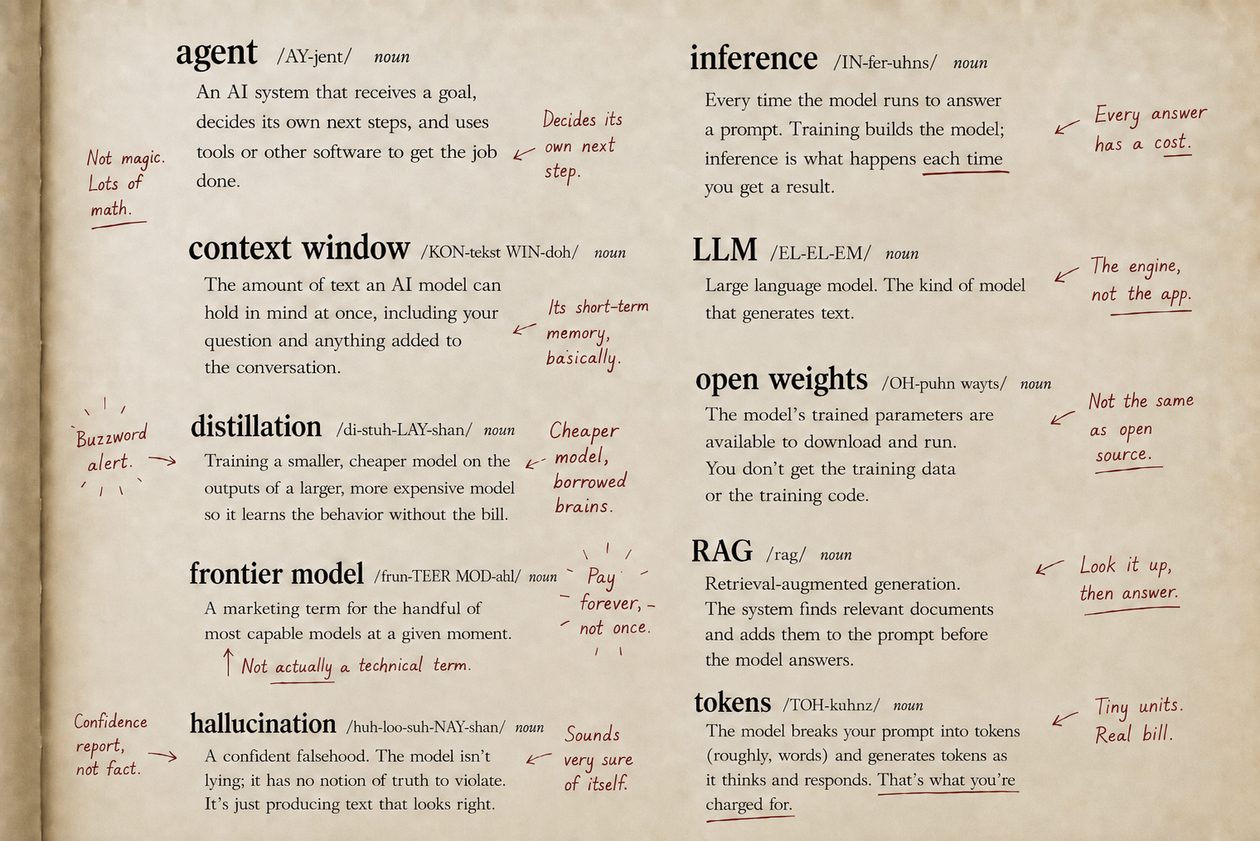
Etzioni on AI: An Opinionated Glossary of AI
Everyone in tech says things like LLM, open weights, RAG and agent; far fewer could define precisely what they all mean. Oren Etzioni sorts out about 30 AI terms in plain English, with a blunt verdict on each and one novel phrase he believes isn't used enough.
Ali Alkhatib: Defining AI
The main issue I have with a lot of work that tries to define AI is that the criteria they use to draw boundaries often turn out to be functionally useless for my needs; these definitions lead us to weird places, letting scholars fixate on strange, unworkable frameworks. Those pedantic fixations don’t really benefit the organizers, activists, regular people who are getting crushed by the systems they’re trying to work against. So I’m going to try to unpack how I think about AI; how I trace the boundaries of the term in a way that’s as useful as possible for me and my needs; and how I would encourage you to scope or define ideas that are important to your work.
AI’s Memorization Crisis
Large language models don’t “learn”—they copy. And that could change everything for the tech industry.