

This conceptual paper investigates the issue of gender disparities in artificial intelligence adoption within organizational settings. It highlights the importance of addressing these differences for workplace inclusivity and performance. The problem lies in the unequal of artificial intelligence adoption between male and female employees’ perspectives. The proposed framework is developed through a review of existing literature highlights differences between male and female employees in their artificial intelligence adoption. The methodology is based on conceptual analysis, derive on previous studies to build a comprehensive understanding of gender disparities in artificial intelligence adoption. An Independent T-Test will be used to analyze the disparities between male and female Malaysian sports graduates in testing the hypothesis development. By addressing these disparities, the paper provides insights into creating inclusive strategies that promote gender equity in the workforce. Overall, the findings aim to guide both researchers and practitioners in designing gender equality policies that address challenges to equal adoption of artificial intelligence.
Women and AI: The Gender Gap in AI Adoption and Recognition [Data]
Lean In’s survey shows how women are losing out in the AI age. Learn how women and men compare in AI adoption in the workplace, recognition, and more.
The AI gender gap | Datawrapper Blog
In this Weekly Chart, we examine the gender gap in AI adoption.
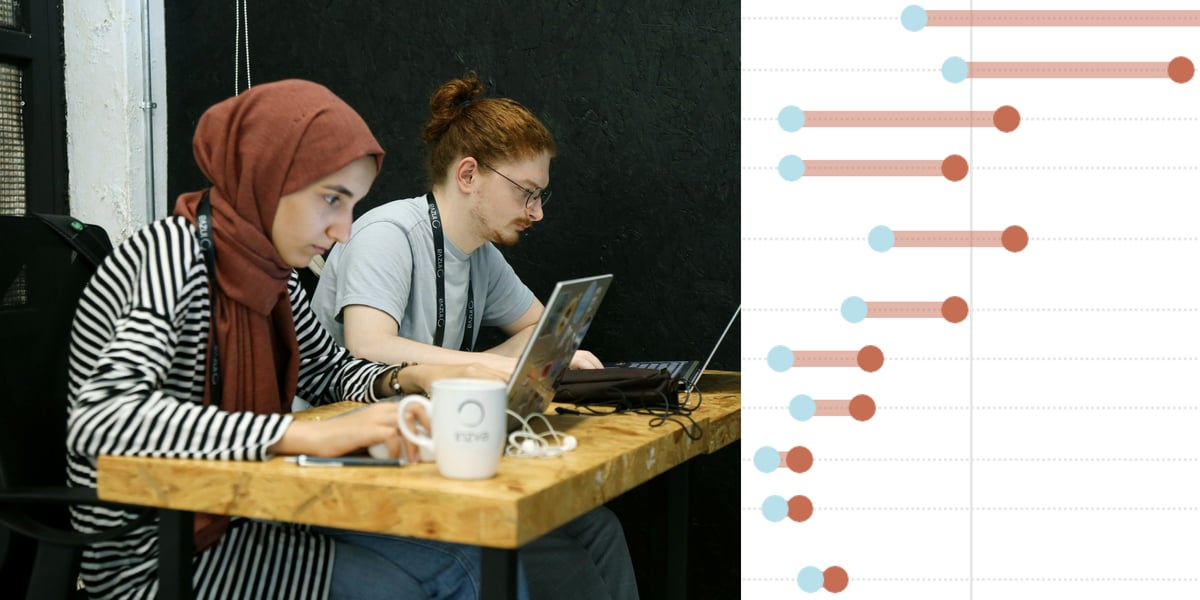
AI adoption higher among men than women: Survey
This large gap — 81.3% compared to 58.8% — stems from the higher representation of women in skilled trades, where AI usage remains extremely low.
Predictors of Artificial Intelligence Technology Adoption Behaviour among Female Entreprenuers in a Typical Emerging Market
Though artificial intelligence (AI) adoption among female entrepreneurs in emerging economies is still limited and poorly understood, AI presents revolutionary

Can the adoption of AI technology widen the gender gap in science? postdocs' use of AI technology
There is a known gender gap in science. Some studies suggest that this gap is decreasing, others that it is not. Although many studies have been conducted on gender equity in science, none have yet focused on the possibility that generative artificial intelligence (AI), a technology that promises to revolutionize research and academic work can have on widening or narrowing the gender gap in science. Postdoctoral researchers are a particularly important population to study in this context, as they have already demonstrated scientific maturity and independence and are poised to become the next generation in science and academia. Thus, this paper focuses on the gendered use of AI technology by postdocs. By using data from the 2023 Nature Post-Doctoral Survey, this paper investigates how postdocs are adopting AI and whether the usage of AI technology is likely to affect the gender gap in science and academia. The results show that females are less engaged with AI than male postdocs by 34%. This disparity may put female researchers at a disadvantage, potentially causing the gender gap to increase or be maintained. The study also reveals variations in AI adoption within gender groups. Younger female postdocs tend to use AI more than their older counterparts. Compared to female postdocs without promising job opportunities, those with good job prospects tend to use AI more frequently. Additionally, female postdocs working outside their native country are more engaged with AI than those working within their native country. For male postdocs, the results indicate that employment is an important factor in AI adoption. Regardless of age, male postdocs tend to use AI as part of their postdoc: they start using it once they begin their postdocs positions and use it more if they are satisfied with their postdoctoral experience.

Artificial Intelligence and gender equality | UN Women – Headquarters
The world has a gender equality problem, and Artificial Intelligence (AI) mirrors the gender bias in our society. Although globally more women are accessing the internet every year, in low-income countries, only 20 per cent are connected. The gender digital divide creates a data gap that is reflected in the gender bias in AI.

New research reveals "staggering" gender gap in ChatGPT adoption
A study reveals that ChatGPT adoption reflects existing workplace inequalities, with younger, higher-paid men using AI more than women and lower-income employees.

The Beauty of AI and Why AI Needs More Women
While women remain underrepresented in the Artificial Intelligence (AI) and tech workforce, their participation is considered crucial for developing the right AI for tomorrow.

How AI Is Fueling the Gender Pay Gap in Tech
A new Wharton study finds that too few women are working with emerging tech, and that exclusion is driving a growing divide in pay.

Women executives warn AI adoption is outpacing workforce development
A Chief and Harris Poll survey reveals how women leaders are shaping AI adoption by prioritizing workforce development and ethical implementation over speed.
Report: Where are the women? Mapping the gender job gap in AI
As AI becomes ubiquitous in everyday life, closing the gender gap in the AI and data science workforce matters.

The 'AI gender gap' narrative is missing the full picture | Fortune
New research shows women leaders are shaping AI strategy, ethics, and oversight—even as concerns about adoption gaps persist.

Women in AI: Numbers Behind the Gender Gap in Tech
How is AI changing the game for women in 2026? From job shifts and personal life-hacks to the rise of female AI founders, explore the unique impact of women in tech today.

The Large Gender Gap in Who Uses AI
A recent study finds that AI usage tilts heavily toward men. Part of the reason: Women worried they might be penalized for using AI.

AI's Missing Link: The Gender Gap in the Talent Pool
Our analysis of data on nearly 1.6 million AI professionals worldwide reveals stark gender imbalances. Women comprise only 22% of AI talent globally, with even lower representation at senior levels – occupying less than 14% of senior executive roles in AI. Within the EU, the disparity is equally concerning.

Paid Program: Why More Women Are Needed in AI
When the world of AI isn’t inclusive, it creates biases in what the data shows and how it’s used.
