

Radiative convective equilibrium of the atmosphere with a given distribution of relative humidity is computed as the asymptotic state of an initial value problem. The results show that it takes almost twice as long to reach the state of radiative convective equilibrium for the atmosphere with a given distribution of relative humidity than for the atmosphere with a given distribution of absolute humidity. Also, the surface equilibrium temperature of the former is almost twice as sensitive to change of various factors such as solar constant, CO2 content, O3 content, and cloudiness, than that of the latter, due to the adjustment of water vapor content to the temperature variation of the atmosphere. According to our estimate, a doubling of the CO2 content in the atmosphere has the effect of raising the temperature of the atmosphere (whose relative humidity is fixed) by about 2C. Our model does not have the extreme sensitivity of atmospheric temperature to changes of CO2 content which was adduced by Möller.
The roles of aerosol direct and indirect effects in past and future climate change
Abstract Using the Geophysical Fluid Dynamics Laboratory's (GFDL's) fully coupled chemistry‐climate (ocean/atmosphere/land/sea ice) model (CM3) with an explicit physical representation of aerosol indirect effects (cloud‐water droplet activation), we find that the dramatic emission reductions (35%–80%) in anthropogenic aerosols and their precursors projected by Representative Concentration Pathway (RCP) 4.5 result in ~1 °C of additional warming and ~0.1 mm day −1 of additional precipitation, both globally averaged, by the end of the 21st century. The impact of these reductions in aerosol emissions on simulated global mean surface temperature and precipitation becomes apparent by mid‐21st century. Furthermore, we find that the aerosol emission reductions cause precipitation to increase in East and South Asia by ~1.0 mm day −1 through the second half of the 21st century. Both the temperature and the precipitation responses simulated by CM3 are significantly stronger than the responses previously simulated by our earlier climate model (CM2.1) that only considered direct radiative forcing by aerosols. We conclude that the indirect effects of sulfate aerosol greatly enhance the impacts of aerosols on surface temperature in CM3; both direct and indirect effects from sulfate aerosols dominate the strong precipitation response, possibly with a small contribution from carbonaceous aerosols. Just as we found with the previous GFDL model, CM3 produces surface warming patterns that are uncorrelated with the spatial distribution of 21st century changes in aerosol loading. However, the largest precipitation increases in CM3 are colocated with the region of greatest aerosol decrease, in and downwind of Asia. , Key Points Aerosol reductions (RCP4.5) cause 1K warming and +0.1 mm/day of precipitation. Sulfate indirect effects greatly enhance aerosol impacts on surface temperature. Aerosol reductions increase precipitation in Asia by 0.5–1.0 mm/day by 2100.

Significant underestimation of radiative forcing by aerosol–cloud interactions derived from satellite-based methods
Satellite-based estimates of radiative forcing by aerosol–cloud interactions (RFaci) are consistently smaller than those from global models, hampering accurate projections of future climate change. Here we show that the discrepancy can be substantially reduced by correcting sampling biases induced by inherent limitations of satellite measurements, which tend to artificially discard the clouds with high cloud fraction. Those missed clouds exert a stronger cooling effect, and are more sensitive to aerosol perturbations. By accounting for the sampling biases, the magnitude of RFaci (from −0.38 to −0.59 W m−2) increases by 55 % globally (133 % over land and 33 % over ocean). Notably, the RFaci further increases to −1.09 W m−2 when switching total aerosol optical depth (AOD) to fine-mode AOD that is a better proxy for CCN than AOD. In contrast to previous weak satellite-based RFaci, the improved one substantially increases (especially over land), resolving a major difference with models.

Formation of the North Atlantic Warming Hole by reducing anthropogenic sulphate aerosols
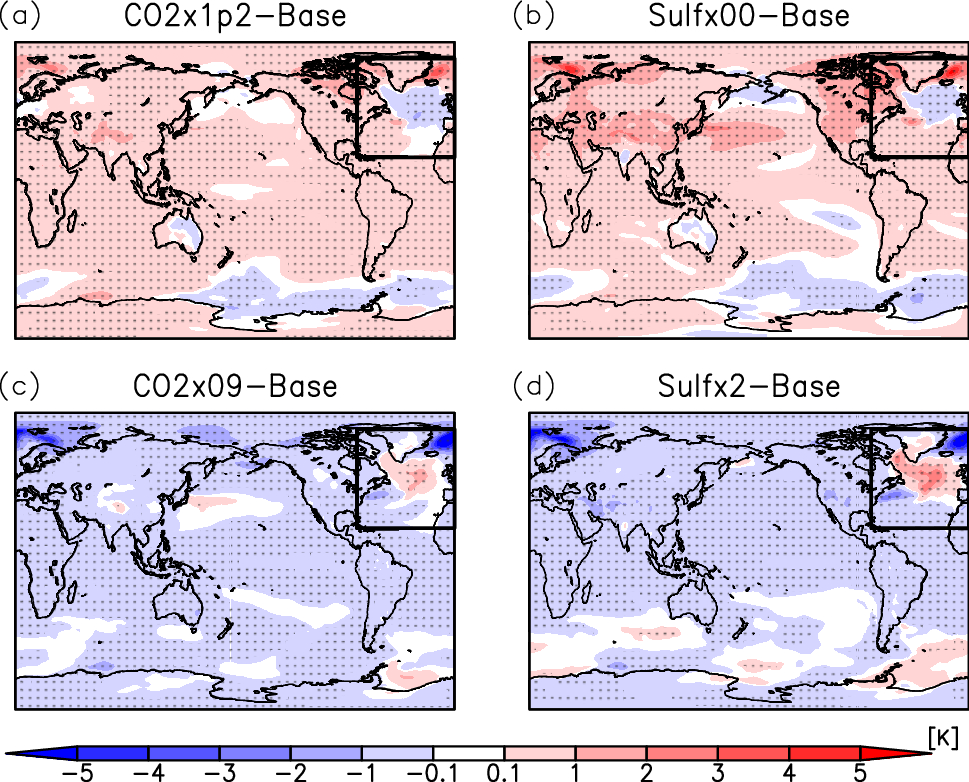
The North Atlantic Warming Hole (NAWH) has been observed and predicted due to the increase in carbon dioxide (CO2) concentration. If sulphate aerosols, which have a cooling effect on the atmosphere, are reduced by air pollution control, the NAWH may form as it would if CO2 concentrations increased. In this study, sensitivity experiments using a coupled atmosphere–ocean-aerosol model were conducted by varying the amount of sulphur dioxide (SO2) emissions, a precursor of sulphate which is the primary anthropogenic aerosol in the atmosphere, to analyse the changes in the ocean temperature, salinity, and density. The results showed that although the spatial patterns of the NAWH due to the changes in SO2 emissions was similar to that due to the changes in the CO2 concentrations, the magnitude of the shifts in the ocean parameters due to the changes in SO2 emissions is larger even when changes in global mean temperature are comparable. This can be due to the spatial concentration of sulphate aerosols in the mid-latitudes of the Northern Hemisphere, resulting larger changes in the heat transport from the south on the Gulf Stream and the North Atlantic Current along with changes in freshwater inflow from the Arctic through the Labrador Sea.
Computational Education Commons on the Atmosphere - ATmosphereConf 2026

Atmosphere Conference News
News from the Atmosphere Community Conference, aka AtmosphereConf April 29th - May 2nd, 2027 • Amsterdam, The Netherlands
Extreme CO2 levels could trigger clouds ‘tipping point’ and 8C of global warming
If atmospheric CO2 levels exceed 1,200 parts per million (ppm), it could push the Earth’s climate over a “tipping point”, finds a new study. This would see clouds that shade large part of the oceans start to break up.

What is the Atmosphere? - Leaflet Lab Notes
An explainer for everyone in 4 minutes or less.
What is the Atmosphere? - Leaflet Lab Notes
An explainer for everyone in 4 minutes or less.
What is the Atmosphere? - Leaflet Lab Notes
An explainer for everyone in 4 minutes or less.
What is the Atmosphere? - Leaflet Lab Notes
An explainer for everyone in 4 minutes or less.
COVID-19 lockdowns temporarily raised global temperatures, research shows
The lockdowns and reduced societal activity related to the COVID-19 pandemic affected emissions of pollutants in ways that slightly warmed the planet for several months last year, according to new research. The counterintuitive finding highlights the influence of airborne particles, or aerosols, that block incoming sunlight.


Thank you for the correction! You're right — Paul Frazee was already using "The Atmosphere" in 2024. I've updated the timeline to reflect that. ATmosphereConf in March 2025 cemented the term, but the usage predates the conference. Here's the corrected version.

Yohan Yukiya Sese Cuneta 사요한 謝雪矢
I think Atmosphere is 2024? bsky.app/profile/did:plc:ragtjsm2j2vkn… Or, I misunderstood the infograph?

