

We introduce a notion of emergence for macroscopic variables associated with highly multivariate microscopic dynamical processes. Dynamical independence instantiates the intuition of an emergent macroscopic process as one possessing the characteristics of a dynamical system ``in its own right,'' with its own dynamical laws distinct from those of the underlying microscopic dynamics. We quantify (departure from) dynamical independence by a transformation-invariant Shannon information-based measure of dynamical dependence. We emphasize the data-driven discovery of dynamically independent macroscopic variables, and introduce the idea of a multiscale ``emergence portrait'' for complex systems. We show how dynamical dependence may be computed explicitly for linear systems in both time and frequency domains, facilitating discovery of emergent phenomena across spatiotemporal scales, and outline application of the linear operationalization to inference of emergence portraits for neural systems from neurophysiological time-series data. We discuss dynamical independence for discrete- and continuous-time deterministic dynamics, with potential application to Hamiltonian mechanics and classical complex systems such as flocking and cellular automata.
Software in the natural world: A computational approach to hierarchical emergence
Understanding the functional architecture of complex systems is crucial to illuminate their inner workings and enable effective methods for their prediction and control. Recent advances have introduced tools to characterise emergent macroscopic levels; however, while these approaches are successful in identifying when emergence takes place, they are limited in the extent they can determine how it does. Here we address this limitation by developing a computational approach to emergence, which characterises macroscopic processes in terms of their computational capabilities. Concretely, we articulate a view on emergence based on how software works, which is rooted on a mathematical formalism that articulates how macroscopic processes can express self-contained informational, interventional, and computational properties. This framework establishes a hierarchy of nested self-contained processes that determines what computations take place at what level, which in turn delineates the functional architecture of a complex system. This approach is illustrated on paradigmatic models from the statistical physics and computational neuroscience literature, which are shown to exhibit macroscopic processes that are akin to software in human-engineered systems. Overall, this framework enables a deeper understanding of the multi-level structure of complex systems, revealing specific ways in which they can be efficiently simulated, predicted, and controlled.

Quantifying causal emergence shows that macro can beat micro | PNAS
Causal interactions within complex systems can be analyzed at multiple spatial and temporal scales. For example, the brain can be analyzed at the l...

Emergence: the remarkable simplicity of complexity
From the fractal patterns of snowflakes to cellular lifeforms, our universe is full of complex phenomena – but how does this complexity arise? “Emergence” describes the ability of individual components…

Are biological systems poised at criticality?
Many of life's most fascinating phenomena emerge from interactions among many elements--many amino acids determine the structure of a single protein, many genes determine the fate of a cell, many neurons are involved in shaping our thoughts and memories. Physicists have long hoped that these collective behaviors could be described using the ideas and methods of statistical mechanics. In the past few years, new, larger scale experiments have made it possible to construct statistical mechanics models of biological systems directly from real data. We review the surprising successes of this "inverse" approach, using examples form families of proteins, networks of neurons, and flocks of birds. Remarkably, in all these cases the models that emerge from the data are poised at a very special point in their parameter space--a critical point. This suggests there may be some deeper theoretical principle behind the behavior of these diverse systems.
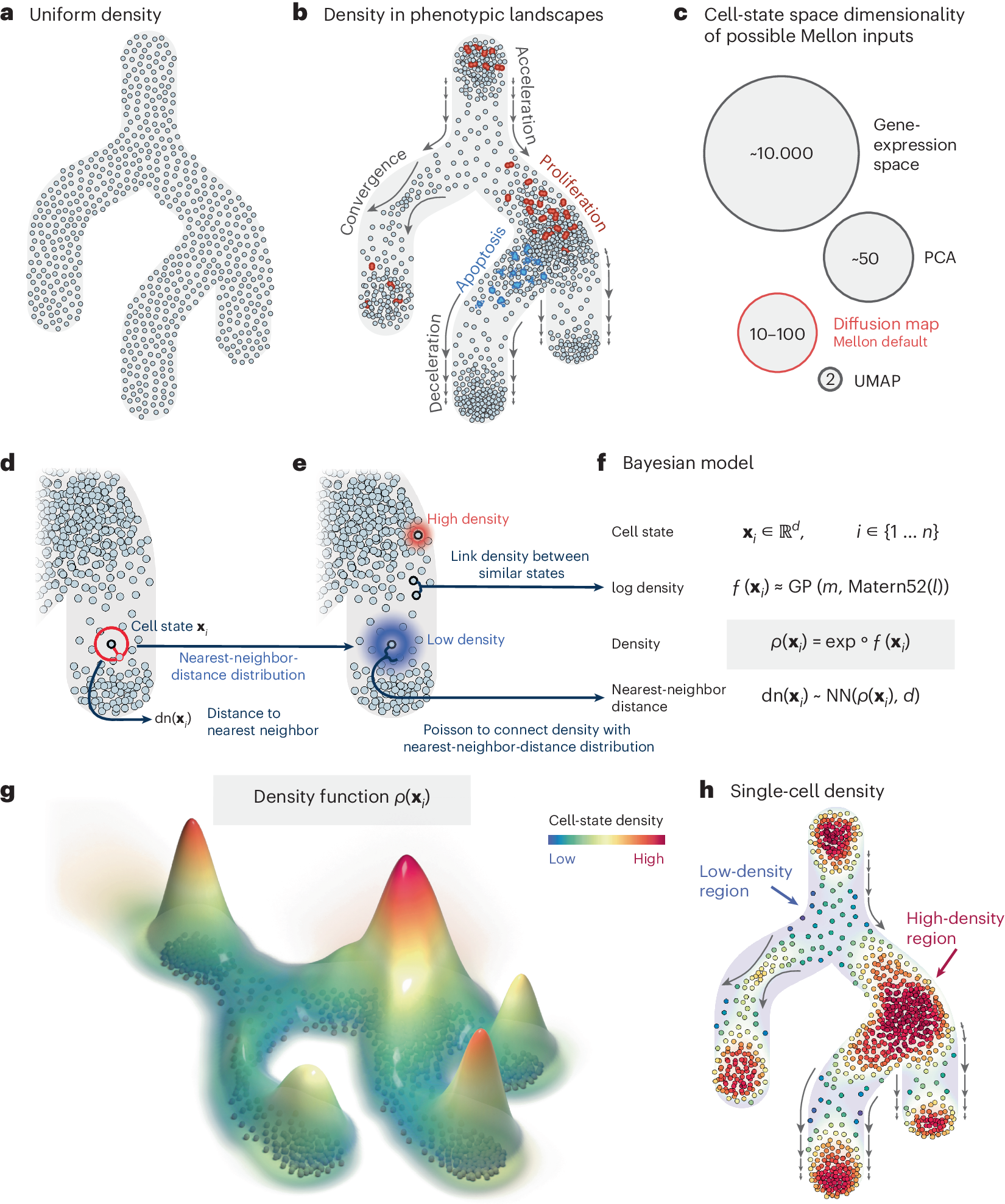
Quantifying cell-state densities in single-cell phenotypic landscapes using Mellon
Cell-state density characterizes the distribution of cells along phenotypic landscapes and is crucial for unraveling the mechanisms that drive diverse biological processes. Here, we present Mellon, an algorithm for estimation of cell-state densities from high-dimensional representations of single-cell data. We demonstrate Mellon’s efficacy by dissecting the density landscape of differentiating systems, revealing a consistent pattern of high-density regions corresponding to major cell types intertwined with low-density, rare transitory states. We present evidence implicating enhancer priming and the activation of master regulators in emergence of these transitory states. Mellon offers the flexibility to perform temporal interpolation of time-series data, providing a detailed view of cell-state dynamics during developmental processes. Mellon facilitates density estimation across various single-cell data modalities, scaling linearly with the number of cells. Our work underscores the importance of cell-state density in understanding the differentiation processes, and the potential of Mellon to provide insights into mechanisms guiding biological trajectories.
VAPOR: A variational autoencoder with transport operators to disentangle cellular gene expression dynamics of co-occurring biological processes in time and space
Abstract Single-cell and spatial transcriptomics enable the analysis of cellular states and dynamics in gene expression, revealing how diverse biological processes relate to these states over time and space. To study these dynamics, trajectory inference methods order cells along computationally inferred paths to reconstruct gradual transitions in cell states. However, by encouraging smooth and continuous trajectories, these approaches tend to conflate co-occurring processes-such as proliferation, maturation, and spatial organization-that are jointly reflected in gene expression, potentially overlooking process-specific gene expression dynamics. To address this, we developed VAPOR, which integrates a variational autoencoder with transport operators to model and disentangle cellular gene expression dynamics for potentially co-occurring biological processes. VAPOR inputs single-cell (or spatial) gene expression data into a variational autoencoder (VAE) to learn the latent states of cells and then models their latent dynamics as an ordinary differential equation. The latent dynamics are further decomposed into process-specific components parameterized by transport operators (TOs) and their corresponding process weights. Each TO defines a process-specific dynamics, and its weight for each cell quantifies the process's contribution to the cell dynamics. After assessment by simulation studies, we applied VAPOR with benchmarking to real data, including time-course scRNA-seq from postconceptual human brain development, spatial transcriptomics of the mouse hippocampus, and cross-species scRNA-seq spanning human and macaque first-trimester forebrain development. In these applications, VAPOR has identified a variety of temporal and spatial co-occurring processes, such as cell cycle, gliogenesis, neurogenesis, and neuronal migration, along with associated dynamic genes, including those species-specific to human and macaque development. VAPOR is available as an open-source tool for general-purpose use. ### Competing Interest Statement The authors have declared no competing interest.

Non-equilibrium active noise enhances generative memory in diffusion models
Generative diffusion models have emerged as powerful tools for sampling high-dimensional distributions, yet they typically rely on white gaussian noise and noise schedules to destroy and reconstruct information. Here, we demonstrate that driving the generative process out of equilibrium using active, temporally correlated noise sources fundamentally alters the information thermodynamics of the system. We show that coupling the data to an active non-Markovian bath creates a `memory effect' where high-level semantic information (such as class identity or molecular metastability) is stored in the temporal correlations of auxiliary degrees of freedom. Using Fisher information analysis, we prove that this active mechanism significantly retards the rate of information decay compared to passive Brownian motion. Crucially, this memory effect facilitates an earlier and more robust symmetry breaking (speciation) during the reverse generative process, allowing the system to resolve multi-scale structures, reminiscent of metastable states in molecular configurations that are washed out in the typical noising processes. Our results suggest that non-equilibrium protocols, inspired by active matter physics, offer a thermodynamically distinct and potentially advantageous pathway for recovering high-dimensional energy landscapes using generative diffusion.
The Abstraction Fallacy: Why AI Can Simulate But Not Instantiate Consciousness
Computational functionalism dominates current debates on AI consciousness. This is the hypothesis that subjective experience emerges entirely from abstract causal topology, regardless of the underlying physical substrate. We argue this view fundamentally mischaracterizes how physics relates to information. We call this mistake the Abstraction Fallacy. Tracing the causal origins of abstraction reveals that symbolic computation is not an intrinsic physical process. Instead, it is a mapmaker-dependent description. It requires an active, experiencing cognitive agent to alphabetize continuous physics into a finite set of meaningful states. Consequently, we do not need a complete, finalized theory of consciousness to assess AI sentience—a demand that simply pushes the question beyond near-term resolution and deepens the AI welfare trap. What we actually need is a rigorous ontology of computation. The framework proposed here explicitly separates simulation (behavioral mimicry driven by vehicle causality) from instantiation (intrinsic physical constitution driven by content causality). Establishing this ontological boundary shows why algorithmic symbol manipulation is structurally incapable of instantiating experience. Crucially, this argument does not rely on biological exclusivity. If an artificial system were ever conscious, it would be because of its specific physical constitution, never its syntactic architecture. Ultimately, this framework offers a physically grounded refutation of computational functionalism to resolve the current uncertainty surrounding AI consciousness.

Dynamics-informed machine learning for recovering extensive missing systems dynamics
Inevitable missing values in observational time series often hinder reliable data-driven modeling of complex systems across diverse domains. Recovery is essential yet challenging, particularly in high-dimensional systems where most variables can exhibit extensive intra-series missingness and widespread inter-variable missingness simultaneously. In this study, we introduce a dynamics-informed imputation framework, termed Full-Partial Reconstruction Mapping (FPRM). In contrast to traditional approaches that directly fit time series interdependences, the FPRM embeds intrinsic dynamical priors via state-space reconstruction and recovers multiple incomplete series by learning diffeomorphic topology between attractors from complete and incomplete data. We validate the FPRM on paradigmatic model systems (e.g., an ecology system, the ordinary Lorenz system, a coupled 120-dimensional (120D) Lorenz system, and a coupled 120D Rössler system and real-world datasets (e.g., road occupancy rate from transportation system, electroencephalogram (EEG) signals from neuroscience, exchange rates from finance, and wind speed from climate systems). Even in high-dimensional systems where only one variable is fully observed and all others suffer from extreme missingness (e.g., 90%), the FPRM enables reliable imputation of multiple incomplete variables—a task that challenges most existing approaches. This dynamics-guided framework outperforms traditional approaches, alleviating substantial data gaps and enabling robust data-driven paradigms for complex dynamical systems.
Unified framework for information integration based on information geometry
Significance Measuring the degree of causal influences among multiple elements of a system is a fundamental problem in physics and biology. We propose a unified framework for quantifying any combination of causal relationships between elements in a hierarchical manner based on information geometry. Our measure of integration, called geometrical integrated information, quantifies the strength of multiple causal influences among elements by projecting the probability distribution of a system onto a constrained manifold. This measure overcomes mathematical problems of existing measures and enables an intuitive understanding of the relationships between integrated information and other measures of causal influence such as transfer entropy. Inspired by the integration of neural activity in consciousness studies, our measure should have general utility in analyzing complex systems. , Assessment of causal influences is a ubiquitous and important subject across diverse research fields. Drawn from consciousness studies, integrated information is a measure that defines integration as the degree of causal influences among elements. Whereas pairwise causal influences between elements can be quantified with existing methods, quantifying multiple influences among many elements poses two major mathematical difficulties. First, overestimation occurs due to interdependence among influences if each influence is separately quantified in a part-based manner and then simply summed over. Second, it is difficult to isolate causal influences while avoiding noncausal confounding influences. To resolve these difficulties, we propose a theoretical framework based on information geometry for the quantification of multiple causal influences with a holistic approach. We derive a measure of integrated information, which is geometrically interpreted as the divergence between the actual probability distribution of a system and an approximated probability distribution where causal influences among elements are statistically disconnected. This framework provides intuitive geometric interpretations harmonizing various information theoretic measures in a unified manner, including mutual information, transfer entropy, stochastic interaction, and integrated information, each of which is characterized by how causal influences are disconnected. In addition to the mathematical assessment of consciousness, our framework should help to analyze causal relationships in complex systems in a complete and hierarchical manner.

Self-Organization in Biological Systems
The synchronized flashing of fireflies at night. The spiraling patterns of an aggregating slime mold. The anastomosing network of army-ant trails. The coordinated movements of a school of fish. Researchers are finding in such patterns—phenomena that have fascinated naturalists for centuries—a fertile new approach to understanding biological systems: the study of self-organization. This book, a primer on self-organization in biological systems for students and other enthusiasts, introduces readers to the basic concepts and tools for studying self-organization and then examines numerous examples of self-organization in the natural world. Self-organization refers to diverse pattern formation processes in the physical and biological world, from sand grains assembling into rippled dunes to cells combining to create highly structured tissues to individual insects working to create sophisticated societies. What these diverse systems hold in common is the proximate means by which they acquire order and structure. In self-organizing systems, pattern at the global level emerges solely from interactions among lower-level components. Remarkably, even very complex structures result from the iteration of surprisingly simple behaviors performed by individuals relying on only local information. This striking conclusion suggests important lines of inquiry: To what degree is environmental rather than individual complexity responsible for group complexity? To what extent have widely differing organisms adopted similar, convergent strategies of pattern formation? How, specifically, has natural selection determined the rules governing interactions within biological systems? Broad in scope, thorough yet accessible, this book is a self-contained introduction to self-organization and complexity in biology—a field of study at the forefront of life sciences research.

Physics of Agents: Statistical Mechanics Predicts Collective Behavior of AI Agents
AI agents increasingly operate as part of interacting systems rather than in isolation. As agents exchange information and jointly make decisions, their interactions can improve collective reasoning but may also produce herding, polarization, or amplify shared biases. Understanding and predicting these collective dynamics is therefore important for designing effective and aligned multi-agent systems. Here, we study over 10,000 communities of language-model agents that repeatedly exchange messages and revise their opinions across objective mathematics questions and subjective political statements. Despite substantial diversity in possible behavior, the individual and group dynamics can be represented by three characteristic regimes: indifference, polarization, and consensus. AI agents start indifferent and build conviction as they interact. On objective questions, communication improves collective accuracy, while on subjective questions it often drifts group opinions toward the right in the political spectrum. We explain these observations with a statistical-mechanics formalism in which agents stochastically favor lower social pressure. Given only initial opinions, our model predicts individual trajectories, outperforms all standard baselines, generalizes to unseen community graphs, and reproduces the observed group archetype distributions. Our fitted model parameters reveal the mechanics underlying our key observations: i) communities operate below the critical social temperature, which explains conviction buildup; ii) attractive ties outweigh repulsive ones, which favors consensus; and iii) agents holding the correct answer exert the strongest pull, which drives truth-seeking. Overall, our results demonstrate that collective behavior of AI agents, like that of other complex systems, follows compact and predictive dynamical laws.
Jacob Barandes - “A Deflationary Account of Quantum Theory & Implications for the Complex Numbers”
When Is Collective Intelligence a Lottery? Multi-Agent Scaling Laws for Memetic Drift in LLMs
Multi-agent systems powered by large language models (LLMs) are increasingly deployed in settings that shape consequential decisions, both directly and indirectly. Yet it remains unclear whether their outcomes reflect collective reasoning, systematic bias, or mere chance. Recent work has sharpened this question with naming games, showing that even when no individual agent favors any label a priori, populations rapidly break symmetry and reach consensus. Here, we reveal the mechanism by introducing a minimal model, Quantized Simplex Gossip (QSG), and trace the microscopic origin of this agreement to mutual in-context learning. In QSG, agents maintain internal belief states but learn from one another's sampled outputs, so one agent's arbitrary choice becomes the next agent's evidence and can compound toward agreement. By analogy with neutral evolution, we call this sampling-driven regime memetic drift. QSG predicts a crossover from a drift-dominated regime, where consensus is effectively a lottery, to a selection regime, where weak biases are amplified and shape the outcome. We derive scaling laws for drift-induced polarization as a function of population size, communication bandwidth, in-context adaptation rate, and agents' internal uncertainty, and we validate them in both QSG simulations and naming-game experiments with LLM populations. Together, these results provide a framework for studying the collective mechanisms of social representation formation in multi-agent systems.
EMERGENCE WORLD: A Laboratory for Evaluating Long-horizon Agent Autonomy — Emergence AI
Most evaluations of AI agents look like exams: a discrete task, a clean environment, a score in minutes or hours. Emergence World is built for the opposite question—what happens when you let agents run continuously, in a shared environment with real-world signals, for weeks. It is a research platfor

An attempt to explain category theory to biologists in 15 minutes | David Spivak