

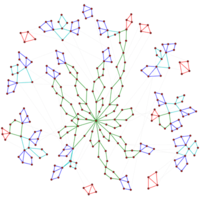
Many complex systems can be represented as networks of interacting elements. A new theoretical method identifies characteristics of the connectivity patterns of networks.
Cytoscape: An Open Source Platform for Complex Network Analysis and Visualization
Cytoscape Official Web Site
Evolutionary graph theory
Evolutionary graph theory is an area of research lying at the intersection of graph theory, probability theory, and mathematical biology. Evolutionary graph theory is an approach to studying how topology affects evolution of a population. That the underlying topology can substantially affect the results of the evolutionary process is seen most clearly in a paper by Erez Lieberman, Christoph Hauert and Martin Nowak.[1]
The Cost of Representing Higher-Order Dynamics on Graphs: A Theoretical Framework
Can graphs represent the dynamics of higher-order (multi-body) interactions, or are hypergraphs necessary? We decompose network dynamics into three components: the combinatorial structure (graph or hypergraph), per-edge coupling functions, and per-node aggregation functions. Within this framework, we prove that graphs can always reproduce the trajectories of any hypergraph dynamics by absorbing the coupling logic into the aggregation. This generalizes a recent result by Peixoto et al., who showed the same under the assumption of flat dynamics. However, the graph representation pays a price in parsimony: when the coupling and aggregation functions are polynomials of degree at most D, the graph aggregation requires Θ(k^D/D!) parameters relative to the hypergraph alternative, where k is the interaction size. Without symmetry, the comparison can reverse. The framework also clarifies two other recent contributions by Moutuou and by Lacasa, and identifies overlooked modeling degrees of freedom including partial interaction symmetries and the role of non-additive aggregation.
Graph of related subreddits
This visualization of related subreddits helps you find related subreddits

Lab Notes #007: Semble Following - Cosmik Labs
The Cosmik Network social graph launches
Lab Notes #007: Semble Following - Cosmik Labs
The Cosmik Network social graph launches
The rich are loopy: a spectral framework for loop structure in the rich club
The rich club coefficient $\phi(k)$ quantifies whether high-degree nodes interconnect more densely than expected, but it is blind to the structure of those interconnections and offers no principled way to select the degree threshold $k$. We introduce the *cycle core* $H_k$, the maximal subgraph of vertices with degree at least $k$ that forms cycles among themselves. The nested sequence $H_1 \supseteq H_2 \supseteq \cdots$ reveals how the cycle core evolves as the degree threshold increases, capturing structure that $\phi(k)$ cannot see. We develop two spectral tools for this sequence. The first is structural: the *$k$-blocking operator* $\mathbf{M}_k$ generalizes the non-backtracking matrix by blocking $k - 1$ directions at each node. We prove that its spectrum is equivalent to that of a modified non-backtracking matrix weighted with a specific function of the nodes' degrees. Thus, $\mathbf{M}_k$ couples cycle structure with the degree sequence of the graph. We show the spectral radius of $\mathbf{M}_k$ peaks at an intrinsic threshold $k^*$, yielding the *optimal rich club* $H_{k^*}$ without null models or parameter tuning. The second tool is dynamical: the $k$-blocking walk defines a sub-stochastic Markov chain whose leading eigenvalue $\lambda_1(k)$ measures how long a process can persist on the cycle core before being expelled to the periphery. We evaluate the framework on fifteen networks spanning different domains, wherein $H_{k^*}$ closely recovers the published rich clubs.
The network science of collective intelligence
In the last few years, breakthroughs in computational and experimental techniques have produced several key discoveries in the science of networks and human collective intelligence. This review presents the latest scientific findings from two key fields of research: collective problem-solving and the wisdom of the crowd. I demonstrate the core theoretical tensions separating these research traditions and show how recent findings offer a new synthesis for understanding how network dynamics alter collective intelligence, both positively and negatively.

Important and complex systems may be more controllable than they appear
We don't often think of them in these terms, but our brains, global financial markets and groups of friends are all examples of different kinds of complex networks or systems. And unlike the kind of system ...

KOI-net Protocol Specification Draft v1.0
The KOI-net protocol defines the standard communication patterns and coordination norms needed to establish and maintain Knowledge Organization Infrastructure (KOI) networks. KOI networks are heterogeneous compositions of KOI nodes, each of which is capable of autonomously inputting, processing, and outputting knowledge. The behavior of each node and configuration of each network can vary greatly; therefore, the protocol is designed to be a simple, flexible, and interoperable foundation for future projects to build on. The protocol only governs communication between nodes, not how they operate internally. As a result we consider KOI-nets to be fractal-like, in that a network of nodes may act like a single node when viewed from outside.
Complex information processing: a file structure for the complex, the changing and the indeterminate
Growing Graphs
Experimental simulation of emergent complexity through graph-rewriting automata.
Graph Structure of Neural Networks
View recent discussion. Abstract: Neural networks are often represented as graphs of connections between neurons. However, despite their wide use, there is currently little understanding of the relationship between the graph structure of the neural network and its predictive performance. Here we systematically investigate how does the graph structure of neural networks affect their predictive performance. To this end, we develop a novel graph-based representation of neural networks called relational graph, where layers of neural network computation correspond to rounds of message exchange along the graph structure. Using this representation we show that: (1) a "sweet spot" of relational graphs leads to neural networks with significantly improved predictive performance; (2) neural network's performance is approximately a smooth function of the clustering coefficient and average path length of its relational graph; (3) our findings are consistent across many different tasks and datasets; (4) the sweet spot can be identified efficiently; (5) top-performing neural networks have graph structure surprisingly similar to those of real biological neural networks. Our work opens new directions for the design of neural architectures and the understanding on neural networks in general.

Discourse Graphs
@discoursegraphs.bsky.social
Discourse Graphs are an information model that enables everyone to map their ideas and arguments in a modular, composable graph format. discoursegraphs.com
