This article confronts monopsony theory’s predictions regarding workers’ wages with observed wage patterns over the business cycle. Using German administrative data for the years 1985 to 2010 and an estimation framework based on duration models, the authors construct a time series of the labor supply elasticity to the firm and estimate its relationship to the unemployment rate. They find that firms possess more monopsony power during economic downturns. Half of this cyclicality stems from workers’ job separations being less wage driven when unemployment rises, and the other half mirrors that firms find it relatively easier to poach workers. Results show that the cyclicality is more pronounced in tight labor markets with low unemployment, and that the findings are robust to controlling for time-invariant unobserved worker or plant heterogeneity. The authors further document that cyclical changes in workers’ entry wages are of similar magnitude as those predicted under pure monopsonistic wage setting.
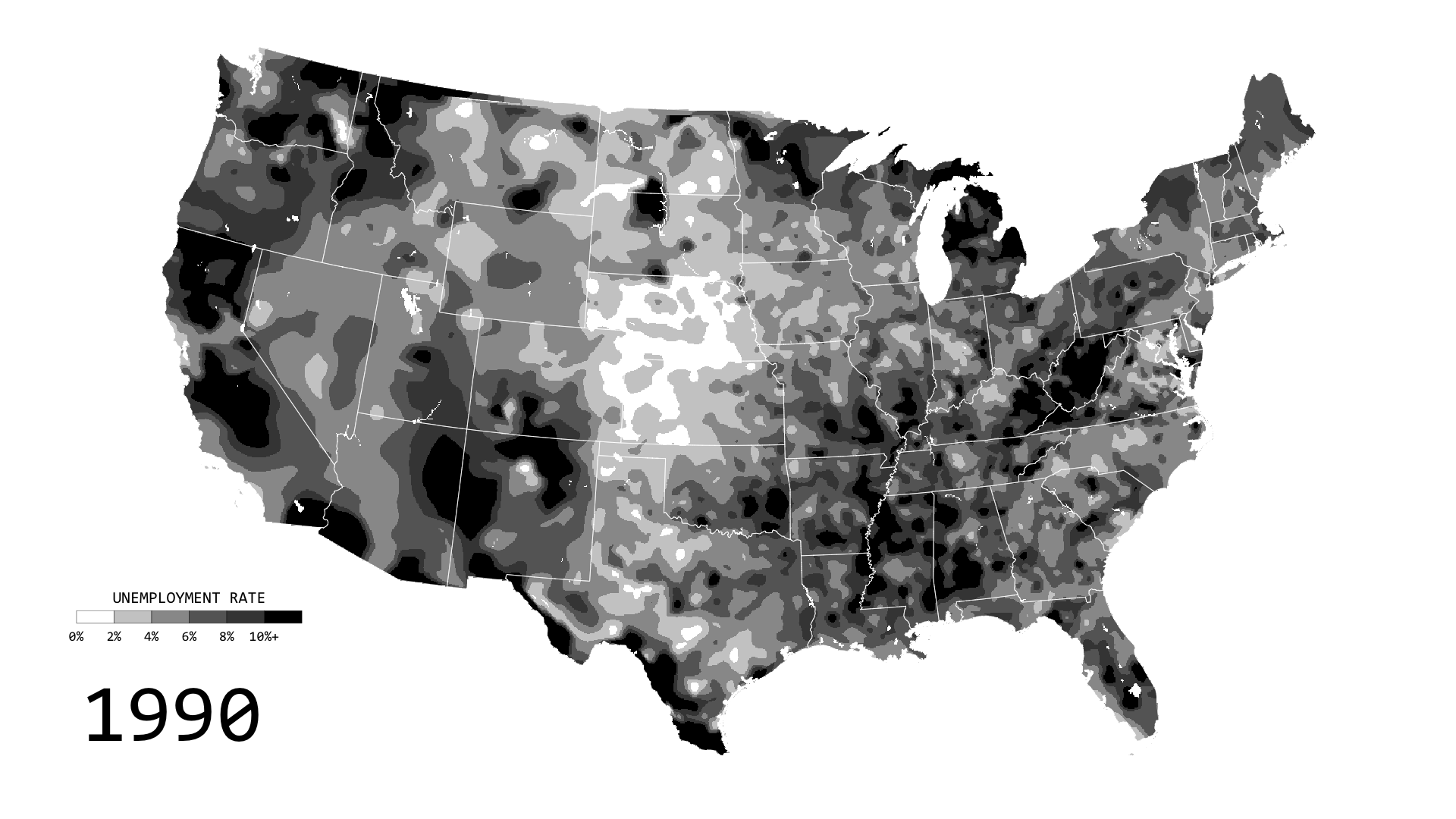
Unemployment in America, Mapped Over Time
Watch the regional changes across the country from 1990 to 2016.
Handbook of Labor Economics
What new tools and models are enriching labor economics?Developments in Research Methods and their Application, Volume 4A summarizes recent advances in the ways economists study wages, employment, and labor markets. Mixing conceptual models and empirical work, contributors cover subjects as diverse as field and laboratory experiments, program evaluation, and behavioral models. The combinations of these improved empirical findings with new models reveal how labor economists are developing new and innovative ways to measure key parameters and test important hypotheses. - Investigates recent advances in methods and models used in labor economics - Demonstrates what these new tools and techniques can accomplish - Documents how conceptual models and empirical work explain important practical issues
Wage Compression Drives Nordic Income Equality
Income inequality in the Nordic countries — Denmark, Finland, Norway, and Sweden — is substantially lower than in the United States or the United Kingdom despite similar levels of per capita income. The Gini coefficient for disposable income in Nordic countries averages 0.27, compared to 0.39 in the US and 0.36 in the UK. In Income Equality in the Nordic Countries: Myths, Facts, and Lessons (NBER Working Paper 33444), Magne Mogstad, Kjell G. Salvanes, and Gaute Torsvik analyze the underlying source of these disparities. They employ detailed microeconomic data and statistical decomposition techniques and consider distributional statistics on income, wages, working hours, education, and skills across these countries.

Labor Market Adaptation to Rising Import Competition
In Places versus People: The Ins and Outs of Labor Market Adjustment to Globalization (NBER Working Paper 33424), David Autor, David Dorn, Gordon H. Hanson, Maggie R. Jones, and Bradley Setzler examine how local labor markets and the workers in these markets adjusted to increased Chinese import competition in the first two decades of this century. They analyze comprehensive employer-employee data from the Census Bureau’s Longitudinal Employer-Household Dynamics program over the 2000–19 period. Their analysis exploits location-specific variation in the impact of growing imports from China following China’s accession to the World Trade Organization (WTO) in 2001, which is due to the heterogeneity in industry composition across local labor markets.
Adjustment Costs, Firm Responses, and Micro vs. Macro Labor Supply Elasticities: Evidence from Danish Tax Records
Abstract. We show that the effects of taxes on labor supply are shaped by interactions between adjustment costs for workers and hours constraints set by fi

Le paradoxe d’Easterlin a 50 ans
S’il fallait dater avec une certaine précision, on pourrait dire que l’idée que la croissance économique est source de progrès a été remise en cause au début des années 1970, précisément quand les pays industrialisés d’alors connaissaient les derniers instants d’une période de croissance exceptionnellement élevée (les Trente glorieuses en France, le Wirtschaftswunder

Are new technologies fuelling wage inequality? Evidence from Spain
New research shows the net effect of technological change (incl. artificial intelligence) on wages in Spain has been to fuel rising wage inequalities

AI Adoption and Inequality
There are competing narratives about artificial intelligence’s impact on inequality. Some argue AI will exacerbate economic disparities, while others suggest it could reduce inequality by primarily disrupting high-income jobs. Using household microdata and a calibrated task-based model, we show these narratives reflect different channels through which AI affects the economy. Unlike previous waves of automation that increased both wage and wealth inequality, AI could reduce wage inequality through the displacement of high-income workers. However, two factors may counter this effect: these workers’ tasks appear highly complementary with AI, potentially increasing their productivity, and they are better positioned to benefit from higher capital returns. When firms can choose how much AI to adopt, the wealth inequality effect is particularly pronounced, as the potential cost savings from automating high-wage tasks drive significantly higher adoption rates. Models that ignore this adoption decision risk understating the trade-off policymakers face between inequality and efficiency.
Job search and unemployment insurance
Do expanded unemployment benefits lower job-finding rates?
Consumer Spending during Unemployment: Positive and Normative Implications
Using de-identified bank account data, we show that spending drops sharply at the large and predictable decrease in income arising from the exhaustion of unemployment insurance (UI) benefits. We use the high-frequency response to a predictable income decline as a new test to distinguish between alternative consumption models. The sensitivity of spending to income we document is inconsistent with rational models of liquidity-constrained households, but is consistent with behavioral models with present-biased or myopic households. Depressed spending after exhaustion also implies that the consumption-smoothing gains from extending UI benefits are four times larger than from raising UI benefit levels. (JEL D14, D91, E21, E24, E70, J65)
Employment protection legislation reforms and the rising cost of job loss
A widely cited argument in favour of easing employment protection rules is that greater flexibility in hiring and firing can lead to increased job matching efficiency and productivity, but this may come at a cost for certain groups of workers. This column examines the impact of the 2012 ‘Fornero Reform’ in Italy, which lowered the legal and financial risks associated with dismissals for employers in order to encourage firms to offer more open-ended contracts and thus help bridge the divide between permanent and temporary employment. In practice, the reform increased the cost of job loss, particularly for younger and more vulnerable workers.

Labor Market Adaptation | Windfall Policy Atlas
How can workers, firms, and education systems adapt to an AI-transformed economy?

Mind the Gap: AI Adoption in Europe and the U.S.
This paper combines international evidence from worker and firm surveys conducted in 2025 and 2026 to document large gaps in AI adoption, both between the US and Europe and across European countries. Cross-country differences in worker demographics and firm composition account for an important share of these gaps. AI adoption, within and across countries, is also closely linked to firm personnel management practices and whether firms actively encourage AI use by workers. Micro-level evidence suggests that AI generates meaningful time savings for many workers. At the macro level, in recent years industries with higher AI adoption rates have experienced faster productivity growth. While we do not establish causality, this relationship is statistically significant and similar in magnitude in Europe and the US. We do not find clear evidence that industry-level AI adoption is associated with employment changes. We discuss limitations of existing data and outline priorities for future data collection to better assess the productivity and labor market effects of AI.
Disappointing 29,000 jobs added in September as unemployment ticks up
Friday's jobs report is the last one that will come out before the Nov. 3 elections that will determine whether President Donald Trump's Republicans maintain full control of Congress.

Still Waters, Rapid Currents: Early Labor Market Transformation under Generative AI
We study the early labor market impacts of AI chatbots by linking large-scale adoption surveys to administrative labor market records in Denmark. We document rapid currents: most employers in exposed occupations have adopted chatbot initiatives, workers report productivity benefits, and new AI-related tasks are widespread. Yet these currents have not broken the surface: using difference-indifferences, we estimate precise null effects on earnings and recorded hours at both the worker and workplace levels, ruling out effects larger than 2% two years after the launch of ChatGPT. What moves is the structure of work: employers absorb AI through task reorganization—including new tasks in content generation, AI oversight, and AI integration—and adopters transition into higher-paying occupations where AI chatbots are more relevant, though still too few to move average earnings. Technological change reshapes work well before it surfaces in earnings or hours.
Unauthorized Immigration Effects on Local Labor Markets
The large increase and subsequent decline of unauthorized immigrant workers in recent years have raised questions about the impact of these changes on local labor markets across the United States. New analysis linking immigration data with employment data for specific areas suggests that the rapid rise in unauthorized immigrant worker flows increased local employment roughly one-for-one. Extending the analysis to the industry level further suggests that the slowdown of net immigration had a large negative impact on local employment, particularly for construction and manufacturing.