


These authors examine the capability of local government to influence economic development by formulating a framework that treats state-business relations as a bargaining process. This framework suggests that governmental influence is tied to the distribution of bargaining advantages along three dimensions of a liberal-democratic political economy: market conditions, popular-control systems, and public-intervention mechanisms. The authors offer an explanation of how characteristics of these dimensions strengthen or weaken city governments in dealing with private enterprise; experiences of U.S. and Western European cities are drawn upon to illustrate this. They conclude that differences in bargaining resources accounts for wide variation in local political control of business development.
Community Wealth Building — Urban Affairs Review
Scholars of urban politics have long debated the issue of what cities can and should do to promote the economic well-being of their residents. As the of election Zohran Mamdani illustrates, urban residents are increasingly demanding that city governments do more to address the increasingly exorbitant costs of housing, childcare, and transportation. One obvious solution is to raise taxes on the private holders of wealth. By the same token, his election has prompted handwringing on the right about the “inevitable” flight of capital out of New York City. Scholarship that runs the gamut from the public choice school associated with the “city limits” perspective (Peterson 1981) through to Marxian accounts (Logan and Molotch 1987) all recognize that the private ownership of wealth and the mobility of capital puts cities in a bind, especially in a context of highly circumscribed levels of federal urban spending. Though several scholars (Logan and Swanstrom 1990; Kantor and Savitch 1993; Schragger 2016) have demonstrated that cities have greater latitude to promote egalitarian public policies than these perspective allow, few would argue that the deep structural problems of economic and social inequality can be fully resolved by tax-and-spend liberalism (Imbroscio 2010).
The Organization of Government in Metropolitan Areas: A Theoretical Inquiry
Allusions to the “problem of metropolitan government” are often made in characterizing the difficulties supposed to arise because a metropolitan region is a legal non-entity. From this point of view, the people of a metropolitan region have no general instrumentality of government available to deal directly with the range of problems which they share in common. Rather there is a multiplicity of federal and state governmental agencies, counties, cities, and special districts that govern within a metropolitan region.This view assumes that the multiplicity of political units in a metropolitan area is essentially a pathological phenomenon. The diagnosis asserts that there are too many governments and not enough government. The symptoms are described as “duplication of functions” and “overlapping jurisdictions.” Autonomous units of government, acting in their own behalf, are considered incapable of resolving the diverse problems of the wider metropolitan community. The political topography of the metropolis is called a “crazy-quilt pattern” and its organization is said to be an “organized chaos.” The prescription is reorganization into larger units—to provide “a general metropolitan framework” for gathering up the various functions of government. A political system with a single dominant center for making decisions is viewed as the ideal model for the organization of metropolitan government. “Gargantua” is one name for it.

Replication Data for: Public Infrastructure and Economic Development: Evidence from Postal Systems
While postal systems have been central to statebuilding efforts around the globe, their contributions to development are largely unclear. We argue that the post office affected economic development in both the short and long terms. To test our argument, we combine original data on the cross-national distribution of postal systems from 1875 to 2007 with granular county-level data in the U.S. from 1850 to 2000. In both country- and county-level analyses, we show that the spread of postal systems affected economic outcomes and persisted over the long term. The results are robust across dependent variables, model specifications, and estimation strategies. We provide additional evidence that suggests these effects were generated by reducing transaction costs and strengthening social capital. Our findings highlight the role of public infrastructure in promoting economic growth, documenting a channel through which state institutions precede growth, and suggest that statebuilding efforts have longstanding effects on relevant communities.
The State and Revolution — Chapter 5
The State and Revolution: Chapter 5: The Economic Basis of the Withering Away of the State
Who Rules Oakland? : Indybay
The Oakland Chamber of Commerce and other business lobbies in the East Bay have recently pressured government officials to crack down on Occupy Oakland. Furthermore, they have popularized a narrative portraying Occupy as "harmful to local business." We critically examine ruling class networks of shared ownership, governance, and political advocacy impacting communities in Oakland by revealing links between the directors and executives of major corporations that are members in the Oakland Chamber of Commerce. In subsequent parts to this series we will provide more detailed information about the directors and executives of these companies, and provide an analysis of their social cohesion, profit-driven collusion, and political influence. More broadly, we will explore networks and institutions of economic and political power in the Bay Area.

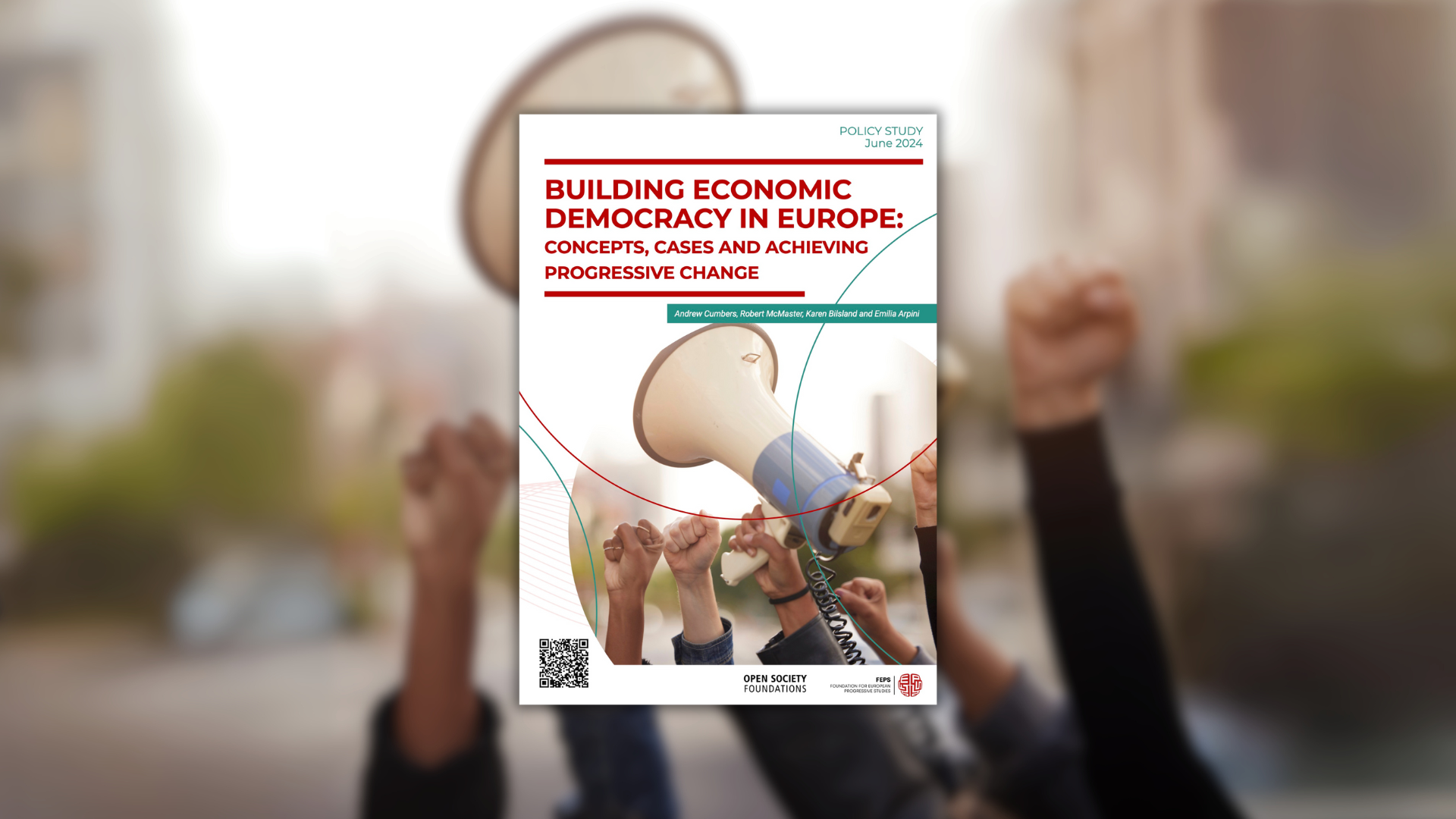
Building Economic Democracy in Europe - Foundation for European Progressive Studies
Concepts, Cases and Achieving Progressive Change
The 'Digital Town Square' Problem
Privately owned public spaces like Twitter are often viewed as “public town squares.” But it's unclear exactly how private companies' influence on the so-called public spaces they control affects actual civic outcomes.

‘What is it actually about?’ Asymmetric mobilisation and the defeat of wage-earner fund policies in Sweden
‘Wage-earner funds’, an ultimately-defeated idea for union-controlled funds to develop stakes in Swedish companies, dominated Swedish politics in the late 1970s and early 1980s. They are regularly cited as a prominent attempt to introduce economic democracy. However, factors behind the funds’ defeat are often under-analysed, with the sequencing of events particularly neglected. This article corrects for this. It seeks to explain the defeat of wage-earner funds by tracing decision-making processes in the Social Democratic Party. It argues that the funds were defeated due to asymmetries in mobilisation, which were connected to asymmetries in everyday experiences. While capital owners mobilised strongly against wage-earner funds as an existential threat, most Social Democratic leaders, voters and union members saw the issue as detached from their everyday concerns. This points to the importance that asymmetries in experience and mobilisation can have in policy contests, which provides an advantage to capital in contests over investment control.
Democracy in trade unions, democracy through trade unions?
Since the Webbs published Industrial Democracy at the end of the nineteenth century, the principle that workers have a legitimate voice in decision-making in the world of work – in some versions through trade unions, in others at least formally through separate representative structures – has become widely accepted in most West European countries. There is now a vast literature on the strengths and weaknesses of such mechanisms, and we review briefly some of the key interpretations of the rise (and fall) of policies and structures for workplace and board-level representation. We also discuss the mainly failed attempts to establish broader processes of economic democracy, which the eclipse of nationally specific mechanisms of class compromise makes again a salient demand. Economic globalization also highlights the need for transnational mechanisms to achieve worker voice (or more radically, control) in the dynamics of capital–labour relations. We therefore examine the role of trade unions in coordinating pressure for a countervailing force at European and global levels, and in the construction of (emergent?) supranational industrial relations. However, many would argue that unions cannot win legitimacy as a democratizing force unless manifestly democratic internally. Therefore we revisit debates on and dilemmas of democracy within trade unions, and examine recent initiatives to enhance democratization.
From Territorial to Functional Sovereignty: The Case of Amazon
Economists tend to characterize the scope of regulation as a simple matter of expanding or contracting state power. But a political economy perspective emphasizes that social relations abhor a power…
The Folk Economics of Housing
Why is housing supply so severely restricted in US cities and suburbs? Urban economists offer two primary hypotheses: homeowner self-interest and political fragmentation. Homeowners, who outnumber and have organizational advantages over renters, are said to lobby against development to protect their property values. The fragmentation hypothesis emphasizes that development's negative externalities are borne locally while most of the benefits accrue regionally or nationally, leading localities to block housing. This paper offers another explanation: ordinary people simply do not believe that adding more housing to the regional stock would reduce housing prices. Across three original surveys of urban and suburban residents, only a minority of respondents say that a large, positive, regional housing supply shock would reduce prices or rents. These beliefs are weakly held and unstable (suggesting people have given the issue little thought), but respondents do have stable views about who is to blame for high housing prices: developers and landlords. Large, bipartisan supermajorities support price controls, demand subsidies, and restrictions on putative bad actors, policies which they believe would be more effective than supply liberalization for widespread affordability. We discuss the implications of these findings for efforts to expand the supply of housing.
Private-sector Trumpism
Monopoly, facial recognition and property rights all add up to a private system of government.

When Does Worker Ownership Work? ESOPs, Law Firms, Codetermination, and Economic Democracy
Common Knowledge: Citizen-led data governance for better cities
Key lessons from the DECODE pilots and tips on how other cities and governments can apply the technologies and methods.

Green economic planning as ‘directed entanglement’
Sustainability transformations depend on ambitious state action. We propose green economic planning as a framework for states to set ambitious climate plans and ensure policy coherence across three dimensions: inputs (sources of information, planning directors, and political regimes), processes (technical expertise and political negotiation), and outputs (monetary-financial, fiscal, and state ownership strategies). To capture how green economic planning works across democratic and authoritarian institutions, we conducted a comparative case study of three countries. France’s intersectoral non-green and Denmark’s sectoral green planning covers democratic institutions, while China’s intersectoral green planning covers authoritarian institutions. Through these cases, we show that 1) green economic planning is both feasible and adaptable across diverse political economies, 2) effective planning requires balancing decentralized information flow with strong central coordination, 3) successful planning depends on managing tensions between autonomous planning agencies, market discipline, and long-term political legitimacy. We term this ‘directed entanglement,’ positioning it as a cornerstone for the emerging research agenda on green economic planning—a blueprint for navigating the use of the state to steer a green transition under capitalism.n analytical framework of elite and resistant imaginaries to trace how these actors construct competing futures of platform labour in EU regulation. These imaginaries transpire in response to the reorganisation of labour relations amidst the digital transformation of socioeconomic institutions. They reveal how platform infrastructures challenge institutional boundaries and reshape the governance of work in the EU. Through a qualitative methodology that combines critical thematic and discourse analysis of stakeholder submissions, the study investigates the frictions that transpire when elite and resistant imaginaries encounter one another. The inductive framework of ‘elite’ and ‘resistant’ imaginaries of platform work illuminates the strategic negotiation of categories and its evolution throughout the policymaking process. The research contributes to scholarship on digital labour and the governance of platforms and algorithmic systems within the EU by offering a critical communications account of how competing imaginaries interact within the regulatory infrastructures of the digital economy. The central empirical contribution of the project lies in re-situating regulatory arbitrage through the analytical lens of elite/resistant imaginaries and discursive friction. The analysis demonstrates how BusinessEurope takes advantage of longstanding techniques of regulatory escape, such as burden shifting and legal fragmentation, and combines them with the systemic structural asymmetries within the European single market to incentivise lenience for platform self-governance models and soft law (Scharpf, 1999). By analysing digital transformation and status classification, the thesis demonstrates how the future of the platform labour economy is co-constructed through frictions that culminate in a sophisticated arbitrage strategy, organised around the ontological construction of the platform as an ‘intermediary’ (Gillespie, 2010). The next chapter discusses the conceptual map of regulatory arbitrage in the PWD as a critical output of the research and considers the limitations of this project, and the future trajectory of trade union discourse on platform work.
Capitalism and markets are closely connected, but they aren't exactly the same thing. And once we recognize that it opens up a huge new terrain for different types of social organization. J.K. Gibson Graham wrote on this a lot. en.wikipedia.org/wiki/J._K._Gibson-Graham
J. K. Gibson-Graham - Wikipedia
en.wikipedia.org