


Social media expose users to an abundance of information about various issues. But they also make it difficult for users to assess the quality of this information. If users do not recognize this, they may overestimate their knowledge about those issues. Knowledge overestimation may lead to increased social media engagement and can be linked to attitudes deeming expert knowledge inferior to common sense, such as science-related populist attitudes. We investigate this during the COVID-19 pandemic in two preregistered, cross-sectional survey experiments in Germany and Taiwan, two countries with different cultures, media environments, and responses to the pandemic. Our study offers two contributions: First, we develop a novel measure of COVID-19-related knowledge. Second, we provide comparative evidence on how social media affordances shape the interplay between knowledge overestimation, social media exposure and engagement, and populist attitudes. We do not find that frequent exposure to COVID-19 information is associated with a higher likelihood of knowledge overestimation. However, we show that overestimation is linked to more user engagement with social media content about COVID-19. Experimental data indicate that engagement depends on whether users are in a private or public communication environment. We find minor differences between Germany and Taiwan.
The limits of social media as a source of political information during routine and crisis times across 17 countries
Recent studies on political knowledge suggest people learn little about political events and societal issues from social media. Potentially, social media are a more effective source of information ...
Does news help us become knowledgeable or think we are knowledgeable? Examining a linkage of traditional and social media use with political knowledge
This study examines traditional and social media news use in relation to political knowledge from the perspective of the Dunning-Kruger effect. Data from a two-wave panel survey show that social me...
Why Don’t We Learn from Social Media? Studying Effects of and Mechanisms behind Social Media News Use on General Surveillance Political Knowledge
Does exposure to news affect what people know about politics? This old question attracted new scholarly interest as the political information environment is changing rapidly. In particular, since c...

Impact of the COVID-19 pandemic on social media
Social media became an important platform for interaction during the COVID-19 pandemic, coinciding with the onset of social distancing. According to a study conducted by Facebook's analytics department, messaging rates rose by over 50% during this period. Individuals confined to their homes utilized social media not only to maintain social connections but also as a source of entertainment to alleviate boredom. Concerns arose regarding the overreliance on social media for primary social interactions, particularly given the constraints imposed by the pandemic.

Illusion of knowledge through Facebook news? Effects of snack news in a news feed on perceived knowledge, attitude strength, and willingness for discussions
Research indicates that using social network sites as a source for news increases perceived knowledge even if, objectively, people fail to acquire knowledge. This might result from the frequent repetition of topics in news posts caused by multiple news outlets posting about the same news topics and the algorithm that favors similar postings. These repeated encounters can have a positive effect on the perception of knowing more, even if actual learning hardly occurs. An experiment (N = 810, representative of German Internet users) tested these assumptions. Participants were assigned to one of four groups and received a news feed with no information, few news posts, many news posts, or a full-length news article. Results indicate that many news posts increased perceived knowledge that is not paralleled by a gain in factual knowledge. Perceived knowledge mediates effects of reading many news posts on more extreme attitudes and the willingness for discussions. Even if participants who read the news article gained factual knowledge, they did not feel more knowledgeable than participants who were exposed to a news feed containing news posts. The results emphasize the meaning of engaging with full news articles, both for learning facts and for more accurate knowledge assessments.
Following news on social media boosts knowledge, belief accuracy and trust
Many worry that news on social media leaves people uninformed or even misinformed. Here we conducted a preregistered two-wave online field experiment in France and Germany (N = 3,395) to estimate the effect of following the news on Instagram and WhatsApp. Participants were asked to follow two accounts for 2 weeks and activate the notifications. In the treatment condition, the accounts were those of news organizations, while in the control condition they covered cooking, cinema or art. The treatment enhanced current affairs knowledge, participants’ ability to discern true from false news stories and awareness of true news stories, as well as trust in the news. The treatment had no significant effects on feelings of being informed, political efficacy, affective polarization and interest in news or politics. These results suggest that, while some forms of social media use are harmful, others are beneficial and can be leveraged to foster a well-informed society.

Overperception of moral outrage in online social networks inflates beliefs about intergroup hostility
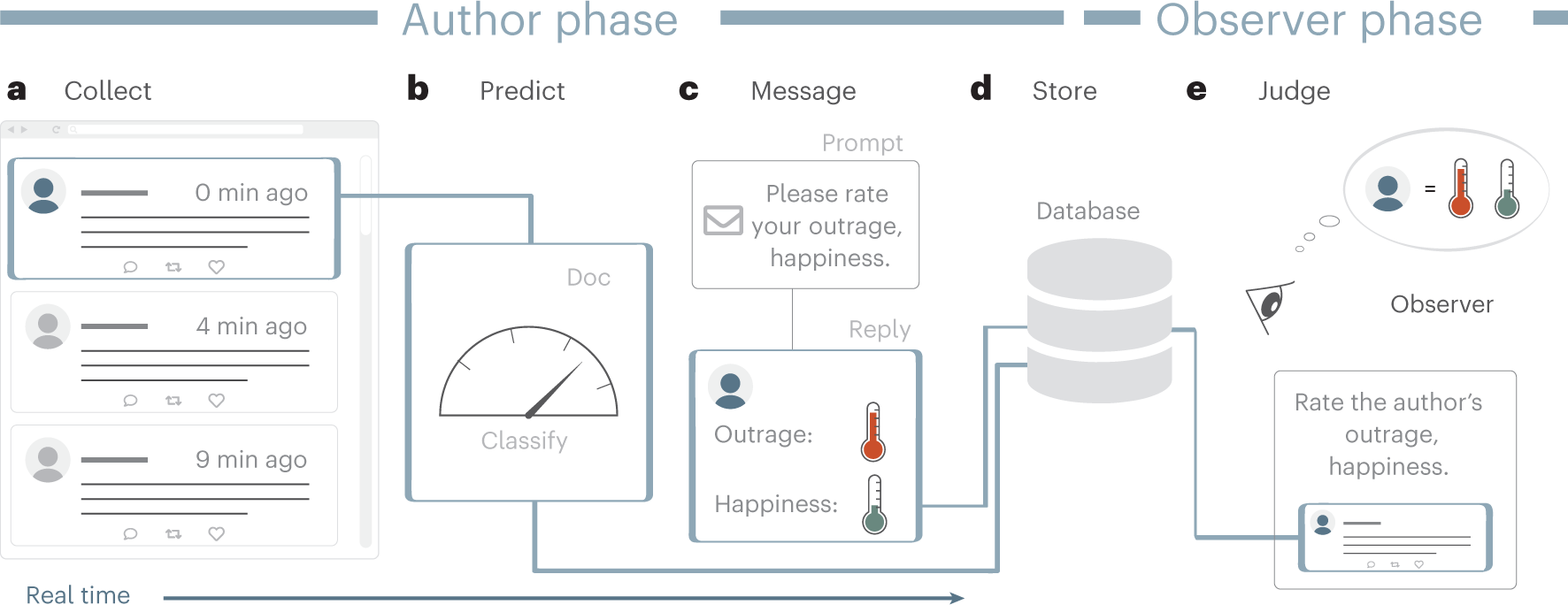
As individuals and political leaders increasingly interact in online social networks, it is important to understand the dynamics of emotion perception online. Here, we propose that social media users overperceive levels of moral outrage felt by individuals and groups, inflating beliefs about intergroup hostility. Using a Twitter field survey, we measured authors’ moral outrage in real time and compared authors’ reports to observers’ judgements of the authors’ moral outrage. We find that observers systematically overperceive moral outrage in authors, inferring more intense moral outrage experiences from messages than the authors of those messages actually reported. This effect was stronger in participants who spent more time on social media to learn about politics. Preregistered confirmatory behavioural experiments found that overperception of individuals’ moral outrage causes overperception of collective moral outrage and inflates beliefs about hostile communication norms, group affective polarization and ideological extremity. Together, these results highlight how individual-level overperceptions of online moral outrage produce collective overperceptions that have the potential to warp our social knowledge of moral and political attitudes.
Sharing without clicking on news in social media
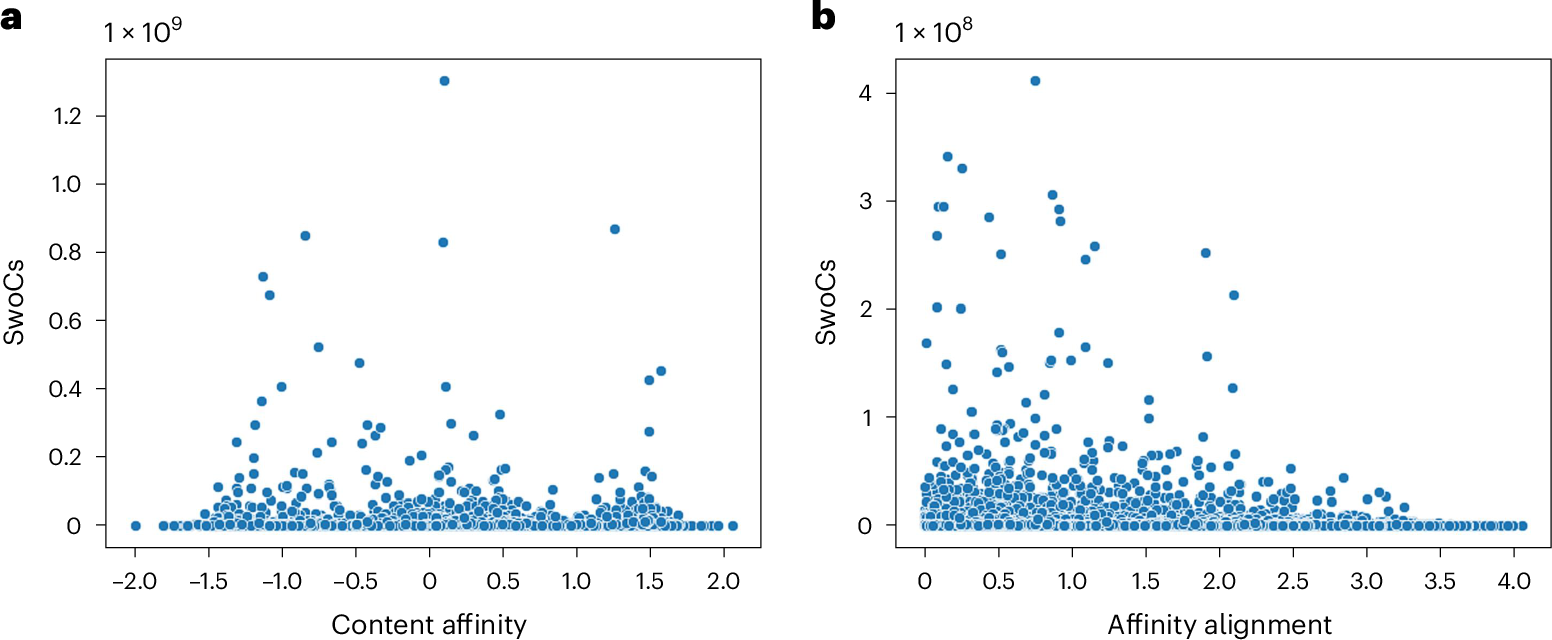
Social media have enabled laypersons to disseminate, at scale, links to news and public affairs information. Many individuals share such links without first reading the linked information. Here we analysed over 35 million public Facebook posts with uniform resource locators shared between 2017 and 2020, and discovered that such ‘shares without clicks’ (SwoCs) constitute around 75% of forwarded links. Extreme and user-aligned political content received more SwoCs, with partisans engaging in it more than politically neutral users. In addition, analyses with 2,969 false uniform resource locators revealed higher shares and, hence, SwoCs by conservatives (76.94%) than liberals (14.25%), probably because, in our dataset, the vast majority (76–82%) of them originated from conservative news domains. Findings suggest that the virality of political content on social media (including misinformation) is driven by superficial processing of headlines and blurbs rather than systematic processing of core content, which has design implications for promoting deliberate discourse in the online public sphere.
Mainstreaming the populist radical right? Online news exposure and voting behavior in the 2019 European Parliament election
How does media exposure relate to support for radical right populist parties (RRPPs)? We contribute to this classic debate by analyzing the web browsing histories and survey responses of six thousand study participants in France, Germany, Italy, Spain, and the UK during the 2019 European Parliament election. Linking direct measures of online news exposure to voting behavior allows us to assess the effects of the salience of issues politicized by RRPPs on their electoral support. The likelihood to vote for RRPPs was higher when the EU was more salient in individual media diets, while exposure to the less salient issue of immigration did not increase the propensity to vote for RRPPs. Alongside consistent results for other party families and interactions with pre-existing voting intentions, the findings indicate that the electoral effects of online media are contingent on the overall salience of a specific issue and voters’ predispositions.

Evaluating Twitter’s algorithmic amplification of low-credibility content: an observational study
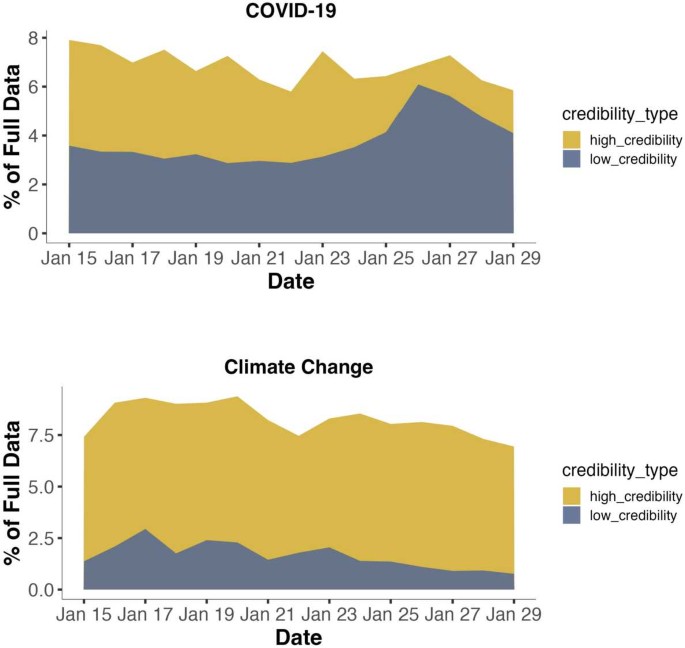
Artificial intelligence (AI)-powered recommender systems play a crucial role in determining the content that users are exposed to on social media platforms. However, the behavioural patterns of these systems are often opaque, complicating the evaluation of their impact on the dissemination and consumption of disinformation and misinformation. To begin addressing this evidence gap, this study presents a measurement approach that uses observed digital traces to infer the status of algorithmic amplification of low-credibility content on Twitter over a 14-day period in January 2023. Using an original dataset of ≈ 2.7 million posts on COVID-19 and climate change published on the platform, this study identifies tweets sharing information from low-credibility domains, and uses a bootstrapping model with two stratifications, a tweet’s engagement level and a user’s followers level, to compare any differences in impressions generated between low-credibility and high-credibility samples. Additional stratification variables of toxicity, political bias, and verified status are also examined. This analysis provides valuable observational evidence on whether the Twitter algorithm favours the visibility of low-credibility content, with results indicating that, on aggregate, tweets containing low-credibility URL domains perform better than tweets that do not across both datasets. However, this effect is largely attributable to a difference in high-engagement, high-followers tweets, which are very impactful in terms of impressions generation, and are more likely receive amplified visibility when containing low-credibility content. Furthermore, high toxicity tweets and those with right-leaning bias see heightened amplification, as do low-credibility tweets from verified accounts. Ultimately, this suggests that Twitter’s recommender system may have facilitated the diffusion of false content by amplifying the visibility of low-credibility content with high-engagement generated by very influential users.
Evaluating Twitter’s algorithmic amplification of low-credibility content: an observational study
Artificial intelligence (AI)-powered recommender systems play a crucial role in determining the content that users are exposed to on social media platforms. However, the behavioural patterns of these systems are often opaque, complicating the evaluation of their impact on the dissemination and consumption of disinformation and misinformation. To begin addressing this evidence gap, this study presents a measurement approach that uses observed digital traces to infer the status of algorithmic amplification of low-credibility content on Twitter over a 14-day period in January 2023. Using an original dataset of ≈ 2.7 million posts on COVID-19 and climate change published on the platform, this study identifies tweets sharing information from low-credibility domains, and uses a bootstrapping model with two stratifications, a tweet’s engagement level and a user’s followers level, to compare any differences in impressions generated between low-credibility and high-credibility samples. Additional stratification variables of toxicity, political bias, and verified status are also examined. This analysis provides valuable observational evidence on whether the Twitter algorithm favours the visibility of low-credibility content, with results indicating that, on aggregate, tweets containing low-credibility URL domains perform better than tweets that do not across both datasets. However, this effect is largely attributable to a difference in high-engagement, high-followers tweets, which are very impactful in terms of impressions generation, and are more likely receive amplified visibility when containing low-credibility content. Furthermore, high toxicity tweets and those with right-leaning bias see heightened amplification, as do low-credibility tweets from verified accounts. Ultimately, this suggests that Twitter’s recommender system may have facilitated the diffusion of false content by amplifying the visibility of low-credibility content with high-engagement generated by very influential users.
Shifts in U.S. Social Media Use, 2020–2024: Decline, Fragmentation, and Enduring Polarization
Using nationally representative data from the 2020 and 2024 American National Election Studies (ANES), this paper describes how U.S. social media use has shifted across platforms, demographics, and politics. Overall platform reach declined, driven by growth in the share of Americans — especially the youngest and oldest cohorts — who report using no social media. Visiting and posting activity on Twitter/X and Facebook have fallen by nearly 50% since 2020, with the decline on Twitter/X driven primarily by reduced participation among Democratic users. While Facebook, YouTube, and Twitter/X lost ground, TikTok and Reddit grew modestly, consistent with a more fragmented digital public sphere. Platform audiences aged and became slightly more educated and racially diverse. Politically, most platforms shifted toward Republican users while remaining, on balance, Democratic-leaning. Twitter/X experienced the largest change: among posters, the partisan balance swung over 70 percentage points from Democrats to Republicans. Across platforms, political posting remains closely tied to affective polarization, as the most partisan respondents are also the most active. As casual users disengage while polarized partisans remain vocal, online discourse becomes narrower and more ideologically extreme.
Facts and Myths about Misperceptions
Misperceptions threaten to warp mass opinion and public policy on controversial issues in politics, science, and health. What explains the prevalence and persistence of these false and unsupported beliefs, which seem to be genuinely held by many people? Though limits on cognitive resources and attention play an important role, many of the most destructive misperceptions arise in domains where individuals have weak incentives to hold accurate beliefs and strong directional motivations to endorse beliefs that are consistent with a group identity such as partisanship. These tendencies are often exploited by elites who frequently create and amplify misperceptions to influence elections and public policy. Though evidence is lacking for claims of a “post-truth” era, changes in the speed with which false information travels and the extent to which it can find receptive audiences require new approaches to counter misinformation. Reducing the propagation and influence of false claims will require further efforts to inoculate people in advance of exposure (for example, media literacy), debunk false claims that are already salient or widespread (for example, fact-checking), reduce the prevalence of low-quality information (for example, changing social media algorithms), and discourage elites from promoting false information (for example, strengthening reputational sanctions).
When Do Parties Lie? Misinformation and Radical-Right Populism Across 26 Countries
The spread of misinformation has emerged as a global concern. Academic attention has recently shifted to emphasize the role of political elites as drivers of misinformation. Yet, little is known of the relationship between party politics and the spread of misinformation—in part due to a dearth of cross-national empirical data needed for comparative study. This article examines which parties are more likely to spread misinformation, by drawing on a comprehensive database of 32M tweets from parliamentarians in 26 countries, spanning 6 years and several election periods. The dataset is combined with external databases such as Parlgov and V-Dem, linking the spread of misinformation to detailed information about political parties and cabinets, thus enabling a comparative politics approach to misinformation. Using multilevel analysis with random country intercepts, we find that radical-right populism is the strongest determinant for the propensity to spread misinformation. Populism, left-wing populism, and right-wing politics are not linked to the spread of misinformation. These results suggest that political misinformation should be understood as part and parcel of the current wave of radical right populism, and its opposition to liberal democratic institution.
Do Science <i>Kardashians</i> Get Citation Premium? Self‐Fulfilling Effects of Social Media on Scientific Impact
ABSTRACT We analyze whether the visibility of scientists on social media affects the number of academic citations. We use the global COVID‐19 pandemic as a quasinatural experiment that exogenously increased public attention and the demand for expertise. Using publications on COVID‐related topics by social media stars and their coauthors prior to the outbreak of the pandemic, we find that social media stars' pre‐COVID‐era papers received about – more citations annually per paper after 2019. Quantitatively comparable results are obtained when we use scientists' Kardashian index (K‐index) as a benchmark for stardom, however we find no significant effects when using the intensive margin of scientists' K‐indexes. We provide a brief discussion of policy implications in light of these findings.

Do social media threaten democracy?
Facebook, Google and Twitter were supposed to save politics as good information drove out prejudice and falsehood. Something has gone very wrong
