


This essay explores administrative evil by reconsidering it through Weber’s ideal-type of bureaucracy and Arendt’s concerns over the bureaucratization of social life. It considers how modern bureaucracy is the structural condition Arendt identified as the banality of evil : systematic displacement of judgment by procedural rationality. Through Weber’s account of bureaucracy’s “special virtue” of impersonality, the paper traces how dehumanization becomes superhumanization —a technical transcendence of human thought now realized in algorithmic governance and artificial intelligence. Administrative evil, then, is not an anomaly but the ordinary moral condition of modern administrative life where thoughtlessness is the design.
Beyond AI: Infrastructuring the Common Good
Rather than taking AI as a central focus, this paper treats it as diagnostic of deeper contradictions. AI intensifies extractivism while being unable to deliver on its promises, and its rampant scaling of energy and resource demands heralds a form of ‘total mobilisation’. This paper proposes decomputing as a programme for pushing back against such technocratic nihilism. Decomputing adopts a degrowth framework and advocates for reclaiming agency through deautomatisation and people’s councils, in order to develop convivial alternatives that centre an ethics of care. It is a philosophical and tactical response to the wider crisis of care induced by the collapse of existing systems. Decomputing proposes a prefigurative praxis for those experiencing ruptures in the infrastructures of everyday life, while minimising the opening for an authoritarian turn or war economy. Rather than capitulating to an increasingly fascistic world order, decomputing advocates a shift in the idea of order itself, one that means challenging the idea that ever more advanced tech is synonymous with progress. The paper argues that reclaiming critical infrastructures can be decoupled from the collapse of the general technopolitical regime, and makes a plausibility argument informed by destituent power and largely forgotten British cybernetics. Where the Luddite call was to ‘put down all machinery hurtful to the Commonality’, the goal of decomputing is the infrastructuring of the common good.
Deconstructing the algorithmic sublime
This special theme contextualizes, examines, and ultimately works to dispel the feelings of “sublime”—of awe and terror that overrides rational thought—that much of the contemporary public discourse on algorithms encourages. Employing critical, reflexive, and ethnographic techniques, these authors show that while algorithms can take on a multiplicity of different cultural meanings, they ultimately remain closely connected to the people who define and deploy them, and the institutions and power relations in which they are embedded. Building on a conversation we began at the Algorithms in Culture conference at U.C. Berkeley in December 2016, we collectively study algorithms as culture (Seaver, this special theme), fetish (Thomas et al.), imaginary (Christin), bureaucratic logic (Caplan and boyd), method of governance (Coletta and Kitchin; Lee; Geiger), mode of inquiry (Baumer), and mode of power (Kubler). [Box: see text]
Human-Computer Insurrection: Notes on an Anarchist HCI
The HCI community has worked to expand and improve our consideration of the societal implications of our work and our corresponding responsibilities. Despite this increased engagement, HCI continues to lack an explicitly articulated politic, which we argue re-inscribes and amplifies systemic oppression. In this paper, we set out an explicit political vision of an HCI grounded in emancipatory autonomy - an anarchist HCI, aimed at dismantling all oppressive systems by mandating suspicion of and a reckoning with imbalanced distributions of power. We outline some of the principles and accountability mechanisms that constitute an anarchist HCI. We offer a potential framework for radically reorienting the field towards creating prefigurative counterpower - systems and spaces that exemplify the world we wish to see, as we go about building the revolution in increment.

Human-Computer Insurrection: Notes on an Anarchist HCI
The HCI community has worked to expand and improve our consideration of the societal implications of our work and our corresponding responsibilities. Despite this increased engagement, HCI continues to lack an explicitly articulated politic, which we argue re-inscribes and amplifies systemic oppression. In this paper, we set out an explicit political vision of an HCI grounded in emancipatory autonomy - an anarchist HCI, aimed at dismantling all oppressive systems by mandating suspicion of and a reckoning with imbalanced distributions of power. We outline some of the principles and accountability mechanisms that constitute an anarchist HCI. We offer a potential framework for radically reorienting the field towards creating prefigurative counterpower - systems and spaces that exemplify the world we wish to see, as we go about building the revolution in increment.
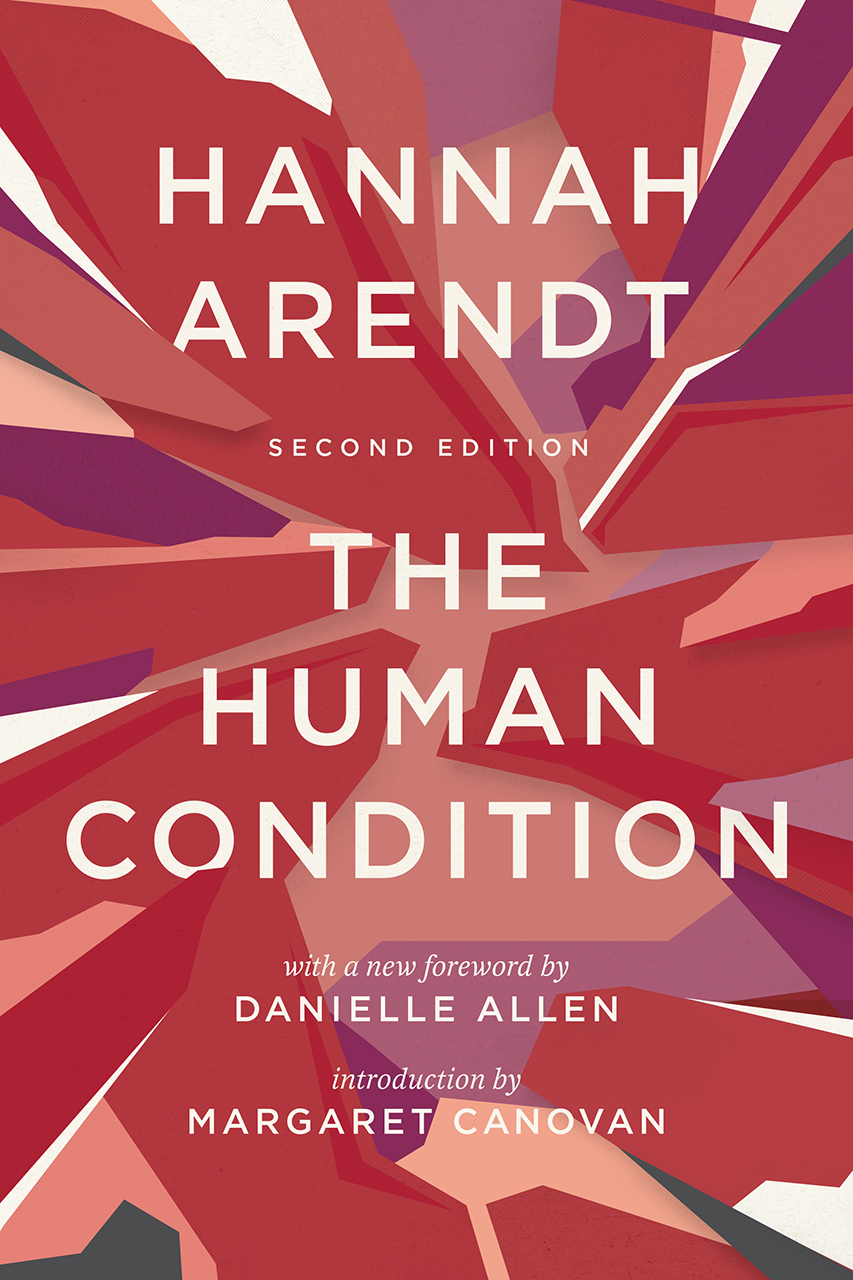
The Human Condition: Second Edition
A classic work of political thought, more relevant today than ever The twenty-first century has seen a resurgence of interest in the political thinker Hannah Arendt, “the theorist of beginnings,” whose work probes the logics underlying unexpected transformations—from totalitarianism to revolution. A work of striking originality, The Human Condition is in many respects more relevant now than when it first appeared in 1958. In her study of the state of modern humanity, Hannah Arendt considers humankind from the perspective of the actions of which it is capable. The problems Arendt identified then—diminishing human agency and political freedom, the paradox that as human powers increase through technological and humanistic inquiry, we are less equipped to control the consequences of our actions—continue to confront us today. This new edition, published to coincide with the sixtieth anniversary of its original publication, contains Margaret Canovan’s 1998 introduction and a new foreword by Danielle Allen. A classic in political and social theory, The Human Condition is a work that has proved both timeless and perpetually timely.
Pluralistic: The ordinariness of evil (19 Aug 2026) – Pluralistic: Daily links from Cory Doctorow
Maybe it seems weird that AI bosses won't stop publicly rending their garments about the terrible potential of their products, from the jobspocalypse that will ensue when AI can do our jobs better than us, to the impending moment when the word-guessing programs learn too many words, wake up and turn us all into paperclips.
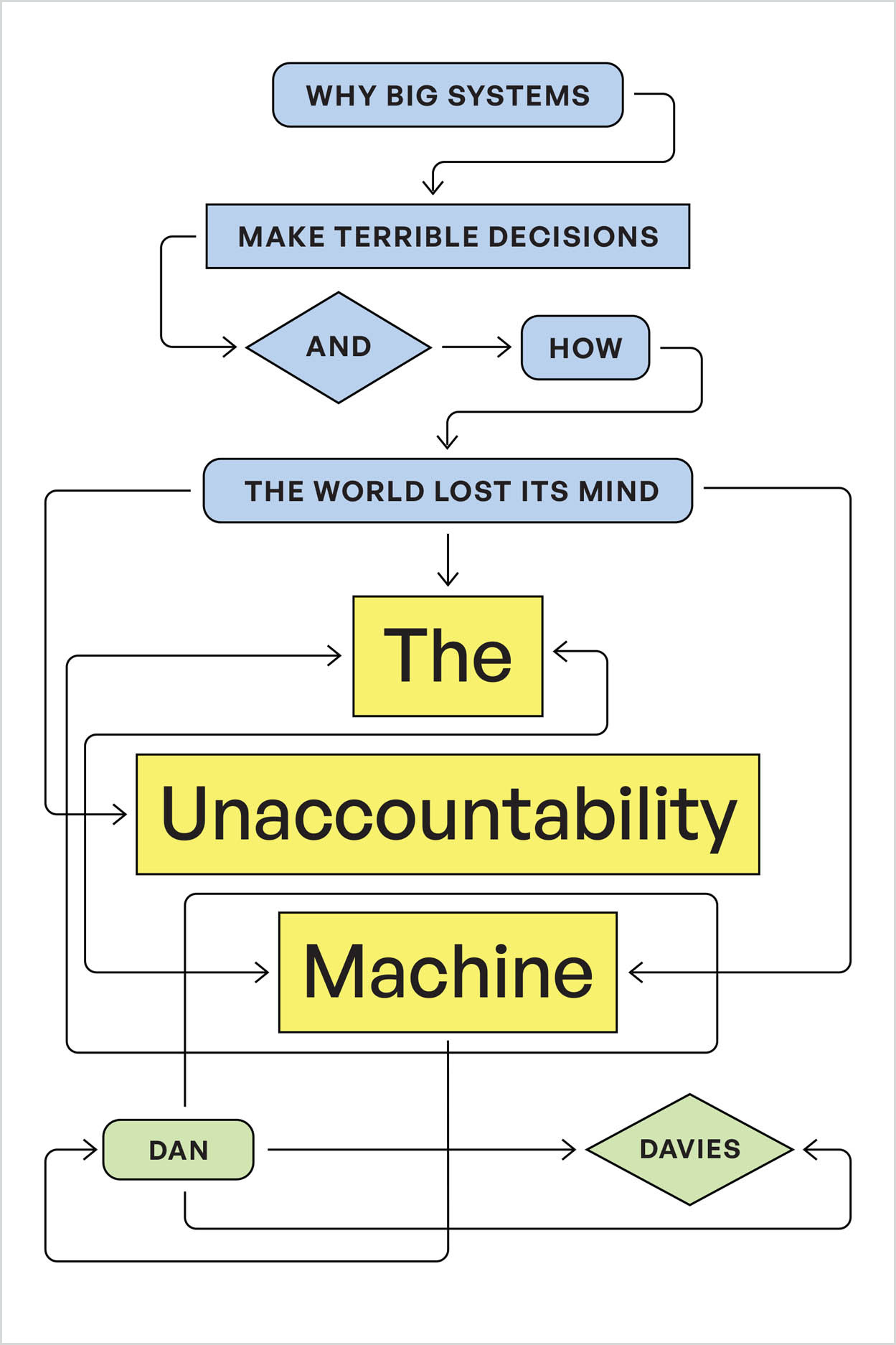
The Unaccountability Machine: Why Big Systems Make Terrible Decisions—and How the World Lost Its Mind
Longlisted for the 2024 Financial Times Book of the Year. How life and the economy became a black box—a collection of systems no one understands, producing outcomes no one likes. Passengers get bumped from flights. Phone menus disconnect. Automated financial trades produce market collapse. Of all the challenges in modern life, some of the most vexing come from our relationships with automation: a large system does us wrong, and there’s nothing we can do about it. The problem, economist Dan Davies shows, is accountability sinks: systems in which decisions are delegated to a complex rule book or set of standard procedures, making it impossible to identify the source of mistakes when they happen. In our increasingly unhuman world—lives dominated by algorithms, artificial intelligence, and large organizations—these accountability sinks produce more than just aggravation. They make life and economy unknowable—a black box for no reason. In The Unaccountability Machine, Davies lays bare how markets, institutions, and even governments systematically generate outcomes that no one—not even those involved in making them—seems to want. Since the earliest days of the computer age, theorists have foreseen the dangers of complex systems without personal accountability. In response, British business scholar Stafford Beer developed an accountability-first approach to management called “cybernetics,” which might have taken off had his biggest client (the Chilean government) not fallen to a bloody coup in 1973. With his signature blend of economic and journalistic rigor, Davies examines what’s gone wrong since Beer, including what might have been had the world embraced cybernetics when it had the chance. The Unaccountability Machine is a revelatory and resonant account of how modern life became predisposed to dysfunction.
THEY WILL REPLACE U.S.: AI AND THE HALLUCINATIONS OF CORPORATIONS
ABSTRACT: I address AI as a manifestation of the corporate form in U.S. culture, and as it relates to the dreams of (or ascribed to) fascism and corporations. The merger of state and corporate power represents the trajectory of the corporation—to take over the state; elide accountability, empathy, transparency and (human) agency; and trade places with (and finally eliminate) people. The merger of state and corporate AI—a final stage of corporate speech, networking, and legal ontology—facilitates the takeover of human personhood by corporate personhood, and I trace the effects of that process in the systemic inversion of norms. Corporate personhood is part of a zero-sum game in which rights, speech, and identities are appropriated from people. When AI technology is grafted onto political systems and social media, the ensuing hallucinations are nightmares. The corporation always has been a posthuman simulacrum of persons, and its AI, in its wake, dreams of eliminating workers and people altogether.
On Authority
A number of Socialists have latterly launched a regular crusade against what they call the principle of authority. It suffices to tell them that this or that act is authoritarian for it to be condemned. This summary mode of procedure is being abused to such an extent that it has become necessary to look into the matter somewhat more closely.
Big Mother: The Technological Body of Evil
A bold examination of artificial intelligence, consciou…

The Least Agentic People Alive
The arms race of deferring agency and the dark acquiescence to robotic bureaucracy.

The Nightmare of Valve’s self-organizing “utopia”
How Valve’s perfect work culture turned into a toxic bully’s yard and what it tells us about “flat hierarchy” workplaces.
HACKING – A Hacker Manifesto
The apologists for the vectoral interest want to limit the se- mantic productivity of the term “hacker” to a mere crimi- nality, precisely because they fear its more abstract and multiple potential—its class potential. Everywhere one hears rumors of the hacker as the new form of juvenile delinquent, or nihilist vandal, or servant of organized crime. Or, the hacker is presented as a mere harmless subculture, an obsessive garage pursuit with its restrictive styles of appear- ance and codes of conduct. Everywhere the desire to open the virtuality of information, to share data as a gift, to ap- propriate the vector for expression is represented as the object of a moral panic, an excuse for surveillance, and the re- striction of technical knowledge to the “proper authorities.” This is not the first time that the productive classes have faced this ideological blackmail. The hacker now appears in the official organs of the ruling order alongside its earlier ar- chetypes, the organized worker, the rebellious farmer. The hacker is in excellent company
How AI Destroys Institutions
Civic institutions—the rule of law, universities, and a free press—are the backbone of democratic life. They are the mechanisms through which complex societies encourage cooperation and stability, while also adapting to changing circumstances. The real superpower of institutions is their ability to evolve and adapt within a hierarchy
We Do This 'Til We Free Us
New York Times Bestseller “Organizing is both science and art. It is thinking through a vision, a strategy, and then figuring out who your targets are, always being concerned about power, always being concerned about how you’re going to actually build power in order to be able to push your issues, in order to be able to get the target to actually move in the way that you want to.” What if social transformation and liberation isn’t about waiting for someone else to come along and save us? What if ordinary people have the power to collectively free ourselves? In this timely collection of essays and interviews, Mariame Kaba reflects on the deep work of abolition and transformative political struggle. With a foreword by Naomi Murakawa and chapters on seeking justice beyond the punishment system, transforming how we deal with harm and accountability, and finding hope in collective struggle for abolition, Kaba’s work is deeply rooted in the relentless belief that we can fundamentally change the world. As Kaba writes, “Nothing that we do that is worthwhile is done alone.”

> the central promise of “ai” is that nothing is worth doing and that community doesn’t exist. It’s individual entitlement as software. It’s Thatcherism. post.lurk.org/@emenel/117441848350524047
emenel (@emenel@post.lurk.org)
post.lurk.org