


Individuals influence each others' decisions about cultural products such as songs, books, and movies; but to what extent can the perception of success become a “self-fulfilling prophecy”? We have explored this question experimentally by artificially inverting the true popularity of songs in an online “music market,” in which 12,207 participants listened to and downloaded songs by unknown bands. We found that most songs experienced self-ful- filling prophecies, in which perceived—but initially false—popularity became real over time. We also found, however, that the inversion was not self-fulfilling for the market as a whole, in part because the very best songs recovered their popularity in the long run. Moreover, the distortion of market information reduced the correlation between appeal and popularity, and led to fewer overall downloads. These results, although partial and speculative, suggest a new approach to the study of cultural markets, and indicate the potential of web-based experiments to explore the social psychological origin of other macrosocio- logical phenomena.
Experimental Study of Inequality and Unpredictability in an Artificial Cultural Market
Hit songs, books, and movies are many times more successful than average, suggesting that “the best” alternatives are qualitatively different from “the rest”; yet experts routinely fail to predict which products will succeed. We investigated this paradox experimentally, by creating an artificial “music market” in which 14,341 participants downloaded previously unknown songs either with or without knowledge of previous participants' choices. Increasing the strength of social influence increased both inequality and unpredictability of success. Success was also only partly determined by quality: The best songs rarely did poorly, and the worst rarely did well, but any other result was possible.

Experimental Study of Inequality and Unpredictability in an Artificial Cultural Market
Hit songs, books, and movies are many times more successful than average, suggesting that “the best” alternatives are qualitatively different from “the rest”; yet experts routinely fail to predict which products will succeed. We investigated this paradox experimentally, by creating an artificial “music market” in which 14,341 participants downloaded previously unknown songs either with or without knowledge of previous participants' choices. Increasing the strength of social influence increased both inequality and unpredictability of success. Success was also only partly determined by quality: The best songs rarely did poorly, and the worst rarely did well, but any other result was possible.
Popularity Feedback Constrains Innovation in Cultural Markets
Real-world creative processes ranging from art to science rely on social feedback-loops between selection and creation. Yet, the effects of popularity feedback on collective creativity remain poorly understood. We investigate how popularity ratings influence cultural dynamics in a large-scale online experiment where participants ($N = 1\,008$) iteratively \textit{select} images from evolving markets and \textit{produce} their own modifications. Results show that exposing the popularity of images reduces cultural diversity and slows innovation, delaying aesthetic improvements. Popularity feedback is associated with changes to both selection and creative stages. During selection, popularity information triggers cumulative advantage, with participants preferentially building upon popular images, reducing diversity. During creation, participants make less disruptive changes, and are more likely to expand existing visual patterns. Feedback loops in cultural markets thus not only shape selection, but also, directly or indirectly, the form and direction of cultural innovation.

The Dynamics of Distortion: How Successive Summarization Alters the Retelling of News
This work advances and tests a theory of how news information evolves as it is successively retold by consumers. Drawing on data from over 11,000 participants across ten experiments, the authors offer evidence that when news is repeatedly retold, it undergoes a stylistic transformation termed “disagreeable personalization,” wherein original facts are increasingly supplanted by opinions and interpretations with a slant toward negativity. The central thesis is that when retellers believe they are more (vs. less) knowledgeable than their recipient about the information they are relaying, they feel more compelled to provide guidance on its meaning and to do so in a persuasive manner. This enhanced motivation to guide persuasively, in turn, leads retellers to not only select the subset of facts they deem most essential but, critically, to provide their interpretations and opinions on those facts, with negativity being used as a means of grabbing their audience’s attention. Implications of this work for research on retelling and consumer information diffusion are explored.
The Dynamics of Distortion: How Successive Summarization Alters the Retelling of News
This work advances and tests a theory of how news information evolves as it is successively retold by consumers. Drawing on data from over 11,000 participants across ten experiments, the authors offer evidence that when news is repeatedly retold, it undergoes a stylistic transformation termed “disagreeable personalization,” wherein original facts are increasingly supplanted by opinions and interpretations with a slant toward negativity. The central thesis is that when retellers believe they are more (vs. less) knowledgeable than their recipient about the information they are relaying, they feel more compelled to provide guidance on its meaning and to do so in a persuasive manner. This enhanced motivation to guide persuasively, in turn, leads retellers to not only select the subset of facts they deem most essential but, critically, to provide their interpretations and opinions on those facts, with negativity being used as a means of grabbing their audience’s attention. Implications of this work for research on retelling and consumer information diffusion are explored.
Accelerating dynamics of collective attention
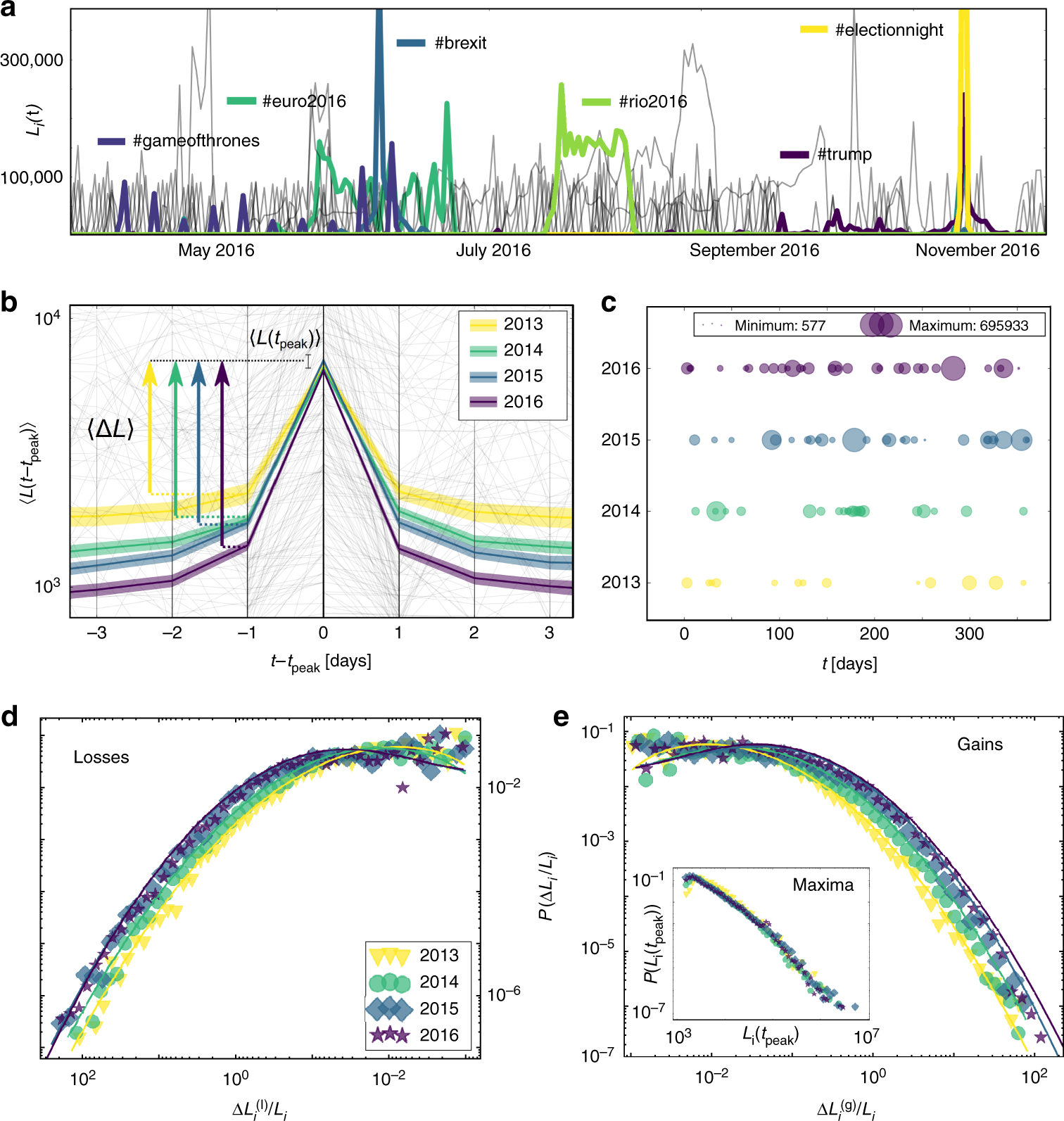
With news pushed to smart phones in real time and social media reactions spreading across the globe in seconds, the public discussion can appear accelerated and temporally fragmented. In longitudinal datasets across various domains, covering multiple decades, we find increasing gradients and shortened periods in the trajectories of how cultural items receive collective attention. Is this the inevitable conclusion of the way information is disseminated and consumed? Our findings support this hypothesis. Using a simple mathematical model of topics competing for finite collective attention, we are able to explain the empirical data remarkably well. Our modeling suggests that the accelerating ups and downs of popular content are driven by increasing production and consumption of content, resulting in a more rapid exhaustion of limited attention resources. In the interplay with competition for novelty, this causes growing turnover rates and individual topics receiving shorter intervals of collective attention.
Advertising as a Reminder: Evidence from the Dutch State Lottery
We show that advertising can act as a reminder for consumers who intend to buy a product. , Consumers who intend to buy a product may forget to do so because they suffer from limited attention. Therefore, they may value being reminded by an advertisement. This reminder effect of advertising could be important in many markets but is usually difficult to document. We study it in the context of buying a product that has existed for almost 300 years: a ticket for the Dutch State Lottery. This context is particularly suitable for our analysis because the product is simple, it is very well known, and there are multiple fixed and known purchase cycles per year. Moreover, radio and TV advertisements are designed explicitly to remind consumers to buy a lottery ticket before the draw. This can conveniently be done online. We develop an approach to distinguish reminder effects of advertising from other effects, such as conveying information about the size of the jackpot. The key idea is that reminder effects are short lived. We use minute-level advertising and online sales data and find that the reminder effect of advertising is strong. Reaching 1% of the population by a radio advertisement leads to an increase in online sales of 1.55% in the four hours after the advertisement is aired. For TV advertisements, the increase is 0.78%. We show that the effects generally last longer for radio advertisements. We also provide direct evidence that reminding consumers not only affects the timing of purchases but also leads to market expansion. Finally, we estimate a model of consumer behavior under limited attention to quantify the effect on total sales. We find that total sales would be 16.7% lower without the reminder effect of advertising and that shifting advertising to the week of the draw would lead to a 9.2% increase in sales. History: Puneet Manchanda served as the senior editor and Günter Hitsch served as associate editor for this article. Supplemental Material: A replication package with code and log files and an Online Appendix are available at https://doi.org/10.1287/mksc.2022.1405 .

The Feed Is Fake
That “viral” song, movie, influencer, and celebrity drama you scrolled by recently was likely the result of a stealth marketing campaign.
Profiting from Hate Music
This report maps how the world's largest digital platforms and music streaming services host, amplify, monetize, and profit from a growing genre of Indian music that dehumanizes Muslims and Christians and incites violence against them.
The Truth About Social Media as an "Advertising Industry," Bluesky's Gamble, and "Reclaiming Conversation" - Nightflight
Media Ownership Monitor
Mass media influences how facts are viewed and debated in a society, contributing to crafting its public opinion. Independence and pluralism...

[Interview] Snow J of Cheerful Music dives into the cross cultural intersection of AI and music – EARMILK
In conversation with Earmilk, Snow. J explores how AI has restructured the foundation of music culture, striking a balance between AI and human-made music as well as Cheerful Music's distinct approach to engaging AI technology in music making and marketing.

Behavioural economics, consumer behaviour and consumer policy: state of the art
Counter to the traditional assumption of neoclassical economics that individuals are rational Homo oeconomici that always seek to maximize their utility and follow their ‘true’ preferences, research in behavioural economics has demonstrated that people's judgements and decisions are often subject to systematic biases and heuristics, and are strongly dependent on the context of the decision. In this article, we briefly review the transition of research from neoclassical economics to behavioural economics, and discuss how the latter has influenced research in consumer behaviour and consumer policy. In particular, we discuss the impacts of key principles such as status quo bias, the endowment effect, mental accounting and the sunk-cost effect, other heuristics and biases related to availability, salience, the anchoring effect and simplicity rules, as well as the effects of other supposedly irrelevant factors such as music, temperature and physical markers on consumers’ decisions. These principles not only add significantly to research on consumer behaviour – they also offer readily available practical implications for consumer policy to nudge behaviour in beneficial directions in consumption domains including financial decision making, product choice, healthy eating and sustainable consumption.
The marketplace of rationalizations
Recent work in economics has rediscovered the importance of belief-based utility for understanding human behaviour. Belief ‘choice’ is subject to an important constraint, however: people can only bring themselves to believe things for which they can find rationalizations. When preferences for similar beliefs are widespread, this constraint generates rationalization markets, social structures in which agents compete to produce rationalizations in exchange for money and social rewards. I explore the nature of such markets, I draw on political media to illustrate their characteristics and behaviour, and I highlight their implications for understanding motivated cognition and misinformation.

Discerning Audiences Through Like Buttons · Issue 6.1, Winter 2024
Column Editor’s Note: The ‘like button’ is a ubiquitous and infamous feature of social media platforms. ‘Likes’ ostensibly allow users to interact and engage with one another, but platform developers hope that data generated by users’ likes allows them to model, predict and even manipulate both individual and collective affective states. This Mining the Past column by communication scholar Carina Albrecht explores the history of the like button from “Little Annie,” developed at CBS in the mid-twentieth century, to the Cambridge Analytica scandal. Throughout this history, researchers and tech developers hoped to make ‘subjectivities’—emotions, preferences, personalities, political orientations—into ‘objectivites’; they sought to turn inner worlds into profitable data. Albrecht’s history reveals that the like button is best understood not as a passive recorder of preexisting affect and sentiment, but rather as a data technology that generated the emotive effects the button claimed to measure.
