


Will people use self-driving cars, virtual doctors, and other algorithmic decision-makers if they outperform humans? The answer depends on the uncertainty inherent in the decision domain. We propose that people have diminishing sensitivity to forecasting error and that this preference results in people favoring riskier (and often worse-performing) decision-making methods, such as human judgment, in inherently uncertain domains. In nine studies ( N = 4,820), we found that (a) people have diminishing sensitivity to each marginal unit of error that a forecast produces, (b) people are less likely to use the best possible algorithm in decision domains that are more unpredictable, (c) people choose between decision-making methods on the basis of the perceived likelihood of those methods producing a near-perfect answer, and (d) people prefer methods that exhibit higher variance in performance (all else being equal). To the extent that investing, medical decision-making, and other domains are inherently uncertain, people may be unwilling to use even the best possible algorithm in those domains.
People Spend Too Much Time On Decisions with Equally Satisfying Outcomes
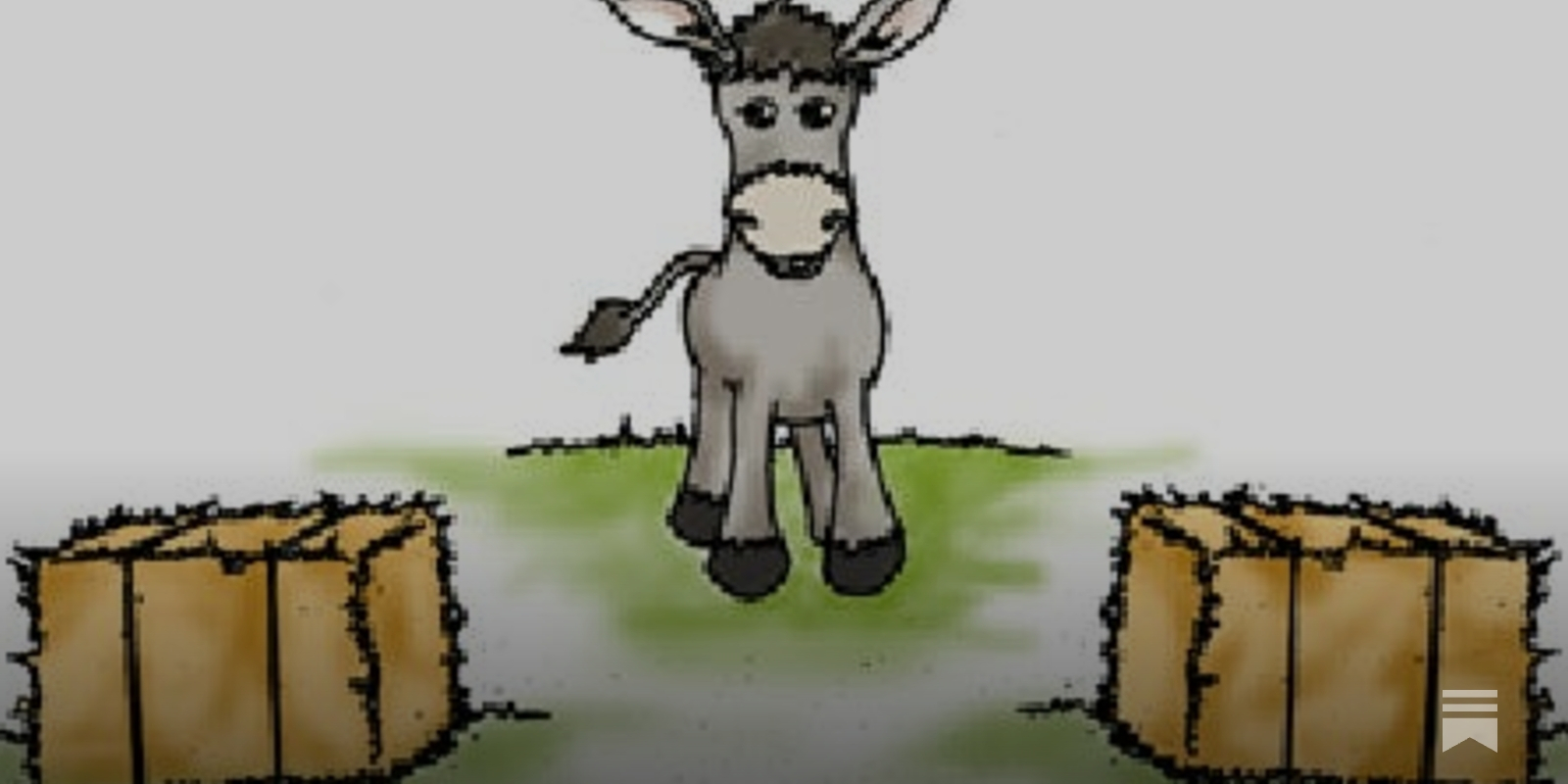
The pitfalls of analysis paralysis
Algorithm appreciation: People prefer algorithmic to human judgment
Even though computational algorithms often outperform human judgment, received wisdom suggests that people may be skeptical of relying on them (Dawes, 1979). Counter to this notion, results from six experiments show that lay people adhere more to advice when they think it comes from an algorithm than from a person. People showed this effect, what we call algorithm appreciation, when making numeric estimates about a visual stimulus (Experiment 1A) and forecasts about the popularity of songs and romantic attraction (Experiments 1B and 1C). Yet, researchers predicted the opposite result (Experiment 1D). Algorithm appreciation persisted when advice appeared jointly or separately (Experiment 2). However, algorithm appreciation waned when: people chose between an algorithm’s estimate and their own (versus an external advisor’s; Experiment 3) and they had expertise in forecasting (Experiment 4). Paradoxically, experienced professionals, who make forecasts on a regular basis, relied less on algorithmic advice than lay people did, which hurt their accuracy. These results shed light on the important question of when people rely on algorithmic advice over advice from people and have implications for the use of “big data” and algorithmic advice it generates.
Misperception of Exponential Growth: Are People Aware of Their Errors?
Previous research shows that individuals make systematic errors when judging exponential growth, which has harmful effects for their financial well-being. This study analyzes how far individuals are aware of their errors and how these errors are shaped by arithmetic and conceptual problems. Whereas arithmetic problems could be overcome using computational assistance like a pocket calculator, this is not the case for conceptual problems, a term we use to subsume other error drivers like a general misunderstanding of exponential growth or overwhelming task complexity. In an incentivized experiment, we find that participants strongly overestimate the accuracy of their intuitive judgment. At the same time, their willingness to pay for arithmetic assistance is too high on average, often much above the actual benefits a calculator provides. Using a multitier system of task complexity we can show that the willingness to pay for arithmetic assistance is hardly related to its benefits, indicating that participants do not really understand how the interplay of arithmetic and conceptual problems shape their errors in exponential growth tasks. Our findings are relevant for policymaking and financial advisory practice and can help to design effective approaches to mitigate the detrimental effects of misperceived exponential growth.

Underspecified Human Decision Experiments Considered Harmful
Decision-making with information displays is a key focus of research in areas like human-AI collaboration and data visualization. However, what constitutes a decision problem, and what is required for an experiment to conclude that decisions are flawed, remain imprecise. We present a widely applicable definition of a decision problem synthesized from statistical decision theory and information economics. We claim that to attribute loss in human performance to bias, an experiment must provide the information that a rational agent would need to identify the normative decision. We evaluate whether recent empirical research on AI-assisted decisions achieves this standard. We find that only 10 (26%) of 39 studies that claim to identify biased behavior presented participants with sufficient information to make this claim in at least one treatment condition. We motivate the value of studying well-defined decision problems by describing a characterization of performance losses they allow to be conceived.

Task-Dependent Algorithm Aversion
Research suggests that consumers are averse to relying on algorithms to perform tasks that are typically done by humans, despite the fact that algorithms often perform better. The authors explore when and why this is true in a wide variety of domains. They find that algorithms are trusted and relied on less for tasks that seem subjective (vs. objective) in nature. However, they show that perceived task objectivity is malleable and that increasing a task’s perceived objectivity increases trust in and use of algorithms for that task. Consumers mistakenly believe that algorithms lack the abilities required to perform subjective tasks. Increasing algorithms’ perceived affective human-likeness is therefore effective at increasing the use of algorithms for subjective tasks. These findings are supported by the results of four online lab studies with over 1,400 participants and two online field studies with over 56,000 participants. The results provide insights into when and why consumers are likely to use algorithms and how marketers can increase their use when they outperform humans.
Task-Dependent Algorithm Aversion
Research suggests that consumers are averse to relying on algorithms to perform tasks that are typically done by humans, despite the fact that algorithms often perform better. The authors explore when and why this is true in a wide variety of domains. They find that algorithms are trusted and relied on less for tasks that seem subjective (vs. objective) in nature. However, they show that perceived task objectivity is malleable and that increasing a task’s perceived objectivity increases trust in and use of algorithms for that task. Consumers mistakenly believe that algorithms lack the abilities required to perform subjective tasks. Increasing algorithms’ perceived affective human-likeness is therefore effective at increasing the use of algorithms for subjective tasks. These findings are supported by the results of four online lab studies with over 1,400 participants and two online field studies with over 56,000 participants. The results provide insights into when and why consumers are likely to use algorithms and how marketers can increase their use when they outperform humans.
Characterizing the causes, dynamics, and consequences of choice deferral
The fact that people often avoid making decisions is well known, and past research has helped to identify some of the conditions and reasons for doing so. For instance, people may forgo choices between bad options because they prefer not to end up with one of those options. It is much less clear when and why people avoid choosing in cases where they eventually will have to make a given decision. To study such instances of choice deferral, we presented participants with a series of choices, and for each choice they were allowed to either choose immediately or defer the decision until later in the experiment. Across six experiments and three choice domains (choices among consumer goods, artwork, and political candidates), we find that the strongest predictor of choice deferral is the overall value of a given set of options, with relative value (i.e., how hard it is to identify the best option) counterintuitively playing a smaller role. We show that the influence of overall value on choice deferral can be accounted for by a dynamic decision model according to which participants appraise the option set relative to a criterion before deciding whether to choose or defer, comparing this to a previous model whereby participants make such a decision based on a predetermined decision time limit. We further reveal that the influence of overall value on choice deferral is determined by how congruent options are with a given choice goal (choose-best or choose-worst) rather than simply how bad those options are. Collectively, our findings shed new light on how people decide to put off the inevitable.
Algorithmic monoculture and social welfare
Significance Algorithmic monoculture is a growing concern in the use of algorithms for high-stakes screening decisions in areas such as employment and lending. If many firms use the same algorithm, even if it is more accurate than the alternatives, the resulting “monoculture” may be susceptible to correlated failures, much as a monocultural system is in biological settings. To investigate this concern, we develop a model of selection under monoculture. We find that even without any assumption of shocks or correlated failures—i.e., under “normal operations”—the quality of decisions may decrease when multiple firms use the same algorithm. Thus, the introduction of a more accurate algorithm may decrease social welfare—a kind of “Braess’ paradox” for algorithmic decision-making. , As algorithms are increasingly applied to screen applicants for high-stakes decisions in employment, lending, and other domains, concerns have been raised about the effects of algorithmic monoculture, in which many decision-makers all rely on the same algorithm. This concern invokes analogies to agriculture, where a monocultural system runs the risk of severe harm from unexpected shocks. Here, we show that the dangers of algorithmic monoculture run much deeper, in that monocultural convergence on a single algorithm by a group of decision-making agents, even when the algorithm is more accurate for any one agent in isolation, can reduce the overall quality of the decisions being made by the full collection of agents. Unexpected shocks are therefore not needed to expose the risks of monoculture; it can hurt accuracy even under “normal” operations and even for algorithms that are more accurate when used by only a single decision-maker. Our results rely on minimal assumptions and involve the development of a probabilistic framework for analyzing systems that use multiple noisy estimates of a set of alternatives.

Algorithmic monoculture and social welfare
Significance Algorithmic monoculture is a growing concern in the use of algorithms for high-stakes screening decisions in areas such as employment and lending. If many firms use the same algorithm, even if it is more accurate than the alternatives, the resulting “monoculture” may be susceptible to correlated failures, much as a monocultural system is in biological settings. To investigate this concern, we develop a model of selection under monoculture. We find that even without any assumption of shocks or correlated failures—i.e., under “normal operations”—the quality of decisions may decrease when multiple firms use the same algorithm. Thus, the introduction of a more accurate algorithm may decrease social welfare—a kind of “Braess’ paradox” for algorithmic decision-making. , As algorithms are increasingly applied to screen applicants for high-stakes decisions in employment, lending, and other domains, concerns have been raised about the effects of algorithmic monoculture, in which many decision-makers all rely on the same algorithm. This concern invokes analogies to agriculture, where a monocultural system runs the risk of severe harm from unexpected shocks. Here, we show that the dangers of algorithmic monoculture run much deeper, in that monocultural convergence on a single algorithm by a group of decision-making agents, even when the algorithm is more accurate for any one agent in isolation, can reduce the overall quality of the decisions being made by the full collection of agents. Unexpected shocks are therefore not needed to expose the risks of monoculture; it can hurt accuracy even under “normal” operations and even for algorithms that are more accurate when used by only a single decision-maker. Our results rely on minimal assumptions and involve the development of a probabilistic framework for analyzing systems that use multiple noisy estimates of a set of alternatives.
Algorithmic personalization of information can cause inaccurate generalization and overconfidence.
Trust and reliance on AI — An experimental study on the extent and costs of overreliance on AI
Decision-making is undergoing rapid changes due to the introduction of artificial intelligence (AI), as AI recommender systems can help mitigate human flaws and increase decision accuracy and efficiency. However, AI can also commit errors or suffer from algorithmic bias. Hence, blind trust in technologies carries risks, as users may follow detrimental advice resulting in undesired consequences. Building upon research on algorithm appreciation and trust in AI, the current study investigates whether users who receive AI advice in an uncertain situation overrely on this advice — to their own detriment and that of other parties. In a domain-independent, incentivized, and interactive behavioral experiment, we find that the mere knowledge of advice being generated by an AI causes people to overrely on it, that is, to follow AI advice even when it contradicts available contextual information as well as their own assessment. Frequently, this overreliance leads not only to inefficient outcomes for the advisee, but also to undesired effects regarding third parties. The results call into question how AI is being used in assisted decision making, emphasizing the importance of AI literacy and effective trust calibration for productive deployment of such systems.
Rational Inattention: A Review
We review the recent literature on rational inattention, identify the main theoretical mechanisms, and explain how it helps us understand a variety of phenomena across fields of economics. The theory of rational inattention assumes that agents cannot process all available information, but they can choose which exact pieces of information to attend to. Several important results in economics have been built around imperfect information. Nowadays, many more forms of information than ever before are available due to new technologies, and yet we are able to digest little of it. Which form of imperfect information we possess and act upon is thus largely determined by which information we choose to pay attention to. These choices are driven by current economic conditions and imply behavior that features numerous empirically supported departures from standard models. Combining these insights about human limitations with the optimizing approach of neoclassical economics yields a new, generally applicable model.
The Realization Effect: Risk-Taking after Realized versus Paper Losses
Understanding how prior outcomes affect risk attitudes is critical for the study of choice under uncertainty. A large literature documents the significant influence of prior losses on risk attitudes. The findings appear contradictory: some studies find greater risk-taking after a loss, whereas others show the opposite—that people take on less risk. I reconcile these seemingly inconsistent findings by distinguishing between realized versus paper losses. Using new and existing data, I replicate prior findings and demonstrate that following a realized loss, individuals avoid risk; if the same loss is not realized, a paper loss, individuals take on greater risk.
Why women are more skeptical of AI than men, according to a new study
Drawing on survey data, the study finds that women consistently perceive AI as riskier, especially when its economic effects are uncertain.

Can Revealed Preferences Clarify LLM Alignment and Steering?
LLMs are increasingly used to make or support high-stakes decisions under uncertainty, where alignment depends not only on factual accuracy but on how models weigh tradeoffs between different outcomes. We present an empirical pipeline for estimating the implied preferences that an LLM's observed choices optimize: we elicit the model's probability distribution over unknowns along with the choice it would make for the decision task and then fit a discrete choice model to recover the cost function that best rationalizes the model's decisions. We show how this revealed-preference description allows rigorous evaluation of whether models behave in a consistently goal-directed way, whether they can verbalize a description of their objectives which matches their revealed decision policy, and whether prompting can reliably steer those policies to implement a user-specified cost function. We apply this evaluation across four medical diagnosis domains and multiple frontier and open-source models. We find that while many models have a nontrivial degree of internal coherence, they also have significant weaknesses in faithfully reporting or adopting preferences in response to user direction.

AI Sycophancy and Decisions
We examine whether sycophantic AI advice distorts decisions. Our experiment involves 1,500 participants in 30 decision environments spanning core domains in eco
