


New technology invariably provokes concerns over potential societal impacts. Even as risks often fail to materialize, the fear continues. The current research explored the psychological underpinnings of this pattern. Across four studies ( N = 2,454 adults recruited via Amazon Mechanical Turk), we found evidence for the role of status quo thinking in evaluating technology. In Study 1, we experimentally manipulated the reported age of unfamiliar technology and found that people evaluate it more favorably when it is described as originating before (vs. after) their birth. In Studies 2 through 4, participants’ age at the time of invention strongly predicts attitudes toward a wide range of real-world technologies. Finally, we found that individual differences in status-quo-based decision-making moderated evaluations of technology. These studies provide insight into how people respond to the rapidly changing technological landscape.
Technology is Not Values Neutral: Ending the Reign of Nihilistic Design
We fail to take tech seriously when we do not grasp its full impact on humans

Our Longing for Inconvenience
People are pining for old technologies—CD players, VCRs, Walkmans. What’s behind our longing for inconvenience?

On technological optimism and technological pragmatism
"There are no guarantees that things are going to turn out very well for anyone.”

Women Worry, Men Adopt: How Gendered Perceptions Shape the Use of Generative AI
Generative artificial intelligence (GenAI) is diffusing rapidly, yet its adoption is strikingly unequal. Using nationally representative UK survey data from 2023 to 2024, we show that women adopt GenAI substantially less often than men because they perceive its societal risks differently. We construct a composite index capturing concerns about mental health, privacy, climate impact, and labor market disruption. This index explains between 9 and 18 percent of the variation in GenAI adoption and ranks among the strongest predictors for women across all age groups, surpassing digital literacy and education for young women. Intersectional analyses show that the largest disparities arise among younger, digitally fluent individuals with high societal risk concerns, where gender gaps in personal use exceed 45 percentage points. Using a synthetic twin panel design, we show that increased optimism about AI's societal impact raises GenAI use among young women from 13 percent to 33 percent, substantially narrowing the gender divide. These findings indicate that gendered perceptions of AI's social and ethical consequences, rather than access or capability, are the primary drivers of unequal GenAI adoption, with implications for productivity, skill formation, and economic inequality in an AI enabled economy.

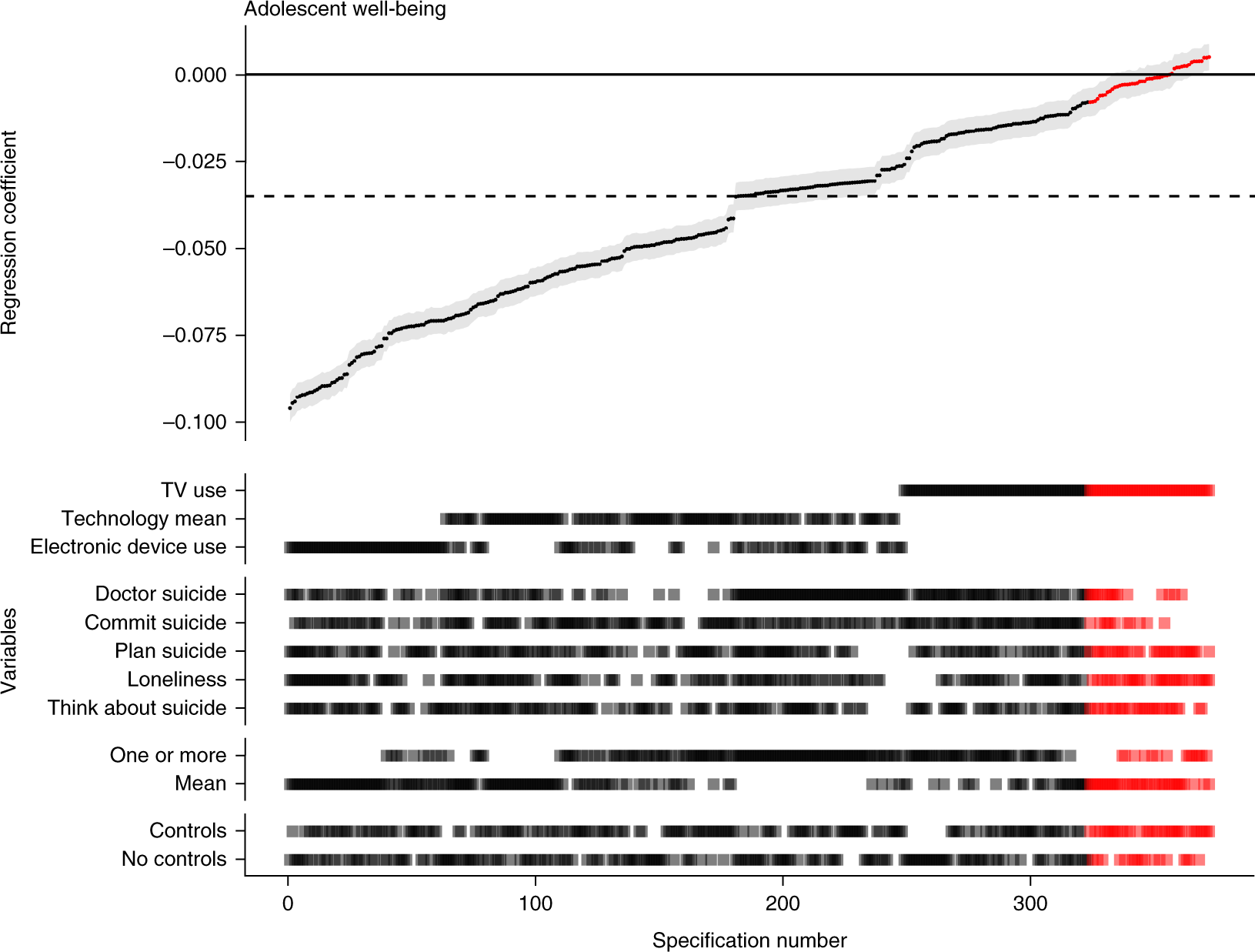
The association between adolescent well-being and digital technology use
The widespread use of digital technologies by young people has spurred speculation that their regular use negatively impacts psychological well-being. Current empirical evidence supporting this idea is largely based on secondary analyses of large-scale social datasets. Though these datasets provide a valuable resource for highly powered investigations, their many variables and observations are often explored with an analytical flexibility that marks small effects as statistically significant, thereby leading to potential false positives and conflicting results. Here we address these methodological challenges by applying specification curve analysis (SCA) across three large-scale social datasets (total n = 355,358) to rigorously examine correlational evidence for the effects of digital technology on adolescents. The association we find between digital technology use and adolescent well-being is negative but small, explaining at most 0.4% of the variation in well-being. Taking the broader context of the data into account suggests that these effects are too small to warrant policy change.
Technopoly: The Surrender of Culture to Technology
A witty, often terrifying that chronicles our transform…

On Getting Old(er) in Tech
After years of scoffing at talk of prejudice in the information technology field -- as a white male with good hair --, I'm starting to call prejudice against my being old(er). It’s true: age discrimination is a real thing.
We used to get excited about technology. What happened?
Innovation that truly serves us all is in scarce supply. That’s a problem.


How tech workers are feeling in 2026: a workforce splitting in two
Results from our second annual tech worker sentiment survey
70 years of AI hype
Quoting from Olivia Guest et al. (2025) "Against the Uncritical Adoption of AI Technologies in Academia."

Lower Artificial Intelligence Literacy Predicts Greater AI Receptivity
As artificial intelligence (AI) transforms society, understanding factors that influence AI receptivity is increasingly important. The current research investigates which types of consumers have greater AI receptivity. Contrary to expectations revealed in four surveys, cross-country data and six additional studies find that people with lower AI literacy are typically more receptive to AI. This lower literacy–greater receptivity link is not explained by differences in perceptions of AI's capability, ethicality, or feared impact on humanity. Instead, this link occurs because people with lower AI literacy are more likely to perceive AI as magical and experience feelings of awe in the face of AI's execution of tasks that seem to require uniquely human attributes. In line with this theorizing, the lower literacy–higher receptivity link is mediated by perceptions of AI as magical and is moderated among tasks not assumed to require distinctly human attributes. These findings suggest that companies may benefit from shifting their marketing efforts and product development toward consumers with lower AI literacy. In addition, efforts to demystify AI may inadvertently reduce its appeal.
Technology is a Siren Song
Orangutan thinking This started with a question I asked myself: How do our minds change when we can receive a plausible, informed, and convincing answe...

Moral Deskilling and Upskilling in a New Machine Age: Reflections on the Ambiguous Future of Character
This paper explores the ambiguous impact of new information and communications technologies (ICTs) on the cultivation of moral skills in human beings. Just as twentieth century advances in machine automation resulted in the economic devaluation of practical knowledge and skillsets historically cultivated by machinists, artisans, and other highly trained workers (Braverman 1974), while also driving the cultivation of new skills in a variety of engineering and white collar occupations, ICTs are also recognized as potential causes of a complex pattern of economic deskilling, reskilling, and upskilling. In this paper, I adapt the conceptual apparatus of sociological debates over economic deskilling to illuminate a different potential for technological deskilling/upskilling, namely the ability of ICTs to contribute to the moral deskilling of human users, a potential that exists alongside rich but currently underrealized possibilities for moral reskilling and/or upskilling. I flesh out this general hypothesis by means of examples involving automated weapons technology, new media practices, and social robotics. I conclude that since moral skills are essential prerequisites for the effective development of practical wisdom and virtuous character, and since market and cultural forces are not presently aligned to bring about the more salutary of the ambiguous potentials presented here, the future shape of these developments warrants our close attention—and perhaps active intervention.

What if technology didn’t feel so… hollow? Some friends and I just released a manifesto about a world where tech leaves us feeling nourished (along with an evolving list of theses about how we can build it) resonantcomputing.org

The Resonant Computing Manifesto
resonantcomputing.org