


The spread of misinformation has emerged as a global concern. Academic attention has recently shifted to emphasize the role of political elites as drivers of mi...
When Do Parties Lie? Misinformation and Radical-Right Populism Across 26 Countries
The spread of misinformation has emerged as a global concern. Academic attention has recently shifted to emphasize the role of political elites as drivers of misinformation. Yet, little is known of the relationship between party politics and the spread of misinformation—in part due to a dearth of cross-national empirical data needed for comparative study. This article examines which parties are more likely to spread misinformation, by drawing on a comprehensive database of 32M tweets from parliamentarians in 26 countries, spanning 6 years and several election periods. The dataset is combined with external databases such as Parlgov and V-Dem, linking the spread of misinformation to detailed information about political parties and cabinets, thus enabling a comparative politics approach to misinformation. Using multilevel analysis with random country intercepts, we find that radical-right populism is the strongest determinant for the propensity to spread misinformation. Populism, left-wing populism, and right-wing politics are not linked to the spread of misinformation. These results suggest that political misinformation should be understood as part and parcel of the current wave of radical right populism, and its opposition to liberal democratic institution.
Media Cues and Citizen Support for Right-Wing Populist Parties
Abstract. Right-wing populist parties are thriving across Europe. Their success is usually attributed to demand-side voter factors and supply-side factors
How to break populist parties’ appeal? An experimental evaluation of communication counter-strategies
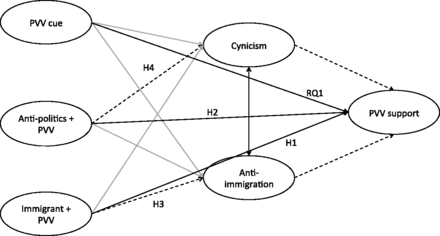
Right-wing populist parties have become a major challenge to liberal democracies worldwide. How can mainstream parties effectively counter their appeal? While prior research has focused on the drivers of populist support, much less is known about how to counter right-wing populist rhetoric. We test four communication counter-strategies that target core elements of right-wing populist appeals: (i) undermining populists’ claims to democratic credibility, (ii) promoting inclusive in-group identity to counter exclusionary narratives, (iii) highlighting their performance legitimacy, and (iv) emphasizing the procedural legitimacy of mainstream parties. Drawing on real-world party communications from social media, manifestos, and press releases, we created 170 experimental treatments (posters and social media posts varying in format and complexity) to simulate how voters encounter political messages in everyday life. In a large-scale survey experiment with over 24,000 respondents in Germany, messages undermining right-wing populists’ democratic credibility prove most effective, particularly among citizens with high initial support for such parties.
The far right is acting as one party. When will we? | Euractiv
Liberal institutions treat each surge of populism as a domestic challenge to be managed within national elections or courts. Meanwhile the far right amplifies each other’s victories, recycles each other’s talking points, and shares disinformation

Legitimize or Delegitimize? Mainstream Party Strategy toward (Former) Pariah Parties and How Voters Respond
Mainstream parties have often shifted from initially portraying new competitors as undemocratic pariahs (i.e., a delegitimizing strategy) to portraying the same parties later as democratic (i.e., a legitimizing strategy). I argue that voters follow mainstream parties’ legitimizing strategies in their legitimacy evaluations of these parties. I investigate this argument with two independent survey experiments and a quantitative media content analysis in two countries that differ sharply in the nature of party competition—from mainstream parties delegitimizing a far-right party (i.e., Germany) to mainstream parties legitimizing it (i.e., Sweden). I find strong evidence that (a) mainstream parties can effectively legitimize pariah parties in the eyes of voters, (b) turning back to delegitimization has little effect, (c) legitimization is no less effective in the face of a third party’s delegitimizing strategy, and (d) legitimization resonates beyond co-partisans. The results suggest that mainstream party legitimization of pariah parties has far-reaching consequences.

Public support for the <i>cordon sanitaire</i> : Descriptive evidence from Spain
Reactions to the rise of far-right parties that advocate democratic backsliding, and the dilution of socially liberal democratic norms present a dilemma for existing political parties. How should existing political parties respond to this challenge? A commonly adopted strategy is to apply a cordon sanitaire which excludes radical right-wing challengers from the government-forming process. Do voters support this policy? Leveraging data from Spain – where the mainstream right has accommodated the radical right-wing party, VOX, via numerous governing coalitions – I rely on individual citizens’ views on how parties should respond to rise of the far-right party, to answer this question. Empirically, the results show very low-level support for the cordon sanitaire in Spain. Indeed, the modal position of the electorate, regardless of their ideological position, is to treat the party just like any other. These results are not conditioned by the propensity of individuals to identify VOX as indeed being a “radical right” party. These descriptive findings suggest that whilst radical right-wing parties may present an inimical threat to democratic norms, citizens do not necessarily view the means of squashing this threat to be one of strategic exclusion. This likely explains why the mainstream right has been able to institutionalise VOX as a political ally: where strategic exclusion is not expected, the mainstream right need not fear violating an expectation that does not exist.
Public support for the <i>cordon sanitaire</i> : Descriptive evidence from Spain
Reactions to the rise of far-right parties that advocate democratic backsliding, and the dilution of socially liberal democratic norms present a dilemma for existing political parties. How should existing political parties respond to this challenge? A commonly adopted strategy is to apply a cordon sanitaire which excludes radical right-wing challengers from the government-forming process. Do voters support this policy? Leveraging data from Spain – where the mainstream right has accommodated the radical right-wing party, VOX, via numerous governing coalitions – I rely on individual citizens’ views on how parties should respond to rise of the far-right party, to answer this question. Empirically, the results show very low-level support for the cordon sanitaire in Spain. Indeed, the modal position of the electorate, regardless of their ideological position, is to treat the party just like any other. These results are not conditioned by the propensity of individuals to identify VOX as indeed being a “radical right” party. These descriptive findings suggest that whilst radical right-wing parties may present an inimical threat to democratic norms, citizens do not necessarily view the means of squashing this threat to be one of strategic exclusion. This likely explains why the mainstream right has been able to institutionalise VOX as a political ally: where strategic exclusion is not expected, the mainstream right need not fear violating an expectation that does not exist.
Anticipating Election Misinformation in the 2026 Midterms
Election misinformation often follows the same pattern every cycle. Here are some of the false and misleading claims that voters are likely to see.

Rising Market Power Has Led to the Rise in Far-Right Political Parties - ProMarket
In new research, Tommaso Crescioli & Toon Van Overbeke find that small business owners and their families who have lost revenue share to rising market concentration among big businesses have turned to far-right political parties to express their grievances.

Facts and Myths about Misperceptions
Misperceptions threaten to warp mass opinion and public policy on controversial issues in politics, science, and health. What explains the prevalence and persistence of these false and unsupported beliefs, which seem to be genuinely held by many people? Though limits on cognitive resources and attention play an important role, many of the most destructive misperceptions arise in domains where individuals have weak incentives to hold accurate beliefs and strong directional motivations to endorse beliefs that are consistent with a group identity such as partisanship. These tendencies are often exploited by elites who frequently create and amplify misperceptions to influence elections and public policy. Though evidence is lacking for claims of a “post-truth” era, changes in the speed with which false information travels and the extent to which it can find receptive audiences require new approaches to counter misinformation. Reducing the propagation and influence of false claims will require further efforts to inoculate people in advance of exposure (for example, media literacy), debunk false claims that are already salient or widespread (for example, fact-checking), reduce the prevalence of low-quality information (for example, changing social media algorithms), and discourage elites from promoting false information (for example, strengthening reputational sanctions).

The Liar’s Dividend: Can Politicians Claim Misinformation to Evade Accountability?
This study addresses the phenomenon of misinformation about misinformation, or politicians "crying wolf"' over fake news. Strategic and false claims that stories are fake news or deepfakes may benefit politicians by helping them maintain support after a scandal. We posit that this benefit, known as the "liar's dividend," may be achieved through two politician strategies: by invoking informational uncertainty or by encouraging oppositional rallying of core supporters. We administer five survey experiments to over 15,000 American adults detailing hypothetical politician responses to stories describing real politician scandals. We find that claims of misinformation representing both strategies raise politician support across partisan subgroups. These strategies are effective against text-based reports of scandals, but are largely ineffective against video evidence and do not reduce general trust in media. Finally, these false claims produce greater dividends for politicians than alternative responses to scandal, such as remaining silent or apologizing.
Persuasion and resistance: A survey experiment on messaging for and against One Nation | School of Politics & International Relations
Since the May 2025 federal election, One Nation's primary vote has risen sharply across published polling. If an election were held today, it would likely be the second-largest bloc in the House of Representatives. What drives this surge — and what, if anything, suppresses it — remains contested, with explanations ranging from economic grievance and cultural backlash to anti-establishment disaffection. While these accounts have been tested experimentally for radical-right parties abroad, they remain largely untested in Australia.
Undermining a Rival Party’s Issue Competence through Negative Campaigning: Experimental Evidence from the USA, Denmark, and Australia
Much party communication encourages voters to lower issue-related evaluations of rival parties. Yet, studies of such influence are rare. Drawing on research on political parties’ negative campaigning, this article starts to fill this gap. We triangulate evidence from four survey experiments across six issues in Denmark, the US, and Australia, and show that a party’s negative campaigning decreases voters’ evaluations of the target party’s issue-handling competence (i.e. issue ownership), but does not backlash on voters’ evaluations of the sponsor. Such attack on the target party does not have to be tied to a negative policy development like the crime rate to undermine the target party’s competence evaluations. At the same time, a negative policy development only undermines a party’s evaluations when it is accompanied by a rival party’s negative campaigning attack. The implications for party competition and the mass-elite linkage are important.
It’s Not Polarization; It’s the Radicalization of the Political Right
Polarization has become the master concept for diagnosing contemporary democratic crises. The notion denotes three features: symmetry between parties, politics as an opinion space where positions diverge, and mutual repulsion between opposing camps. Yet none of these capture current realities. Across democracies, the central dynamic is not two poles drifting apart but the transformation of the political right into authoritarianism, norm breaking, and openness to political violence. Social democratic and center-right parties tend to respond in the opposite way from what “polarization” implies: by accommodating rightward. Attempts to salvage the polarization frame with modifiers (“asymmetric,” “affective,” “sectarian,” “pernicious”) concede these realities but risk hollowing out the concept’s definitional core. These limitations reveal a deeper misdiagnosis: when one party turns antidemocratic and illiberal, incivility and conflict are inevitable—but they are symptoms, not the root problem. Misdiagnosing them as the central issue leads to viewing civility and compromise as remedies, thereby risking the legitimation of authoritarian actors. This article proposes an alternative lens: the radicalization of the political right. Developed in the study of extremism, the radicalization framework better captures asymmetric change, identity-driven politics, and the mainstreaming of illiberalism. It foregrounds identity fusion, threat narratives, elite entrepreneurship, and escalation. Concepts are never politically innocent and persisting with “polarization” risks both misdiagnosing and normalizing authoritarian threats.
It’s Not Polarization; It’s the Radicalization of the Political Right
Polarization has become the master concept for diagnosing contemporary democratic crises. The notion denotes three features: symmetry between parties, politics as an opinion space where positions diverge, and mutual repulsion between opposing camps. Yet none of these capture current realities. Across democracies, the central dynamic is not two poles drifting apart but the transformation of the political right into authoritarianism, norm breaking, and openness to political violence. Social democratic and center-right parties tend to respond in the opposite way from what “polarization” implies: by accommodating rightward. Attempts to salvage the polarization frame with modifiers (“asymmetric,” “affective,” “sectarian,” “pernicious”) concede these realities but risk hollowing out the concept’s definitional core. These limitations reveal a deeper misdiagnosis: when one party turns antidemocratic and illiberal, incivility and conflict are inevitable—but they are symptoms, not the root problem. Misdiagnosing them as the central issue leads to viewing civility and compromise as remedies, thereby risking the legitimation of authoritarian actors. This article proposes an alternative lens: the radicalization of the political right. Developed in the study of extremism, the radicalization framework better captures asymmetric change, identity-driven politics, and the mainstreaming of illiberalism. It foregrounds identity fusion, threat narratives, elite entrepreneurship, and escalation. Concepts are never politically innocent and persisting with “polarization” risks both misdiagnosing and normalizing authoritarian threats.
The Populist Dynamic: Experimental Evidence on the Effects of Countering Populism
We evaluate how traditional parties may respond to populist parties on issues aligning with populist messages. During the 2020 Italian referendum on the reduction of members of Parliament, we conducted a large-scale field experiment, exposing 200 municipalities to nearly a million impressions of programmatic advertisement. Our treatments comprised two video ads against the reform: one debunking populist rhetoric and another attributing blame to populist politicians. This anti-populist campaign proved effective through demobilization, as it reduced both turnout and the votes in favor of the reform. Notably, the effects were more pronounced in municipalities with lower rates of college graduates, higher unemployment, and a history of populist votes. This exogenous influence introduced a unique populist dynamic, observable in the 2022 national election where treated municipalities showed increased support for Brothers of Italy, a rising populist party, and decreased support for both traditional parties and the populists behind the 2020 reform. A follow-up survey further showed increased political interest and diminished trust in political institutions among the residents of municipalities targeted by the campaign.