


I argue that prediction is not primarily a technological means for knowing future outcomes, but a social model for extracting and concentrating discretionary power. Prediction is a ‘relational grammar’ that governs this allocation of discretion: the everyday ability to define one's situation. This extractive dynamic extends a long historical pattern, in which new methods for producing knowledge entail a redistribution of decision-making power. I focus on two contemporary domains: (1) crime and policing are emblematic of how predictive systems are extractive by design, with pre-existing interests governing what is measured and what persistently goes unmeasured. (2) The prediction of productivity demonstrates the long tradition of extracting discretion as a means to extract labour power. Time after time, making human behaviour more predictable for the client of prediction (the manager, the police officer) often means making life and work more unpredictable for the target of prediction (the employee, the urban citizen).
Prediction as extraction of discretion
I argue that prediction is not primarily a technological means for knowing future outcomes, but a social model for extracting and concentrating discretionary power. Prediction is a ‘relational grammar’ that governs this allocation of discretion: the everyday ability to define one's situation. This extractive dynamic extends a long historical pattern, in which new methods for producing knowledge entail a redistribution of decision-making power. I focus on two contemporary domains: (1) crime and policing are emblematic of how predictive systems are extractive by design, with pre-existing interests governing what is measured and what persistently goes unmeasured. (2) The prediction of productivity demonstrates the long tradition of extracting discretion as a means to extract labour power. Time after time, making human behaviour more predictable for the client of prediction (the manager, the police officer) often means making life and work more unpredictable for the target of prediction (the employee, the urban citizen).
Predictive Policing and the Politics of Patterns
Abstract Patterns are the epistemological core of predictive policing. With the move towards digital prediction tools, the authority of the pattern is rearticulated and reinforced in police work. Based on empirical research about predictive policing software and practices, this article puts the authority of patterns into perspective. Introducing four ideal-typical styles of pattern identification, we illustrate that patterns are not based on a singular logic, but on varying rationalities that give form to and formalize different understandings about crime. Yet, patterns render such different modes of reasoning about crime, and the way in which they feed back into policing cultures, opaque. Ultimately, this invites a stronger reflection about the political nature of patterns.

Predictive Policing and the Politics of Patterns
Abstract. Patterns are the epistemological core of predictive policing. With the move towards digital prediction tools, the authority of the pattern is rea
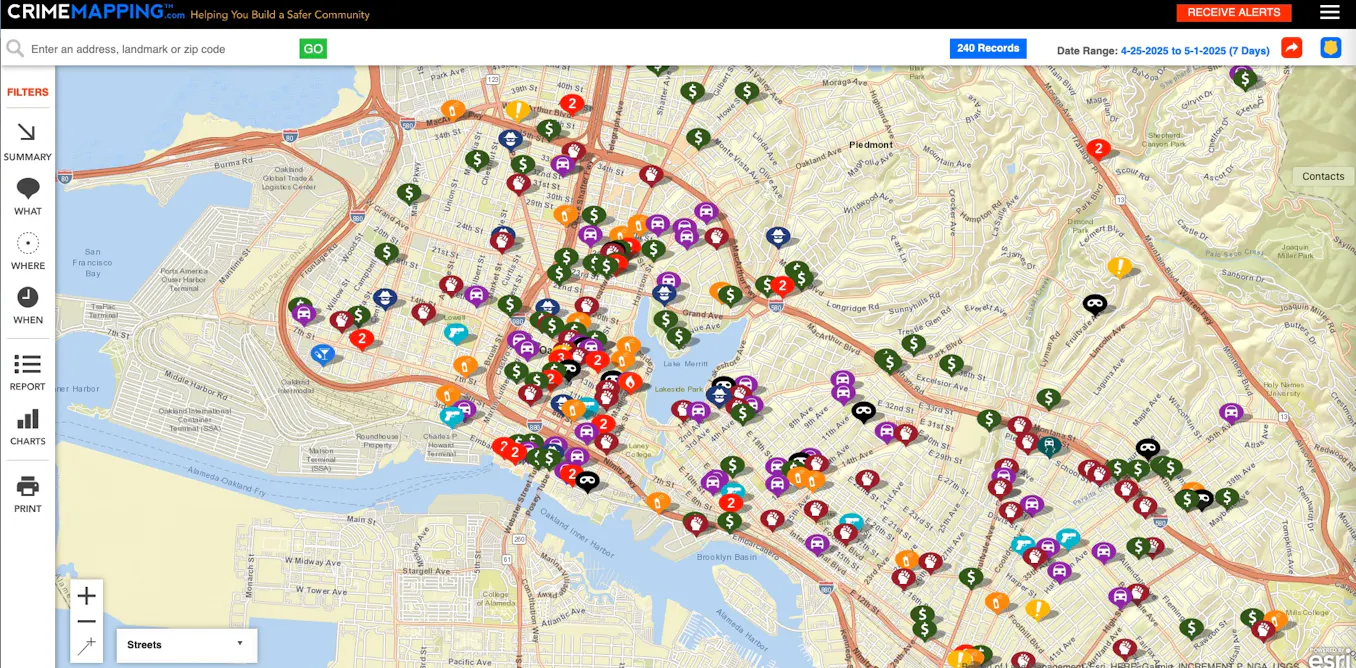
Predictive Policing Explained
Attempts to forecast crime with algorithmic techniques could reinforce existing racial biases in the criminal justice system.

Artificial Intelligence, Predictive Policing, and Risk Assessment for Law Enforcement
There are widespread concerns about the use of artificial intelligence in law enforcement. Predictive policing and risk assessment are salient examples. Worries include the accuracy of forecasts that guide both activities, the prospect of bias, and an apparent lack of operational transparency. Nearly breathless media coverage of artificial intelligence helps shape the narrative. In this review, we address these issues by first unpacking depictions of artificial intelligence. Its use in predictive policing to forecast crimes in time and space is largely an exercise in spatial statistics that in principle can make policing more effective and more surgical. Its use in criminal justice risk assessment to forecast who will commit crimes is largely an exercise in adaptive, nonparametric regression. It can in principle allow law enforcement agencies to better provide for public safety with the least restrictive means necessary, which can mean far less use of incarceration. None of this is mysterious. Nevertheless, concerns about accuracy, fairness, and transparency are real, and there are tradeoffs between them for which there can be no technical fix. You can't have it all. Solutions will be found through political and legislative processes achieving an acceptable balance between competing priorities.
Predictive policing AI is on the rise − making it accountable to the public could curb its harmful effects
AI that anticipates where crimes are likely to occur and who might commit them has a troubling track record. Democratic accountability could shine a light on the technology and how it’s used.
Predictive policing AI is on the rise − making it accountable to the public could curb its harmful effects
AI that anticipates where crimes are likely to occur and who might commit them has a troubling track record. Democratic accountability could shine a light on the technology and how it’s used.
Does Predictive Policing Lead to Biased Arrests? Results From a Randomized Controlled Trial
Racial bias in predictive policing algorithms has been the focus of a number of recent news articles, statements of concern by several national organizations (e.g., the ACLU and NAACP), and simulat...
Does Predictive Policing Lead to Biased Arrests? Results From a Randomized Controlled Trial
Racial bias in predictive policing algorithms has been the focus of a number of recent news articles, statements of concern by several national organizations (e.g., the ACLU and NAACP), and simulat...
What people learn from punishment: A cognitive model
Authorities, from parents of toddlers to leaders of formal institutions, use punishment to communicate disapproval and enforce social norms. Ideally, from whether and how severely a transgression is punished, targets and observers infer shared social norms. Yet in light of every punitive choice, observers also evaluate the motives and legitimacy of the authority. Here, we show that the effects of punishment can only be understood by considering these inferences simultaneously. We measured human observers’ joint inferences empirically in three preregistered experiments ( N = 1 , 254 ) and developed a rational Bayesian model using an inverse planning framework that captures and explains these inferences and their interactions quantitatively and parsimoniously. When people have different priors about norms or authorities, the model predicted and we experimentally confirmed that observing punishment by the authority can sustain polarization. This work reveals the rational logic behind how people learn from punishment and a key constraint on the function of punishment in establishing shared social norms.

Six Rules for Effective Forecasting
Reprint: R0707K The primary goal of forecasting is to identify the full range of possibilities facing a company, society, or the world at large. In this article, Saffo demythologizes the forecasting process to help executives become sophisticated and participative consumers of forecasts, rather than passive absorbers. He illustrates how to use forecasts to at once broaden understanding of possibilities and narrow the decision space within which one must exercise intuition. The events of 9/11, for example, were a much bigger surprise than they should have been. After all, airliners flown into monuments were the stuff of Tom Clancy novels in the 1990s, and everyone knew that terrorists had a very personal antipathy toward the World Trade Center. So why was 9/11 such a surprise? What can executives do to avoid being blindsided by other such wild cards, be they radical shifts in markets or the seemingly sudden emergence of disruptive technologies? In describing what forecasters are trying to achieve, Saffo outlines six simple, commonsense rules that smart managers should observe as they embark on a voyage of discovery with professional forecasters. Map a cone of uncertainty, he advises, look for the S curve, embrace the things that don’t fit, hold strong opinions weakly, look back twice as far as you look forward, and know when not to make a forecast.
[122] Arresting Flexibility: A QJE field experiment on police behavior with about 40 outcome variables
A forthcoming paper in the Quarterly Journal of Economics (QJE), “A Cognitive View of Policing” (htm), reports results from a field experiment showing that teaching police officers to &…

How AI-powered policing is endangering the public’s trust in police
Growing concerns about police use of AI could erode the public’s perception of trust in the legal system.
