


When practitioners used the term “social media” to describe the internet tools that emerged in the mid-aughts, they were giving a name to the kinds of platforms and protocols that allowed people to socialize with friends and communities of interest by using digital technologies. Twenty years later, users of social media are far more likely to scroll than post – and the content that they consume is often strategically produced and algorithmically curated. In this essay, I argue that the very essence of social media has changed. To more effectively interrogate what we are witnessing, we need to stop presuming that these tools are “social media” and begin recognizing that they are now “parasocial media.” Doing so raises new questions about digitally mediated sociality, not to mention the politics and governance of these platforms.
Shifts in U.S. Social Media Use, 2020–2024: Decline, Fragmentation, and Enduring Polarization
The social media ecosystem appears to be in flux. Twitter’s rebranding to X has come to symbolize a broader reorganization of online publics – political reshuffling, user attrition, and uncertainty over the role of legacy platforms. Simultaneously, the shift from text-based, networked feeds toward algorithmically curated, short-form video has accelerated, with TikTok setting the pace for the wider ecosystem [18, 14, 16]. At the same time, everyday communication increasingly migrates from large, open networks to semi-private spaces such as group chats and messaging apps. Commentators describe a digital public sphere in transition: smaller, more fragmented, less dominated by traditional social networking sites, and rise of more broadcast-oriented forms of media – with some even suggesting that we are seeing the beginning of the end of the social media era.
Building A Prosocial Media Ecosystem | NOEMA
There’s never been a better time to make social media what it always should have been: a tool to strengthen rather than strip-mine the social fabric.

Towards a Post-Social Media Studies
For two decades, "social media" has been the master lens through which scholars have understood digital communication—an era defined by user-generated content, networked publics, and participatory culture. That era is drawing to a close. This paper argues that three interrelated dynamics are dissolving the social media paradigm: an algorithmic shift from social-graph-based to interest-based recommendation, which is remaking the active "user" into a passive "viewer"; the generative AI revolution, which is replacing user-generated content with synthetic media and decoupling platforms from any dependence on human participation; and an exodus from public platforms toward private, closed spaces. Together, these dynamics are giving rise to three distinct post-social formations: algorithmically governed broadcasting platforms, semi-private spheres and micro-communities, and AI-mediated communication as a new media form in its own right. Understanding this transformation demands a fundamental reorientation of the field—new conceptual tools that move beyond networked publics and participatory culture, new methods suited to synthetic and ephemeral media environments, and renewed attention to the political stakes of communication systems that no longer require human participation.
Whose Global Village — Ramesh Srinivasan
In the digital age, technology has shrunk the physical world into a “global village,” where we all seem to be connected as an online community as information travels to the farthest reaches of the planet with the click of a mouse. Yet from the US election, to the growth of the alt-right movement, to the Dakota pipeline to the question of ISIS, we also have begun to recognize how incredibly disconnected we are at the same time, occupying various bubbles and self-selected communities.While we think of platforms such as Twitter and Facebook as open and accessible to all, in reality, these are commercial entities developed primarily by and for the Western world. Considering how new technologies increasingly shape labor, economics, and politics, these tools often reinforce the inequalities of globalization, rarely reflecting the perspectives of those at the bottom of the digital divide.
Social Media Should Be Public Infrastructure (with Ben Cerveny)
Custodians of the Internet
A revealing and gripping investigation into how social media platforms police what we post online—and the large societal impact of these decisions Most use...
RIP social media. What comes next is messy.
As social media splinters, how can we keep the new online spaces from devolving into toxic pits of despair?

Social Networking and Ethics
In the 21st century, new media technologies for socialnetworking such as Facebook, Twitter, WhatsApp and YouTube began totransform the social, political and informational practices ofindividuals and institutions across the globe, inviting philosophicalresponses from the community of applied ethicists and philosophers oftechnology. While scholarly responses to social media continue to bechallenged by the rapidly evolving nature of these technologies, theurgent need for attention to the social networking phenomenon isunderscored by the fact that it has profoundly reshaped how many humanbeings initiate and/or maintain virtually every type of ethicallysignificant social bond or role: friend-to-friend, parent-to-child,co-worker-to co-worker, employer-to-employee, teacher-to-student,neighbor-to-neighbor, seller-to-buyer, doctor-to-patient, andvoter-to-voter, to offer just a partial list. Nor are the ethicalimplications of these technologies strictly interpersonal, as it hasbecome evident that social networking services (hereafter referred toas SNS) and other new digital media have profound implications fordemocracy, public institutions and the rule of law. The complex web ofinteractions between SNS developers and users, and their online andoffline communities, corporations and governments—along with thediverse and sometimes conflicting motives and interests of thesevarious stakeholders—will continue to require rigorous ethicalanalysis for decades to come.
Digital gardens let you cultivate your own little bit of the internet
A growing number of people are creating individualized, creative sites that eschew the one-size-fits-all look and feel of social media
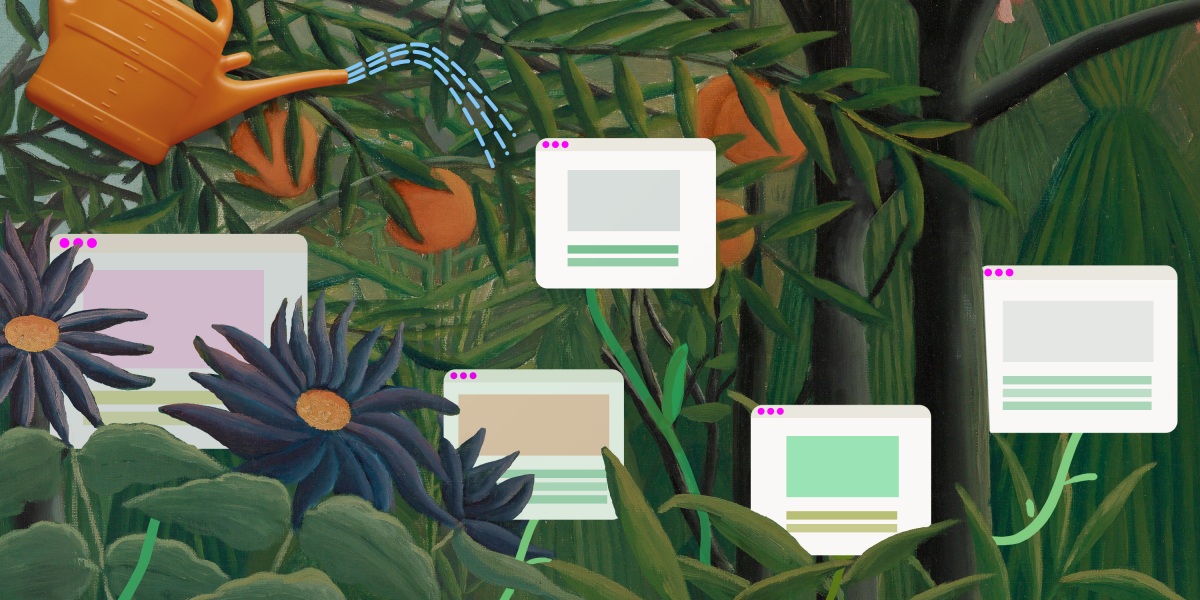
Blue Skies Ahead: Social Media's Quiet User Revolution
In a digital landscape increasingly defined by user concerns over privacy and control, a quiet revolution is taking shape.

Rediscovering the Magic of the Blogosphere, with John O’Nolan and Matthias Pfefferle
Rediscovering the Magic of the Blogosphere, with John O’Nolan and Matthias Pfefferle
Seeing the Politics of Decentralized Social Media Protocols
Calls to decentralize feed-based social media have been driven by concerns about the concentrated power of centralized platforms and their societal impact. In response, numerous decentralized social media protocols have emerged, each interpreting “decentralization” in a different way. We analyze four such protocols (ActivityPub, AT Protocol, Nostr, and Farcaster) drawing on protocol documentation, media coverage, direct usage, and semi-structured interviews with protocol developers and experts to situate each protocol within its socio-technical goals. To support this analysis, we develop a grounded lexicon that facilitates the description and comparison of analogous components across each protocol. With it, we show how each protocol distributes control over key components differently, shaping who holds power over critical aspects such as user identity, curation, and infrastructural ownership. By examining protocols as socio-technical artifacts, we show how they prioritize different values and make distinct trade-offs, providing CSCW researchers with a lens to more effectively evaluate and design future decentralized social media systems.

Empowering Users, Not Overlords: Overcoming Digital Helplessness
Disclosure: I’m on the board of Bluesky, so feel free to take as many grains of salt as you want in reading it, though all of it applies equally to other decentralized social media ecosys…

Social media is no longer social. Most of it is passive viewing of videos and pictures from people we've never met. But we're still studying social media like it's 2010. We've entered the post-social media era — and research needs to catch up. osf.io/preprints/socarxiv/6nue7_v1 preprint w/ Richard Rogers
