


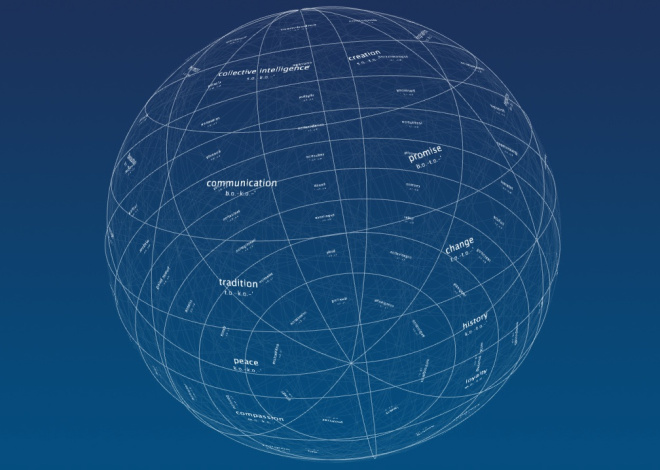
This paper presents IEML, Information Economy MetaLanguage, a constructed language with the same expressive power as a natural language and with computable semantics. Distinguished from pragmatic and referential semantics, linguistic semantics have not yet been completely formalized. Only its syntagmatic dimension has been mathematized in the form of regular languages. Its paradigmatic dimension remained to be formalized. In order to complete the mathematizing of language, including its paradigmatic dimension, I have coded linguistic semantics with IEML. This article introduces its 3000-word dictionary, its formal grammar, and its integrated tools for building semantic graphs. For the future, IEML could become a vector for a fluid calculation and communication of meaning—semantic interoperability—capable of de-compartmentalizing the digital memory, and of advancing the progress of collective intelligence, artificial intelligence, and digital humanities. I conclude by indicating some research directions.
IEML: The Information Economy MetaLanguage
IEML is an acronym for Information Economy MetaLanguage. IEML is intended to become a standard for expressing semantic metadata and for modelling complex human systems. Here is the definitive scien…
Ologs: A Categorical Framework for Knowledge Representation
In this paper we introduce the olog, or ontology log, a category-theoretic model for knowledge representation (KR). Grounded in formal mathematics, ologs can be rigorously formulated and cross-compared in ways that other KR models (such as semantic networks) cannot. An olog is similar to a relational database schema; in fact an olog can serve as a data repository if desired. Unlike database schemas, which are generally difficult to create or modify, ologs are designed to be user-friendly enough that authoring or reconfiguring an olog is a matter of course rather than a difficult chore. It is hoped that learning to author ologs is much simpler than learning a database definition language, despite their similarity. We describe ologs carefully and illustrate with many examples. As an application we show that any primitive recursive function can be described by an olog. We also show that ologs can be aligned or connected together into a larger network using functors. The various methods of information flow and institutions can then be used to integrate local and global world-views. We finish by providing several different avenues for future research.
A Categorical Unification for Multi-Model Data: Part I Categorical Model and Normal Forms
Modern database systems face a significant challenge in effectively handling the Variety of data. The primary objective of this paper is to establish a unified data model and theoretical framework for multi-model data management. To achieve this, we present a categorical framework to unify three types of structured or semi-structured data: relation, XML, and graph-structured data. Utilizing the language of category theory, our framework offers a sound formal abstraction for representing these diverse data types. We extend the Entity-Relationship (ER) diagram with enriched semantic constraints, incorporating categorical ingredients such as pullback, pushout and limit. Furthermore, we develop a categorical normal form theory which is applied to category data to reduce redundancy and facilitate data maintenance. Those normal forms are applicable to relation, XML and graph data simultaneously, thereby eliminating the need for ad-hoc, model-specific definitions as found in separated normal form theories before. Finally, we discuss the connections between this new normal form framework and Boyce-Codd normal form, fourth normal form, and XML normal form.

Specification of graph translators with triple graph grammars
Data integration is a key issue for any integrated set of software tools. A typical CASE environment, for instance, offers tools for the manipulation of requirements and software design documents, and it provides more or less sophisticated assistance for keeping these documents in a consistent state. Up to now, almost all data consistency observing or preserving integration tools are hand-crafted due to the lack of generic implementation frameworks and the absence of adequate specification formalisms. Triple graph grammars are intended to fill this gap and to support the specification of interdependencies between graph-like data structures on a very high level. Furthermore, they are the fundamentals of a new machinery for the production of batch-oriented as well as incrementally working data integration tools.

What Kind of Programming is Natural Language Programming?
In previous posts I’ve written about Natural Language Programming, Dijkstra’s Ghost – the End of The Symbolic Supremacy and Ephemeral Editable Specifications (aka Extract, Edit, A…

OWL - Semantic Web Standards
The W3C Web Ontology Language (OWL) is a Semantic Web language designed to represent rich and complex knowledge about things, groups of things, and relations between things. OWL is a computational logic-based language such that knowledge expressed in OWL can be exploited by computer programs, e.g., to verify the consistency of that knowledge or to make implicit knowledge explicit. OWL documents, known as ontologies, can be published in the World Wide Web and may refer to or be referred from other OWL ontologies. OWL is part of the W3C’s Semantic Web technology stack, which includes RDF, RDFS, SPARQL, etc.
Semantic Web
The Semantic Web, sometimes known as Web 3.0, is an extension of the World Wide Web through standards set by the World Wide Web Consortium (W3C). The goal of the Semantic Web is to make Internet data machine-readable.

Functorial data migration
In this paper we present a simple database definition language: that of categories and functors. A database schema is a small category and an instance is a set-valued functor on it. We show that morphisms of schemas induce three “data migration functors”, which translate instances from one schema to the other in canonical ways. These functors parameterize projections, unions, and joins over all tables simultaneously and can be used in place of conjunctive and disjunctive queries. We also show how to connect a database and a functional programming language by introducing a functorial connection between the schema and the category of types for that language. We begin the paper with a multitude of examples to motivate the definitions, and near the end we provide a dictionary whereby one can translate database concepts into category-theoretic concepts and vice versa.
Coeffects: a calculus of context-dependent computation
The notion of context in functional languages no longer refers just to variables in scope. Context can capture additional properties of variables (usage patterns in linear logics; caching requirements in dataflow languages) as well as additional resources or properties of the execution environment (rebindable resources; platform version in a cross-platform application). The recently introduced notion of coeffects captures the latter, whole-context properties, but it failed to capture fine-grained per-variable properties.We remedy this by developing a generalized coeffect system with annotations indexed by a coeffect shape. By instantiating a concrete shape, our system captures previously studied flat (whole-context) coeffects, but also structural (per-variable) coeffects, making coeffect analyses more useful. We show that the structural system enjoys desirable syntactic properties and we give a categorical semantics using extended notions of indexed comonad.The examples presented in this paper are based on analysis of established language features (liveness, linear logics, dataflow, dynamic scoping) and we argue that such context-aware properties will also be useful for future development of languages for increasingly heterogeneous and distributed platforms.

Stanford CS336 Language Modeling from Scratch I 2025
DevReal: Simple Knowledge Graphs with Outlines, neo4j, and Modal, Cameron Pfiffer
Haystack: A Platform for Authoring End User Semantic Web Applications
The Semantic Web promises to open innumerable opportunities for automation and information retrieval by standardizing the protocols for metadata exchange. However, just as the success of the World Wide Web can be attributed to the ease of use and ubiquity of Web browsers, we believe that the unfolding of the Semantic Web vision depends on users getting powerful but easy-to-use tools for managing their information. But unlike HTML, which can be easily edited in any text editor, RDF is more complicated to author and does not have an obvious presentation mechanism. Previous work has concentrated on the ideas of generic RDF graph visualization and RDF Schema-based form generation. In this paper, we present a comprehensive platform for constructing end user applications that create, manipulate, and visualize arbitrary RDF-encoded information, adding another layer to the abstraction cake. We discuss a programming environment specifically designed for manipulating RDF and introduce user interface concepts on top that allow the developer to quickly assemble applications that are based on RDF data models. Also, because user interface specifications and program logic are themselves describable in RDF, applications built upon our framework enjoy properties such as network updatability, extensibility, and end user customizability – all desirable characteristics in the spirit of the Semantic Web.

Probabilistic compositional semantics, purely
We provide a general framework for the integration of formal semantics with probabilistic reasoning. This framework is conservative, in the sense that it relies only on typed λ-calculus and is thus co
Relational foundations for functorial data migration | Proceedings of the 15th Symposium on Database Programming Languages
In this paper we present a simple database definition language: that of categories and functors. A database schema is a small category and an instance is a set-valued functor on it. We show that morphisms of schemas induce three ''data migration ...
Alex Russell | Web Components and Model Driven Views | Fronteers 2011
There's a lot of tension between today's markup and the semantics we're trying to express in our apps. HTML5 adds a few new types to help describe common cases, but what about when there's no allegory in markup for what you're building? What we need now is infrastructure, not guilt about being "non-semantic". This talk explores new standards-track work in WebKit that's going to enable say-what-you-mean development in completely new ways.
