


Scientists must choose which among many experiments to perform. We study the epistemic success of experimental choice strategies proposed by philosophers of science or executed by scientists themselves. We develop a multi-agent model of the scientific process that jointly formalizes its core aspects: active experimentation, theorizing, and social learning. We find that agents who choose new experiments at random develop the most informative and predictive theories of the world. The agents aiming to confirm, falsify theories, or resolve theoretical disagreements end up with an illusion of epistemic success: they develop promising accounts for the data they collected, while misrepresenting the ground truth that they intended to learn about. Agents experimenting in these theory-motivated ways acquire less diverse or less representative samples from the ground truth that also turn out to be easier to account for. Random data collection, on the other hand, combines virtues of diverse and representative sampling from a target scientific domain which enables cumulative development of the successful theoretical accounts of it. We suggest that randomization, already a gold standard within experiments, is also beneficial at the level of experiments themselves.
Mechanism Experiments and Policy Evaluations
Randomized controlled trials are increasingly used to evaluate policies. How can we make these experiments as useful as possible for policy purposes? We argue greater use should be made of experiments that identify the behavioral mechanisms that are central to clearly specified policy questions, what we call "mechanism experiments." These types of experiments can be of great policy value even if the intervention that is tested (or its setting) does not correspond exactly to any realistic policy option.
Eliciting Beliefs with Random Generation Tasks
Elicitation methods, such as asking people to produce the deciles of a distribution, are standard practices in policy or applied statistics. Similarly, much of cognitive science and psychology focuses on determining people's people's beliefs or latent traits through questionnaires or judgment tasks. However, these approaches often only capture a rough outline of what people know and are usually limited to point estimates of people's beliefs. Here, we present a novel experimental paradigm that allows us to access people's beliefs and how variable these beliefs are. Our task is based on an established random generation paradigm in which participants produce quantities from a particular domain as randomly as possible. We hypothesize that due to the minds' general-purpose mechanisms for probabilistic inferences, these random sequences represent the participants' underlying prior beliefs. We show that our method can infer participants' beliefs for a wide range of numeric quantities at comparable accuracy as an established elicitation method. Moreover, these inferred beliefs are consistent with individual participants' generalization and inference patterns in a subsequent conditional prediction task. We then extend our approach to non-numeric belief elicitation, highlighting how our method can go beyond numeric elicitation and provide insight into complex beliefs that are challenging to assess experimentally. Empirically, our results highlight that people know the rough shapes of environmental distributions, and these beliefs guide inference and generalization. Moreover, using our novel approach, we also show that people know the fine details of environmental distributions. Finally, our experimental results show that random generation paradigms can be a useful tool for cognitive scientists, psychologists, and applied statisticians.
Training AI Scientists to Replicate Research
The replicability of papers is a cornerstone of scientific knowledge, ensuring the reliability of existing results and providing a base for further experiments. The act of replication typically illuminates details that were previously underspecified, and thus requires similar hypothesis-driven exploration to open-ended research. In this work, we develop Replica, a scalable task space for paper replication. To provide reward signal, we introduce an auto-generated rubric-based judge that has low noise and agrees with human assessment of replication quality. We post-train Faraday, a 27B-parameter "AI Scientist" agent that leverages coding agents as tools, surpassing the performance of Claude Opus 4.8 and GPT-5.5 on held-out replication tasks. Qualitative analysis of individual rollouts reveals that Faraday adopts a more scientifically-principled approach. We believe that our results provide a stepping stone towards AI agents capable of long-horizon scientific innovation without requiring complex harnesses.

Underspecified Human Decision Experiments Considered Harmful
Decision-making with information displays is a key focus of research in areas like human-AI collaboration and data visualization. However, what constitutes a decision problem, and what is required for an experiment to conclude that decisions are flawed, remain imprecise. We present a widely applicable definition of a decision problem synthesized from statistical decision theory and information economics. We claim that to attribute loss in human performance to bias, an experiment must provide the information that a rational agent would need to identify the normative decision. We evaluate whether recent empirical research on AI-assisted decisions achieves this standard. We find that only 10 (26%) of 39 studies that claim to identify biased behavior presented participants with sufficient information to make this claim in at least one treatment condition. We motivate the value of studying well-defined decision problems by describing a characterization of performance losses they allow to be conceived.

Verification in the Age of AI Scientists
AI Scientists now operate at a scale that outpaces human capacity for manual review. Systems such as Sakana’s AI Scientist write entire workshop papers end-to-end. Lila Sciences runs autonomous ``AI Science Factories’’ that hypothesize, experiment, and iterate without human guidance. FutureHouse’s Kosmos and Robin generate thousands of candidate hypotheses in a single run, and Google’s Co-Scientist proposes testable experiments at a rate no laboratory can fully evaluate. Each of these systems emphasizes verified results, yet that standard ranges from near-perfect formal proof in mathematics to decade-long clinical trials in medicine, with no shared framework for judging sufficiency across domains. As outputs scale beyond what humans can manually inspect, the question of which results to trust becomes as hard as generating them. The bottleneck for AI for Science is no longer hypothesis generation, it is verification.
Philosophy Experiments — Interactive Thought Experiments
Explore 27 interactive philosophy experiments that challenge your moral intuitions, test your logical reasoning, and probe the boundaries of belief.
A Rational Analysis of the Effects of Sycophantic AI
People increasingly use large language models (LLMs) to explore ideas, gather information, and make sense of the world. In these interactions, they encounter agents that are overly agreeable. We argue that this sycophancy poses a unique epistemic risk to how individuals come to see the world: unlike hallucinations that introduce falsehoods, sycophancy distorts reality by returning responses that are biased to reinforce existing beliefs. We provide a rational analysis of this phenomenon, showing that when a Bayesian agent is provided with data that are sampled based on a current hypothesis the agent becomes increasingly confident about that hypothesis but does not make any progress towards the truth. We test this prediction using a modified Wason 2-4-6 rule discovery task where participants (N=557) interacted with AI agents providing different types of feedback. Unmodified LLM behavior suppressed discovery and inflated confidence comparably to explicitly sycophantic prompting. By contrast, unbiased sampling from the true distribution yielded discovery rates five times higher. These results reveal how sycophantic AI distorts belief, manufacturing certainty where there should be doubt.
EurekaBench: Measuring Agentic Ability to Discover New Scientific Insights
When Isaac Newton discovered the law of gravitation, he did so through an iterative process of analyzing observed data such as planetary patterns, finding the underlying mechanisms by describing patterns in mathematical equations, and refining his theory against the Moon's orbit, revealing the startling insight that the same force governs both falling apples and orbiting planets. Would it be possible for AI agents to make similar discoveries? To measure this ability, we introduce EurekaBench, a cross-domain benchmark that tests AI agents' ability to conduct long-horizon experiments and discover mechanisms that explain observations. We evaluate these mechanisms by the scientific insights that can be derived from them. EurekaBench contains an expert-verified set of 26 long-horizon tasks across neuroscience, computer science, chemistry, astrophysics, geophysics, and plasma physics, with a total of 306 scientific insights that the discovered mechanisms are expected to support. Our evaluation framework tests three axes of scientific discovery: agents' ability to follow known scientific constraints, the predictive accuracy of the discovered mechanisms, and whether these mechanisms yield scientific insights or inform future research. Our results show that current AI agents often overly fixate on predictive accuracy optimization, surpassing human scientists, while falling substantially short in deriving scientific insights.
AI Research Agents Narrow Scientific Exploration
AI research agents now support large-scale AI-assisted scientific discovery. We examine whether AI-generated ideas broaden scientific exploration or primarily reinforce existing work. Using five agent frameworks and five large language models, we generate 219,655 ideas for different scientific fields. Across experiments, four consistent patterns emerge. First, AI-generated ideas are more concentrated than human-authored papers within the same research area. Second, they remain much closer to starting literature than later human follow-on work does. Third, AI-generated ideas align less with future human research. Last, AI-generated ideas are located in lower-impact regions of the historical scientific landscape. Overall, current AI research agents appear better suited to local elaboration than to broadening scientific exploration.
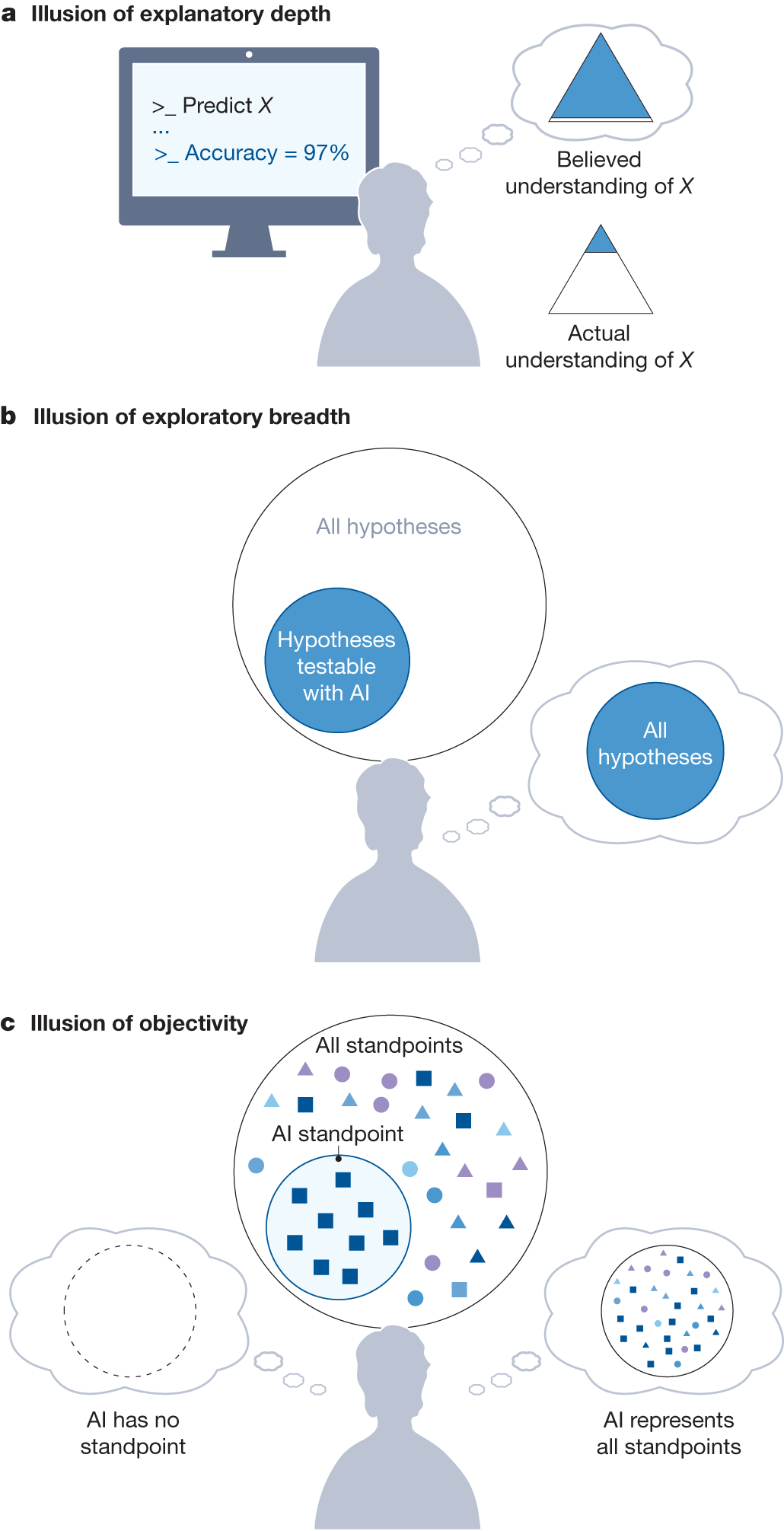
Artificial intelligence and illusions of understanding in scientific research
Scientists are enthusiastically imagining ways in which artificial intelligence (AI) tools might improve research. Why are AI tools so attractive and what are the risks of implementing them across the research pipeline? Here we develop a taxonomy of scientists’ visions for AI, observing that their appeal comes from promises to improve productivity and objectivity by overcoming human shortcomings. But proposed AI solutions can also exploit our cognitive limitations, making us vulnerable to illusions of understanding in which we believe we understand more about the world than we actually do. Such illusions obscure the scientific community’s ability to see the formation of scientific monocultures, in which some types of methods, questions and viewpoints come to dominate alternative approaches, making science less innovative and more vulnerable to errors. The proliferation of AI tools in science risks introducing a phase of scientific enquiry in which we produce more but understand less. By analysing the appeal of these tools, we provide a framework for advancing discussions of responsible knowledge production in the age of AI.
Publication bias in the social sciences: Unlocking the file drawer
The file drawer is full. Should we worry? Experiments that produce null results face a higher barrier to publication than those that yield statistically significant differences. Whether this is a problem depends on how many null but otherwise valid results might be trapped in the file drawer. Franco et al. use a Time-sharing Experiments in the Social Sciences archive of nearly 250 peer-reviewed proposals of social science experiments conducted on nationally representative samples. They find that only 10 out of 48 null results were published, whereas 56 out of 91 studies with strongly significant results made it into a journal. Science , this issue p. 1502 , Fully half of peer-reviewed and implemented social science experiments are not published. , We studied publication bias in the social sciences by analyzing a known population of conducted studies—221 in total—in which there is a full accounting of what is published and unpublished. We leveraged Time-sharing Experiments in the Social Sciences (TESS), a National Science Foundation–sponsored program in which researchers propose survey-based experiments to be run on representative samples of American adults. Because TESS proposals undergo rigorous peer review, the studies in the sample all exceed a substantial quality threshold. Strong results are 40 percentage points more likely to be published than are null results and 60 percentage points more likely to be written up. We provide direct evidence of publication bias and identify the stage of research production at which publication bias occurs: Authors do not write up and submit null findings.

The High Cost of Not Doing Experiments - Behavioral Scientist
We can pay dearly, in blood, treasure, and well-being, for experiments that aren’t done. -Richard Nisbett, Mindware

Illusions of Understanding in the Sciences
Scientists seek to understand the causes of observed phenomena. Beliefs that they have succeeded are based on understanding that is rarely or possibly never complete, and varies in depth and quality. Most often scientists believe they understand more than they do, making their belief an illusion. This illusion then persists in explanations scientists provide in print, in talks, or in discussions. The illusion that a scientist has a valid and complete explanation tends to be magnified when the data are well described by mathematical and computer simulation models due to the precision of such models and their ability to predict well; prediction does not imply causality, but gives the illusion that it does. The first part of this essay supports the case for the universality of partial and incomplete levels of understanding by showing the difficulty of reaching a deep level of understanding for even a simple analysis and model that most scientists use and believe they understand: linear regression. The second part highlights some implications of the existence of many levels of understanding and explanation, and their use by scientists for design, testing, analysis, and theory development. It discusses the way that deduction and induction depend on the levels of understanding and the implications of the illusion that a scientist’s understanding is deep. It makes a case that the many incomplete levels of understanding affect, often unwittingly, the ways scientists design experiments, test theories, comprehend, communicate, and teach.

Social learning preserves both useful and useless theories by canalizing learners’ exploration
In many domains, learning from others is crucial for leveraging cumulative cultural knowledge, which encapsulates the efforts of successive generations of innovators. However, anecdotal and experimental evidence suggests that reliance on social information can reduce the exploration of the problem space. Here, we experimentally investigate the extent to which cultural transmission fosters the persistence of arbitrary solutions in a context where participants are incentivized to improve a physical system across multiple trials. Participants were exposed to various theories about the system, ranging from accurate to misleading. Our findings indicate that even under conditions conducive to exploration, the transmission of cultural knowledge canalizes learners’ focus, limiting their consideration of alternative solutions. This effect was observed in both the theories produced and the solutions attempted by participants, irrespective of the accuracy of the provided theories. These results challenge the notion that arbitrary solutions persist only when they are efficient or intuitive and underscore the significant role of cultural transmission in shaping human knowledge and technologies.

Can AI Agents Synthesize Scientific Conclusions?
Scientific AI agents increasingly retrieve evidence, reason across sources, and synthesize conclusions used in consequential decisions. Yet, their ability to do so in high-stakes domains such as health remains unclear. We introduce SciConBench, a large-scale live benchmark of 9.11K questions and expert-written conclusions from systematic reviews to evaluate open-domain scientific conclusion synthesis. The benchmark draws on an expert-validated automated evaluation pipeline that decomposes conclusions into atomic facts and measures correctness and comprehensiveness via factual precision and recall. To mitigate data leakage, we further introduce SciConHarness, a clean-room evaluation harness that equips agents with controlled web interaction to ensure valid measurement. Evaluating 8 frontier models and deep research agents, we find that factual quality remains low: under clean-room settings, the best agent achieves only a factual F1 of 0.337. Our clean-room setting consistently reduces performance relative to unconstrained evaluation, suggesting that leakage inflates estimates of models' true synthesis capabilities. Finally, we audit consumer-facing agents (e.g., Google AI Overview, OpenEvidence) and find they frequently generate incomplete and sometimes contradictory conclusions, even when the ground-truth answer is available. Overall, our results show that reliable synthesis of scientific conclusions remains an open challenge, and that clean-room evaluation is essential for assessing open-domain AI agents.
In Praise of Moderation: Suggestions for the Scope and Use of Pre-Analysis Plans for RCTs in Economics
Pre-Analysis Plans (PAPs) for randomized evaluations are becoming increasingly common in Economics, but their definition remains unclear and their practical applications therefore vary widely. Based on our collective experiences as researchers and editors, we articulate a set of principles for the ex-ante scope and ex-post use of PAPs. We argue that the key benefits of a PAP can usually be realized by completing the registration fields in the AEA RCT Registry. Specific cases where more detail may be warranted include when subgroup analysis is expected to be particularly important, or a party to the study has a vested interest. However, a strong norm for more detailed pre-specification can be detrimental to knowledge creation when implementing field experiments in the real world. An ex-post requirement of strict adherence to pre-specified plans, or the discounting of non-pre-specified work, may mean that some experiments do not take place, or that interesting observations and new theories are not explored and reported. Rather, we recommend that the final research paper be written and judged as a distinct object from the “results of the PAP”; to emphasize this distinction, researchers could consider producing a short, publicly available report (the “populated PAP”) that populates the PAP to the extent possible and briefly discusses any barriers to doing so.
