


This article proposes collective free music improvisation (CFMI) pedagogical strategies that support the development of twenty-first-century competencies (21CCs) among young, diverse learners. It highlights the educational benefits of integrating CFMI into music learning and outlines three key pedagogical dimensions that facilitate CFMI: socio-musical interaction, personal musical vocabulary, and shared understanding. Drawing on authentic classroom examples, the article illustrates how these dimensions can be developed to meaningfully engage learners in CFMI and foster core 21CCs—particularly communication, collaboration, and inventive thinking. These insights offer practical guidance for educators aiming to implement CFMI with similarly profiled student populations.
Creativity through Recomposition in the Music Ensemble
Musical creativity is an essential component of a robust music education. There are many ways to invite and develop the creative capacities of K–12 music students. In this article, we propose the idea that recomposing within and around repertoire can be a creative starting point for student composition in an ensemble music classroom. We share examples of potential recomposition projects, questions to prompt student reflection, and other pedagogical considerations as a springboard for compositional projects with students. We hope that the open-ended nature of this mindset will encourage more creative musical spaces.
Intersections in Music Education: Implications of Universal Design for Learning, Culturally Responsive Education, and Trauma-Informed Education for P–12 Praxis
To increase equity in music education, teachers can strive to know each student as a whole child, proactively remove barriers to learning, and seek to honor students’ multifaceted and intersectional identities. In this article, we first define intersectionality and examine demographics in music education. Then, we summarize three asset-based pedagogical approaches (Universal Design for Learning, Culturally Responsive Education, and Trauma-Informed Education) and synthesize their similarities. Finally, we present implications in the form of generative ideas for music educator praxis, or values-guided action. We hope our suggestions help music educators create music experiences where students (and families) feel seen, safe, welcomed, and valued as musicians and people. We also hope our suggestions can contribute to music teacher collegiality and collaboration by providing educators with tools to develop positive relationships with colleagues who are different from themselves.
Teaching Improvisation in Choir: Moving from “Recreative” to “Creative” Choral Artistry
This article describes a research study in which a collegiate choral ensemble learned vocal improvisation techniques as part of their regular rehearsals. While learning to improvise, singers had the opportunity to provide real-time feedback of their perceptions and experiences learning a new skill in a traditional choral setting. In this article, we share what we learned, including the rewards and challenges of teaching improvisation, our reflections as instructors, and perspectives from some of the singers. We also describe the activities we tried and offer strategies for other choir teachers who want to bring improvisation into their own classrooms.
Improvisation in Ensembles: Conduction - #ImaginingPossibilities
How might we support creativity in large ensembles? What if students could co-create music with a conductor without staff notation or written music altogether? Perhaps novel in K-12 settings, ensemble-based improvisation exists in diverse musical cultures. What might we learn from conduction, a sophisticated gestural system that Butch Morris developed to facilitate improvisation and creation […]

Student-Centered Music Education - #ImaginingPossibilities
Many music educators speak about student-centered or learner-centered music programs, but what do these terms mean? What is a student-centered ensemble or a learner-centered music class? These resources will support you in fostering and facilitating learner-centered music programs! (Some of the resources below are affiliate links – see the affiliate policy language here if you […]
“I Made Myself Fit In”: Johny’s Story
The purpose of this narrative inquiry was to re-story the experiences of a first-year music teacher with regard to race and class. Johny was a first-year high school guitar teacher in the southwestern United States who identified as Hispanic and was raised in a family with a lower income. He was also a first-generation college student whose path to university study was atypical because of his major instrument, musical background, little high school music class participation, and entrance to postsecondary music study at a community college. Johny’s story is a work of critical storytelling and is interpreted through an intersectional framework. His story compels us to thoughtfully attend to curriculum, musical knowledge, equity, and how music educators can serve an increasingly diverse student population in schools of music. Issues for consideration include (a) increased support of nontraditional students, including those from marginalized populations, such as students with lower incomes, first-generation students, and community college transfer students, and (b) promoting meaningful and collaborative change across multiple areas in schools of music.
Global mindset and music education: a comparison of curriculum documents in the United States and Spain
Over the past several decades, educational policymakers around the world have made changes based on three competencies they believe students will need to be successful in an increasingly globalized...

REIMAGINING INCLUSIVE MUSIC EDUCATION: REFLECTIONS FROM A BLACK MUSIC EDUCATOR - ProQuest
Explore millions of resources from scholarly journals, books, newspapers, videos and more, on the ProQuest Platform.
Toward an Anti-Racist Music Education: A Critical Pedagogy of Popular Music Teacher Education
In this article, we propose a framework for a critical pedagogy of popular music for teacher education to better prepare music teachers to enact anti-racist praxis within their classrooms. Although a growing body of literature in music education addresses issues of racism within the field, fewer scholars have studied this within teacher education. Drawing from critical pedagogy, our framework centers popular music as a means for music teacher educators to interrogate issues of identity and power and (re)contextualize pedagogy, considering the socio-political contexts and communities from which music practices originate. These processes facilitate reflection on how racisms shape taken-for-granted practices within music education by centering the socio-political contexts of popular music. Through our framework, music teacher educators could prompt pre-service music educators to consider the multiple racialized epistemologies of musical value students and teachers bring to the classroom, working toward the possibility of enacting a multicentric approach to music education.
Music educators’ perceptions of divisive concepts laws
Since the inception of widespread public schooling in the United States, state legislatures have mandated curricular content and instructional practices to advance various social projects and visio...
Music educators’ perceptions of divisive concepts laws
Since the inception of widespread public schooling in the United States, state legislatures have mandated curricular content and instructional practices to advance various social projects and visio...
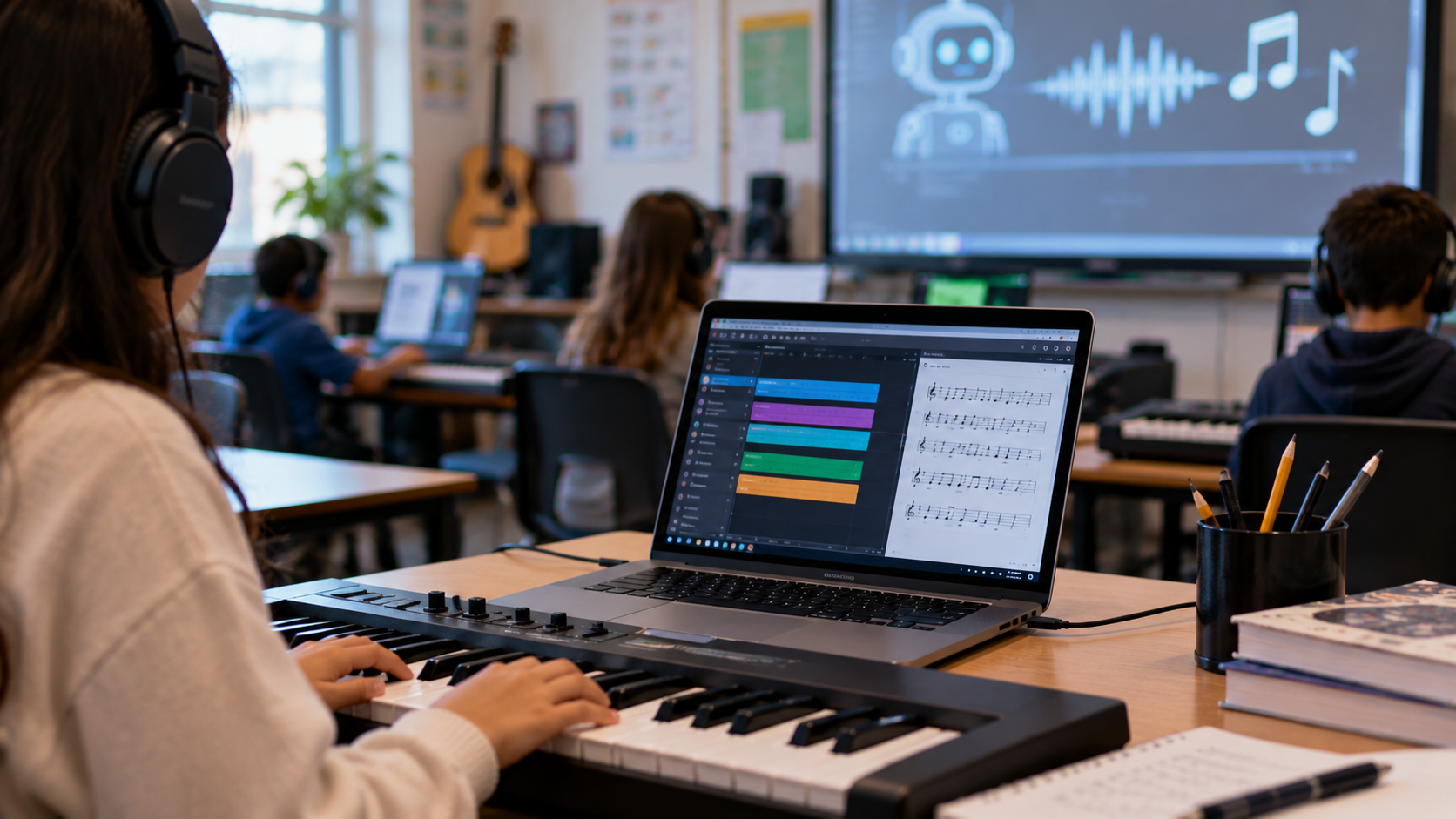
Artificial Intelligence in Music Classrooms: PK-12 Educators’ Practices, Concerns, and Confidence
Abstract In this descriptive survey study, we explore PK-12 music educators’ perceptions of AI, their current practices, confidence, concerns, and the types of support they need to utilize AI within their music programs. Fifty-four music educators from elementary, middle, and high school settings in Indiana completed an online survey. Quantitative survey responses such as demographic […]
Where is <i>Mi Gente</i> ? Codeswitching (Afro)Latinidad in the music classroom
Musical codeswitching (CS) entails mixing musical ideas and genres. The term CS originated in linguistics, based on language alternations attested in bilinguals. Switches in sociocultural behaviors also now receive scholarly attention as CS. The current multiple case study explores CS domains (music, language, and behavior) in the context of music education programs, where CS remains under-researched. This study also fills a gap by examining historically underrepresented individuals’ (HURIs) participation in music education. Here, a CS-based account provides a deeper understanding of the complex sociocultural capital, linguistic resources and lived experiences that HURIs navigate. As part of an interpretive qualitative study design, semi-structured interviews were carried out with a HURI subpopulation (bilingual, [Afro]Latina/o/x faculty, and students) in music education. Findings show participants perceive CS to be mandatory for accessing dominant U.S. music school culture. Additional findings reveal HURIs must master CS in musical, linguistic, and behavioral domains to avoid negative outcomes, yet sustained multi-CS scenarios may have psychological and even physical costs. Insights from CS are thus critical for pinpointing institutional barriers to greater HURI involvement in music education.
Divining an Afrofuturist Music Education – ACT
Published in Action, Criticism, and Theory for Music Education 22 (4): 131–58. [pdf] https://doi.org/10.22176/act22.4.131
Black Music, White Halls: Toward a Black American Music Curriculum – ACT
Published in Action, Criticism, and Theory for Music Education 25 (1): 52–76 [pdf]. https://doi.org/10.22176/act25.1.52
Supporting Creativity in Ensembles

Resources, research, and ideas for music educators to support student creativity in ensembles such as band, choir, and orchestra.
Improvising in Ensembles (by Etobias-musiced) — Semble
Creating (composing) in Ensembles (by Etobias-musiced) — Semble