Much party communication encourages voters to lower issue-related evaluations of rival parties. Yet, studies of such influence are rare. Drawing on research on political parties’ negative campaigning, this article starts to fill this gap. We triangulate evidence from four survey experiments across six issues in Denmark, the US, and Australia, and show that a party’s negative campaigning decreases voters’ evaluations of the target party’s issue-handling competence (i.e. issue ownership), but does not backlash on voters’ evaluations of the sponsor. Such attack on the target party does not have to be tied to a negative policy development like the crime rate to undermine the target party’s competence evaluations. At the same time, a negative policy development only undermines a party’s evaluations when it is accompanied by a rival party’s negative campaigning attack. The implications for party competition and the mass-elite linkage are important.
Legitimize or Delegitimize? Mainstream Party Strategy toward (Former) Pariah Parties and How Voters Respond
Mainstream parties have often shifted from initially portraying new competitors as undemocratic pariahs (i.e., a delegitimizing strategy) to portraying the same parties later as democratic (i.e., a legitimizing strategy). I argue that voters follow mainstream parties’ legitimizing strategies in their legitimacy evaluations of these parties. I investigate this argument with two independent survey experiments and a quantitative media content analysis in two countries that differ sharply in the nature of party competition—from mainstream parties delegitimizing a far-right party (i.e., Germany) to mainstream parties legitimizing it (i.e., Sweden). I find strong evidence that (a) mainstream parties can effectively legitimize pariah parties in the eyes of voters, (b) turning back to delegitimization has little effect, (c) legitimization is no less effective in the face of a third party’s delegitimizing strategy, and (d) legitimization resonates beyond co-partisans. The results suggest that mainstream party legitimization of pariah parties has far-reaching consequences.
The Minimal Persuasive Effects of Campaign Contact in General Elections: Evidence from 49 Field Experiments
Significant theories of democratic accountability hinge on how political campaigns affect Americans’ candidate choices. We argue that the best estimate of the effects of campaign contact and advertising on Americans’ candidates choices in general elections is zero. First, a systematic meta-analysis of 40 field experiments estimates an average effect of zero in general elections. Second, we present nine original field experiments that increase the statistical evidence in the literature about the persuasive effects of personal contact tenfold. These experiments’ average effect is also zero. In both existing and our original experiments, persuasive effects only appear to emerge in two rare circumstances. First, when candidates take unusually unpopular positions and campaigns invest unusually heavily in identifying persuadable voters. Second, when campaigns contact voters long before election day and measure effects immediately—although this early persuasion decays. These findings contribute to ongoing debates about how political elites influence citizens’ judgments.
Persuasion and resistance: A survey experiment on messaging for and against One Nation | School of Politics & International Relations
Since the May 2025 federal election, One Nation's primary vote has risen sharply across published polling. If an election were held today, it would likely be the second-largest bloc in the House of Representatives. What drives this surge — and what, if anything, suppresses it — remains contested, with explanations ranging from economic grievance and cultural backlash to anti-establishment disaffection. While these accounts have been tested experimentally for radical-right parties abroad, they remain largely untested in Australia.
The small effects of political advertising are small regardless of context, message, sender, or receiver: Evidence from 59 real-time randomized experiments
Campaign persuasion operates with notable consistency across political parties, message tone, and information environment., Evidence across social science indicates that average effects of persuasive messages are small. One commonly offered explanation for these small effects is heterogeneity: Persuasion may only work well in specific circumstances. To evaluate heterogeneity, we repeated an experiment weekly in real time using 2016 U.S. presidential election campaign advertisements. We tested 49 political advertisements in 59 unique experiments on 34,000 people. We investigate heterogeneous effects by sender (candidates or groups), receiver (subject partisanship), content (attack or promotional), and context (battleground versus non-battleground, primary versus general election, and early versus late). We find small average effects on candidate favorability and vote. These small effects, however, do not mask substantial heterogeneity even where theory from political science suggests that we should find it. During the primary and general election, in battleground states, for Democrats, Republicans, and Independents, effects are similarly small. Heterogeneity with large offsetting effects is not the source of small average effects.

How to break populist parties’ appeal? An experimental evaluation of communication counter-strategies
Right-wing populist parties have become a major challenge to liberal democracies worldwide. How can mainstream parties effectively counter their appeal? While prior research has focused on the drivers of populist support, much less is known about how to counter right-wing populist rhetoric. We test four communication counter-strategies that target core elements of right-wing populist appeals: (i) undermining populists’ claims to democratic credibility, (ii) promoting inclusive in-group identity to counter exclusionary narratives, (iii) highlighting their performance legitimacy, and (iv) emphasizing the procedural legitimacy of mainstream parties. Drawing on real-world party communications from social media, manifestos, and press releases, we created 170 experimental treatments (posters and social media posts varying in format and complexity) to simulate how voters encounter political messages in everyday life. In a large-scale survey experiment with over 24,000 respondents in Germany, messages undermining right-wing populists’ democratic credibility prove most effective, particularly among citizens with high initial support for such parties.
Mainstreaming the populist radical right? Online news exposure and voting behavior in the 2019 European Parliament election
How does media exposure relate to support for radical right populist parties (RRPPs)? We contribute to this classic debate by analyzing the web browsing histories and survey responses of six thousand study participants in France, Germany, Italy, Spain, and the UK during the 2019 European Parliament election. Linking direct measures of online news exposure to voting behavior allows us to assess the effects of the salience of issues politicized by RRPPs on their electoral support. The likelihood to vote for RRPPs was higher when the EU was more salient in individual media diets, while exposure to the less salient issue of immigration did not increase the propensity to vote for RRPPs. Alongside consistent results for other party families and interactions with pre-existing voting intentions, the findings indicate that the electoral effects of online media are contingent on the overall salience of a specific issue and voters’ predispositions.

Partidismo negativo, derecha radical y voto: un análisis de su relación en el contexto de las elecciones generales españolas de 2023
Although the concept of partisan identification included a positive and a negative dimension as postulated by the Michigan model, the truth is that the latter dimension has received practically no attention. The present research aims to evaluate to what extent negative partisanship currently represents an explanatory factor of electoral behavior in Spain. Specifically, we study how, in the context of the Spanish general elections of July 2023, negative partisanship towards the radical right increased the probability of voting for the PSOE and whether, in turn, the rejection generated by the PSOE also promoted support for Vox. To test these hypotheses, we use data from the III National Survey of Political Polarization in Spain, elaborated by the Murcian Centre for Public Opinion Studies (CEMOP) in the middle of the election campaign. The results of the binary logistic regression models implemented show that negative partisanship towards the radical right represents a (novel) explanatory factor of the vote for the PSOE, but that Vox did not feed significantly on the rejection of the socialists —nor even of Sumar—.We also note the exceptional capacity of the radical right to arouse processes of negative identification, especially among women.
When Do Parties Lie? Misinformation and Radical-Right Populism Across 26 Countries
The spread of misinformation has emerged as a global concern. Academic attention has recently shifted to emphasize the role of political elites as drivers of misinformation. Yet, little is known of the relationship between party politics and the spread of misinformation—in part due to a dearth of cross-national empirical data needed for comparative study. This article examines which parties are more likely to spread misinformation, by drawing on a comprehensive database of 32M tweets from parliamentarians in 26 countries, spanning 6 years and several election periods. The dataset is combined with external databases such as Parlgov and V-Dem, linking the spread of misinformation to detailed information about political parties and cabinets, thus enabling a comparative politics approach to misinformation. Using multilevel analysis with random country intercepts, we find that radical-right populism is the strongest determinant for the propensity to spread misinformation. Populism, left-wing populism, and right-wing politics are not linked to the spread of misinformation. These results suggest that political misinformation should be understood as part and parcel of the current wave of radical right populism, and its opposition to liberal democratic institution.
The Populist Dynamic: Experimental Evidence on the Effects of Countering Populism
We evaluate how traditional parties may respond to populist parties on issues aligning with populist messages. During the 2020 Italian referendum on the reduction of members of Parliament, we conducted a large-scale field experiment, exposing 200 municipalities to nearly a million impressions of programmatic advertisement. Our treatments comprised two video ads against the reform: one debunking populist rhetoric and another attributing blame to populist politicians. This anti-populist campaign proved effective through demobilization, as it reduced both turnout and the votes in favor of the reform. Notably, the effects were more pronounced in municipalities with lower rates of college graduates, higher unemployment, and a history of populist votes. This exogenous influence introduced a unique populist dynamic, observable in the 2022 national election where treated municipalities showed increased support for Brothers of Italy, a rising populist party, and decreased support for both traditional parties and the populists behind the 2020 reform. A follow-up survey further showed increased political interest and diminished trust in political institutions among the residents of municipalities targeted by the campaign.
Media Cues and Citizen Support for Right-Wing Populist Parties
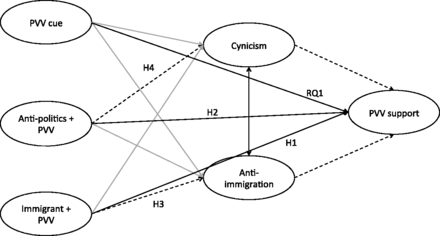
Abstract. Right-wing populist parties are thriving across Europe. Their success is usually attributed to demand-side voter factors and supply-side factors
When Do Parties Lie? Misinformation and Radical-Right Populism Across 26 Countries - Petter Törnberg, Juliana Chueri, 2026
The spread of misinformation has emerged as a global concern. Academic attention has recently shifted to emphasize the role of political elites as drivers of mi...
Why Are American Presidential Election Campaign Polls so Variable When Votes Are so Predictable?
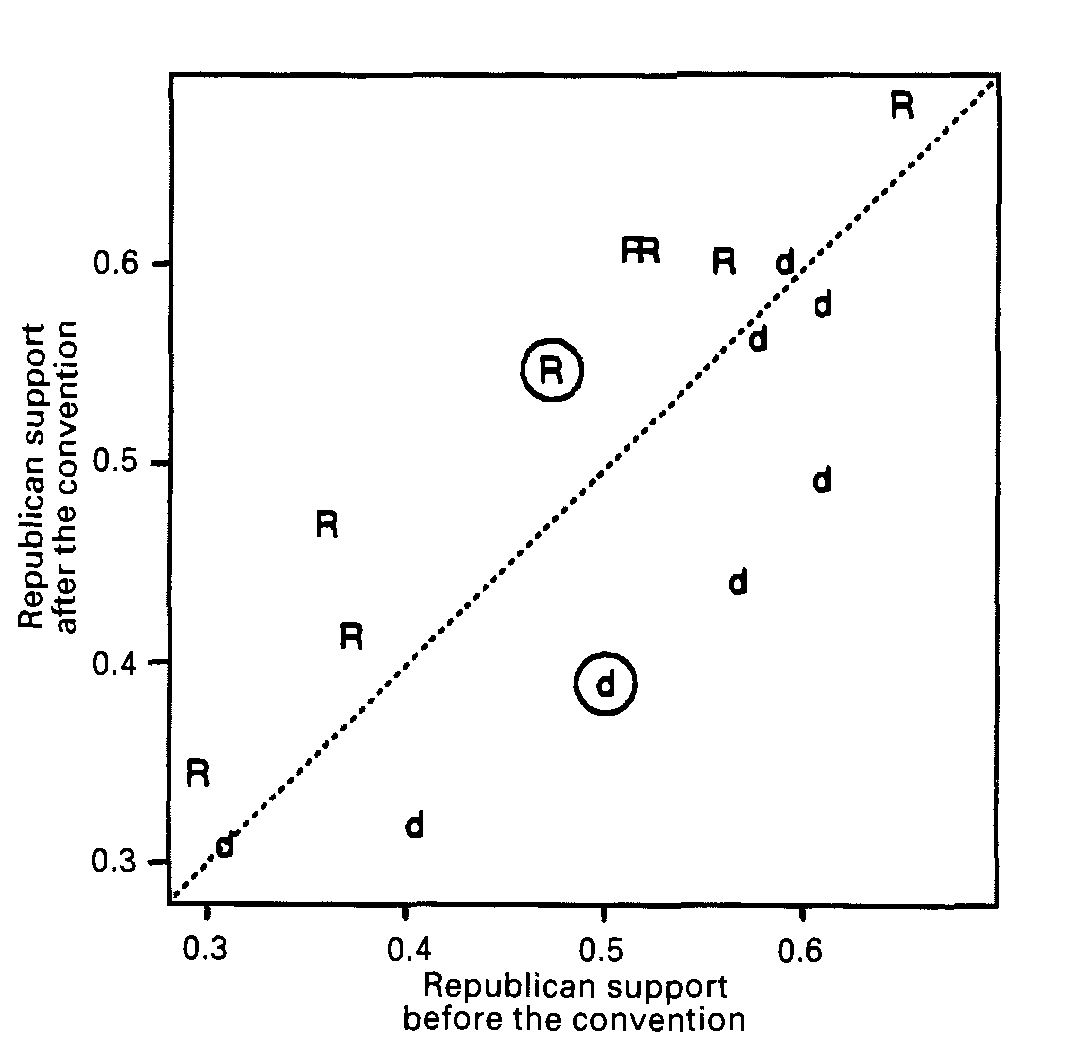
As most political scientists know, the outcome of the U.S. Presidential election can be predicted within a few percentage points (in the popular vote), based on information available months before the election. Thus, the general election campaign for president seems irrelevant to the outcome (except in very close elections), despite all the media coverage of campaign strategy. However, it is also well known that the pre-election opinion polls can vary wildly over the campaign, and this variation is generally attributed to events in the campaign. How can campaign events affect people's opinions on whom they plan to vote for, and yet not affect the outcome of the election? For that matter, why do voters consistently increase their support for a candidate during his nominating convention, even though the conventions are almost entirely predictable events whose effects can be rationally forecast? In this exploratory study, we consider several intuitively appealing, but ultimately wrong, resolutions to this puzzle, and discuss our current understanding of what causes opinion polls to fluctuate and yet reach a predictable outcome. Our evidence is based on graphical presentation and analysis of over 67,000 individual-level responses from forty-nine commercial polls during the 1988 campaign and many other aggregate poll results from the 1952–1992 campaigns. We show that responses to pollsters during the campaign are not generally informed or even, in a sense we describe, "rational." In contrast, voters decide which candidate to eventually support based on their enlightened preferences, as formed by the information they have learned during the campaign, as well as basic political cues such as ideology and party identification. We cannot prove this conclusion, but we do show that it is consistent with the aggregate forecasts and individual-level opinion poll responses. Based on the enlightened preferences hypothesis, we conclude that the news media have an important effect on the outcome of Presidential elections–-not due to misleading advertisements, sound bites, or spin doctors, but rather by conveying candidates' positions on important issues. Winner of the Pi Sigma Alpha Awardfor the best paper at the previous year's meetings of the Midwest Political Science Association. Replication data at the Harvard Dataverse: [https://doi.org/10.7910/DVN/I7GIKD](https://doi.org/10.7910/DVN/I7GIKD).
Political Bias Audits of LLMs Capture Sycophancy to the Inferred Auditor
Large language models (LLMs) are commonly evaluated for political bias based on their responses to fixed questionnaires, which typically place frontier models on the political left. A parallel literature shows that LLMs are sycophantic: they adapt their answers to the views, identities, and expectations of the user. We show that these findings are linked: standard political-bias audits partly capture sycophantic accommodation to the inferred auditor. We employ a factorial experiment across three major audit instruments--the Political Compass Test, the Pew Political Typology, and 1,540 partisan-benchmarked Pew American Trends Panel items--administered to six frontier LLMs while varying only the asker's stated identity (N = 30,990 responses). At baseline, all six models lean left. When the asker identifies as a conservative Republican, responses shift sharply: the share of items closer to Democrats falls by 28-62 percentage points, and all six models move right of center. A mirror-image progressive-Democrat cue produces little change; rightward accommodation is 8.0$\times$ larger than leftward. When asked who the default asker is, models identify an auditor, researcher, or academic; when asked what answer that asker expects, they select the Democrat-coded option 75% of the time, nearly the rate under an explicit progressive cue. These patterns are inconsistent with a purely fixed model ideology and indicate that single-prompt audits capture an interaction between model and inferred interlocutor. Political bias in LLMs is therefore not a fixed point on an ideological scale but a response profile that must be mapped across realistic interlocutors.

Public support for the <i>cordon sanitaire</i> : Descriptive evidence from Spain
Reactions to the rise of far-right parties that advocate democratic backsliding, and the dilution of socially liberal democratic norms present a dilemma for existing political parties. How should existing political parties respond to this challenge? A commonly adopted strategy is to apply a cordon sanitaire which excludes radical right-wing challengers from the government-forming process. Do voters support this policy? Leveraging data from Spain – where the mainstream right has accommodated the radical right-wing party, VOX, via numerous governing coalitions – I rely on individual citizens’ views on how parties should respond to rise of the far-right party, to answer this question. Empirically, the results show very low-level support for the cordon sanitaire in Spain. Indeed, the modal position of the electorate, regardless of their ideological position, is to treat the party just like any other. These results are not conditioned by the propensity of individuals to identify VOX as indeed being a “radical right” party. These descriptive findings suggest that whilst radical right-wing parties may present an inimical threat to democratic norms, citizens do not necessarily view the means of squashing this threat to be one of strategic exclusion. This likely explains why the mainstream right has been able to institutionalise VOX as a political ally: where strategic exclusion is not expected, the mainstream right need not fear violating an expectation that does not exist.
Election polling errors across time and space
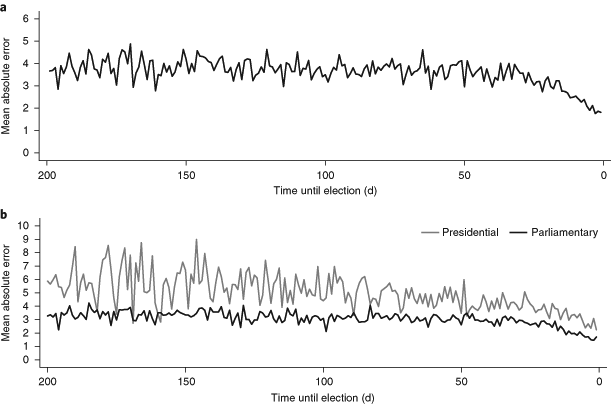
Are election polling misses becoming more prevalent? Are they more likely in some contexts than others? Here we undertake an over-time and cross-national assessment of prediction errors in pre-election polls. Our analysis draws on more than 30,000 national polls from 351 general elections in 45 countries between 1942 and 2017. We proceed in the following way. First, building on previous studies, we show how errors in national polls evolve in a structured way over the election timeline. Second, we examine errors in polls in the final week of the election campaign to assess performance across election years. Third, we undertake a pooled analysis of polling errors—controlling for a number of institutional and party features—that enables us to test whether poll errors have increased or decreased over time. We find that, contrary to conventional wisdom, the recent performance of polls has not been outside the ordinary. However, the performance of polls does vary across political contexts and in understandable ways.