Media use varies between persons (person-specific variation) and within persons (situation-specific variation, that is, the same individual uses media different...
No effect of different types of media on well-being
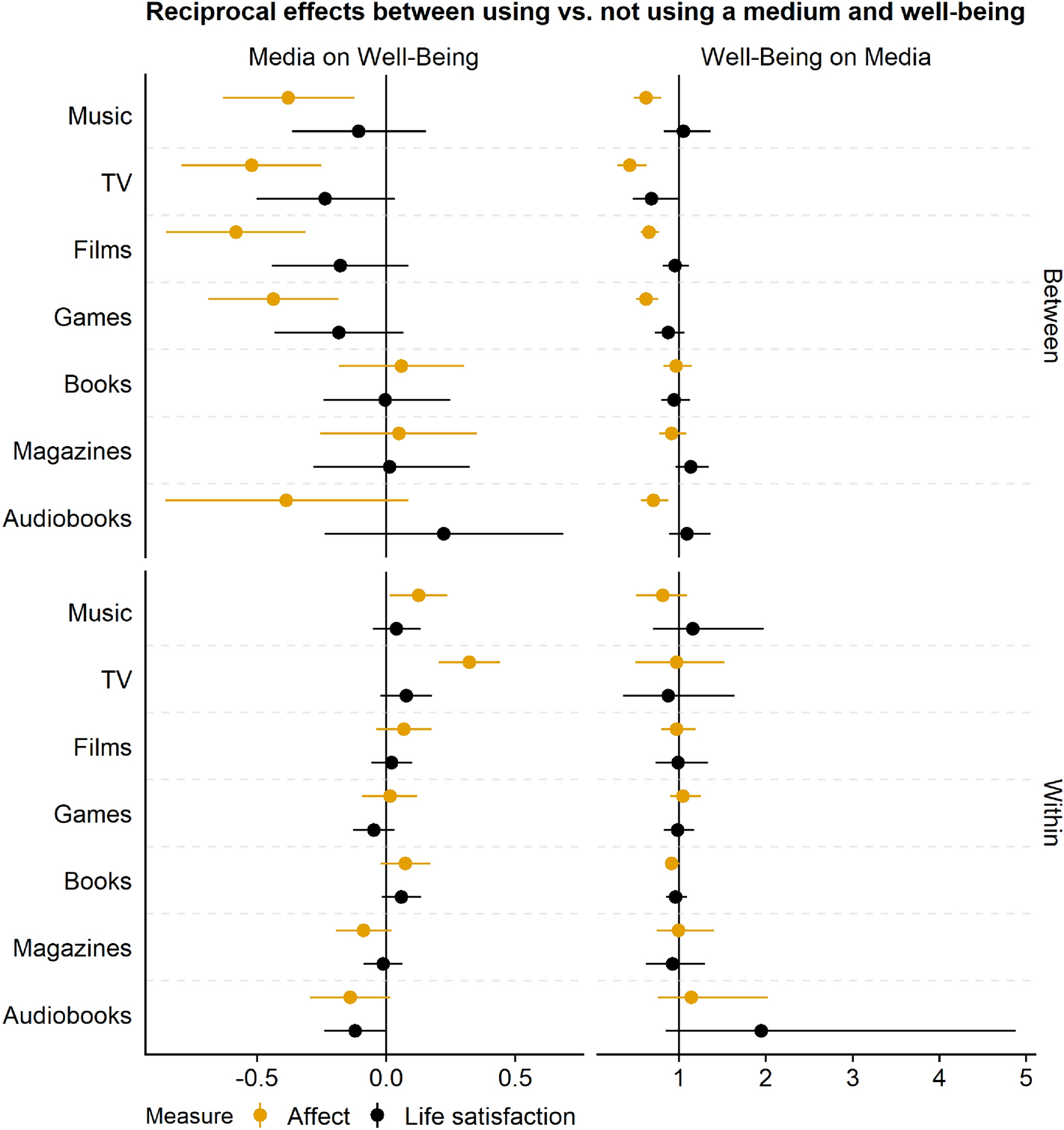
It is often assumed that traditional forms of media such as books enhance well-being, whereas new media do not. However, we lack evidence for such claims and media research is mainly focused on how much time people spend with a medium, but not whether someone used a medium or not. We explored the effect of media use during one week on well-being at the end of the week, differentiating time spent with a medium and use versus nonuse, over a wide range of different media types: music, TV, films, video games, (e-)books, (digital) magazines, and audiobooks. Results from a six-week longitudinal study representative of the UK population 16 years and older (N = 2159) showed that effects were generally small; between-person relations but rarely within-person effects; mostly for use versus nonuse and not time spent with a medium; and on affective well-being, not life satisfaction.
Objective, subjective, and accurate reporting of social media use: No evidence that daily social media use correlates with personality traits, motivational states, or well-being.
No Sense of Place: The Impact of Electronic Media on Social Behavior
Introduction: Behavior in Its PlacePart I--Media as Change Mechanisms Media and Behavior: A Missing LinkMedia, Situations, and BehaviorWhy Roles Change When Media ChangePart II--From Print Situations to Electronic Situations The Merging of Public SpheresThe Blurring of Public and Private BehaviorsThe Separation of Social Place from Physical PlacePart III--The New Social Landscape New Group IdentitiesNew Ways of BecomingQuestioning AuthorityEffect LoopsPart IV--Three Dimensions of Social Change The Merging of Masculinity and FemininityThe Blurring of Childhood and AdulthoodLowering the Politica

Metamedia
The term metamedia, coined by Alan Kay and Adele Goldberg, refers to new relationships between form and content in the development of new technologies and new media.[1]
No Sense of Place: The Impact of Electronic Media on Social Behavior
Electronic media present us with a collage of experiences from everyplace. We eat dinner at home while watching starving children thousands of miles away reach out to us for food. From our easy chairs, we stare at blindfolded hostages, and coolly

how do you a call a person who is interacting with digital media ?
We use tools from computer science, media design, and digital art to study massive cultural data sets. Directed by Dr. Lev Manovich.
Computer-Mediated Communication, Social Media, and Mental Health: A Conceptual and Empirical Meta-Review
Computer-mediated communication (CMC), and specifically social media, may affect the mental health (MH) and well-being of its users, for better or worse. Research on this topic has accumulated rapidly, accompanied by controversial public debate and numerous systematic reviews and meta-analyses. Yet, a higher-level integration of the multiple disparate conceptual and operational approaches to CMC and MH and individual review findings is desperately needed. To this end, we first develop two organizing frameworks that systematize conceptual and operational approaches to CMC and MH. Based on these frameworks, we integrate the literature through a meta-review of 34 reviews and a content analysis of 594 publications. Meta-analytic evidence, overall, suggests a small negative association between social media use and MH. However, effects are complex and depend on the CMC and MH indicators investigated. Based on our conceptual review and the evidence synthesis, we devise an agenda for future research in this interdisciplinary field.
The Internet's Meaning Crisis
Parasocial media is a response to excessive irrelevance

Social Media and Depression Symptoms: a Meta-Analysis
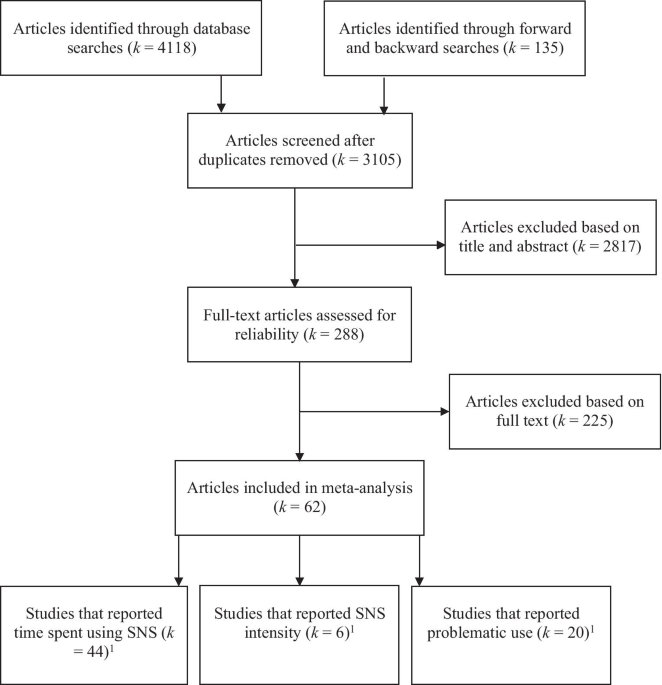
Social Networking Sites (SNS) have close to 3 billion users worldwide. Recently, however, SNS have come under media scrutiny for their potential association with depression. Two previous meta-analyses failed to find evidence for a robust concurrent association between SNS use and depression symptoms. However, these analyses focused primarily on the time spent using SNS. The current meta-analysis is the first to consider the multi-dimensional nature of SNS use, and examines separately the quantitative associations of depression symptoms to SNS use in three types of SNS studies examining three distinct constructs of SNS use: time spent using SNS, intensity of SNS use, and problematic SNS use. Sixty-two studies (N = 451, 229) met inclusion criteria. Depression symptoms were significantly, but weakly, associated with time spent using SNS (r = 0.11) and intensity of SNS use (r = 0.09). However, the association of depression symptoms to problematic SNS use was moderate (r = 0.29), was significantly higher than for time spent using SNS (Qbetween = 35.85, p < 0.001) or intensity of SNS use (Qbetween = 13.95, p < 0.001), and was not significantly moderated by age, gender, year of study publication, or mode of recruitment. These results suggest that future research examining causal models of the relation of SNS use and depression, as well as research on intervention and prevention, should focus in more detail on individuals who are engaging in a pattern of problematic SNS use.
Do social media experiments prove a link with mental health: A methodological and meta-analytic review.
Cognitive Load and Social Media Advertising
Social media engagement requires cognitive resources, which subsequently impact the advertisements consumers see while browsing. For the most part, however, advertising practitioners and scholars s...

Tetrad of media effects
Marshall McLuhan's tetrad of media effects uses a tetrad - a four-part construct - to examine the effects on society of any technology/medium by dividing its effects into four categories and displaying them simultaneously. The tetrad first appeared in print in articles by McLuhan in the journals Technology and Culture (1975) and et cetera (1977). It first appeared in book form in his posthumously-published works Laws of Media (1988) and The Global Village (1989).

A Statistical Interrogation of “The Case for Causality, Part 1” by Rausch and Haidt – Matthew B. Jané
I don’t know anything about the literature on social media and mental health so my focus on this post is to interrogate the statistical approach taken by the article written by Zach Rausch and Jonathon Haidt (link here) and to some extent the original meta-analysis by Ferguson.

Taming the endless scroll? Short-form videos, digital routines and neurocognitive outcomes in youth
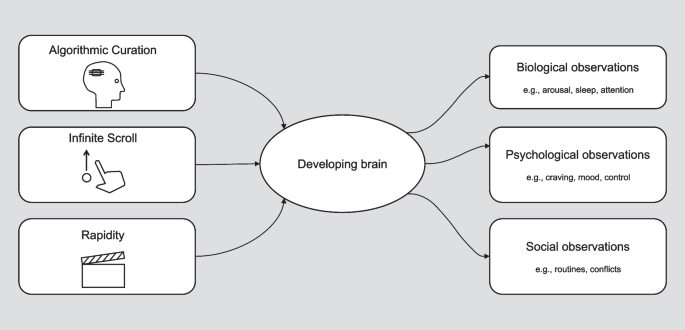
Short-form videos (SFVs) deliver digital content in a way that sets them apart from other media. Concerns have arisen that such user interfaces may diminish attention, memory and emotional wellbeing in young people, yet evidence has not previously been synthesised for this demographic and in isolation from other media types. To assess the association between exposure to SFV-interfaces and neurocognitive outcomes in individuals aged $$\varvec{\le 25}$$years, and to appraise the certainty of this evidence. Following PRISMA and Cochrane guidelines, four databases (PubMed, PsycINFO, WoS, Cochrane Reviews) were searched (2015–2025). Of 1,498 records, 42 studies (N = 46,912; mean age = 16.8) met the PICOS criteria. Most were cross-sectional (88%), with two longitudinal, one EEG, and one MRI study. Risk of bias and quality were evaluated using GRADE. Heavy, unstructured SFV use (typically $$\varvec{\ge 4}$$h/day) was consistently associated with: small-to-moderate increases in inattention ($$\varvec{\beta \approx 0.30}$$) and impulsivity ($$\varvec{\beta \approx 0.25}$$); moderate reductions in working-memory span ($$\varvec{\beta \approx -0.75}$$) and self-regulation ($$\varvec{\beta \approx -0.45}$$); moderate elevations in anxiety ($$\varvec{\beta \approx 0.35}$$), depression ($$\varvec{\beta \approx 0.48}$$) and stress ($$\varvec{\beta \approx 0.32}$$); and a moderate-to-large surge in addiction symptoms ($$\varvec{\beta \approx 0.60}$$). Two cross-sectional imaging studies also reported associations between heavier short-video use and neurobiological measures. These included grey-matter volume differences in the orbitofrontal cortex and cerebellum, altered resting-state signal synchrony, and reduced P300 amplitudes. Protective factors included supportive environments, digital routines, and digital literacy. Consistent, albeit preliminary, evidence links excessive SFV watching to cognitive and emotional challenges in youth. Longitudinal and experimental studies are urgently needed, alongside trials of modifiable levers to reduce addiction-like use and related harms.
The Impact of Internet and Social Media Use on Well-Being: A Longitudinal Analysis of Adolescents Across Nine Years
Abstract The present research examines the longitudinal average impact of frequency of use of Internet and social networking sites (SNS) on subjective well-being of adolescents in Germany. Based on five-wave panel data that cover a period of nine years, we disentangle between-person and within-person effects of media use on depressive symptomatology and life satisfaction as indicators of subjective well-being. Additionally, we control for confounders such as TV use, self-esteem, and satisfaction with friends. We found that frequency of Internet use in general and use of SNS in particular is not substantially related subjective well-being. The explanatory power of general Internet use or SNS use to predict between-person differences or within-person change in subjective well-being is close to zero. TV use, a potentially confounding variable, is negatively related to satisfaction with life, but it does not affect depressive symptomatology. However, this effect is too small to be of practical relevance.