

Reorienting distribution and monetization in the attention economy.
Exploring the Frontier of Feeds - The Open Garden
Reorienting distribution and monetization in the attention economy.
Rethinking the cognitive foundations of the attention economy
The attention economy is the economic system in which human attention is the scarce resource. This literature takes a particular passage in Herbert Simon’s seminal Chapter Designing Organization fo...

About The Other Night... - Graze Newsletter
How Graze is defining the next era of a decentralized, open social attention economy.
The Feed is the Product: Why We Stay in Walled Gardens, and Why We Might Finally Leave for the Open Social Web - Zsolt's pckt blog
We have known this for years. We have known that the major platforms are bad for our attention, our sleep, our politics, our children, and our sense of reality....
Serving the For You Feed - AT Protocol
How the maintainer of the popular For You feed serves it from their living room!

INVESTING IN REGENERATIVE AGRICULTURE AND FOOD
THE INVESTING IN REGENERATIVE AGRICULTURE AND FOOD PODCASTThrough 400+ interviews with farmers, investors, scientists, and entrepreneurs, the podcast puts the spotlight on the pioneers in the regenerative food and agriculture space to learn more on how to put our money to work to regenerate soil, people, local communities and ecosystems while making an appropriate and fair return.
An attention economic perspective on the future of the information age
In this paper, we apply an attention economic perspective to explain current and predict future trends in our society. We first describe the rise of the attention economy, and we highlight one important mechanism of this economy: a spiral of attention scarcity. Second, we show that an attention economic perspective provides glimpses of a potential future. In particular, we predict an information environment that increasingly targets citizens with attention-grabbing content, form, and technology; a continuing trend toward excessive media consumption levels; and a continuing trend toward inattentive uses of information. We also predict increasing problems of public misinformation and misconceptions; an increased prevalence of certain mental and physical health issues; and an increased reliance on technology to perform mental tasks. At the end of this paper, we show why and how despite these predictions, alternative futures are conceivable. These alternatives largely depend on the behavior of various social actors. We discuss resistance to the attention economy by consumers and producers, a laissez-faire policy toward the attention economy, a policy of taxing attention-seeking efforts, and the promotion of public values in regulatory policies toward the internet.
The attention market—and what is wrong with it
Attention is described as a “scarce commodity” that is traded in “a marketplace.” This, it is further claimed, contributes to a “widespread sense of attentional crisis.” But is there really an attention market, and if so, what, if anything, is wrong with it? We defend the claim that there are markets in attention. We provide an account of such attention markets and use that account to address what is morally wrong with them. Our account draws on knowledge of how attention works and what roles it plays in the mind. The attention market trades in an ability to influence our attention – somewhat (though not exactly) like the labor market trades in an ability to influence how we use our capacity for work. Specifically, the commodity it trades in is attentional landscaping potential, viz. the ability to systematically influence patterns of attention by changes to the sensory environment individuals are exposed to. Attention markets thus, we argue, commodify influence over a human capacity that plays a central role in shaping individual experience, agency, and belief formation. This feature of attention markets makes them ethically problematic. As markets in access to external influence, attention markets pose a special threat to individual autonomy and escape the classical liberal defense of free markets. Those who value autonomy should worry about the attention markets that exist today.


Revisiting evidence for an attentional tunneling effect caused by scarcity
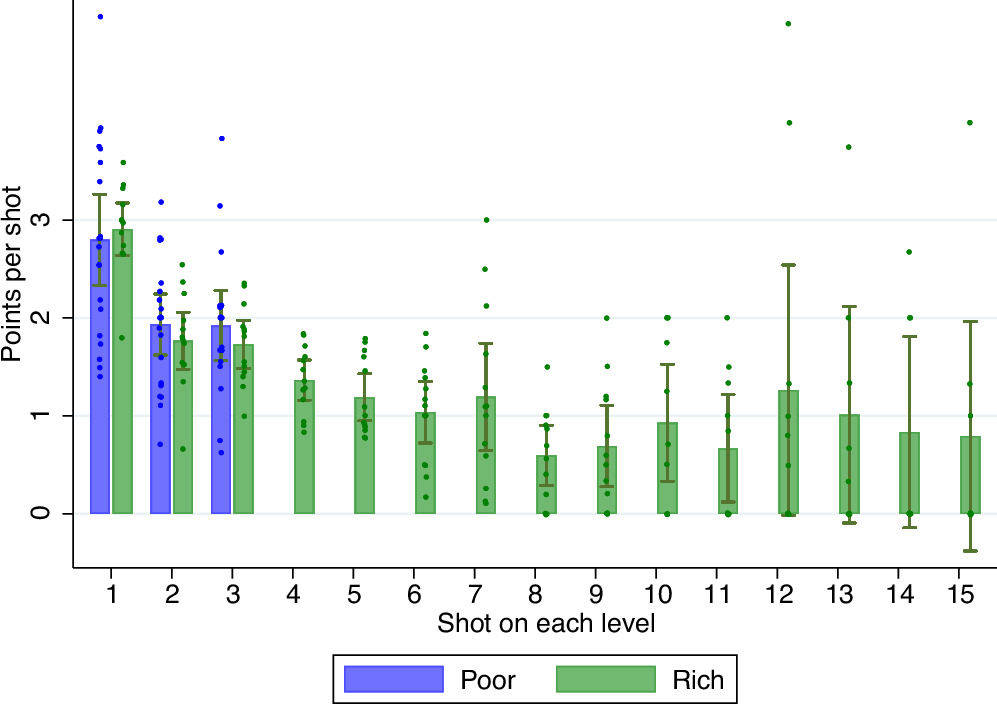
People in poverty sometimes behave in ways that perpetuate their socioeconomic condition. By one influential account, these behaviors arise from psychological effects of scarcity on attention that create greater focus toward managing scarce resources, at the cost of attention to potentially-beneficial information outside of this ‘tunnel’. Although the tunneling hypothesis has been widely discussed in academia and beyond, its direct empirical support derives primarily from a landmark study by Shah et al. (2012) in which participants played games while their access to resources was experimentally manipulated, rendering participants either ‘rich’ or ‘poor’. Here, we present new analyses that contest the original interpretation of the data, showing that the behavioral differences between ‘rich’ and ‘poor’ participants are more parsimoniously explained by the game’s structure than by an attentional shift caused by the scarcity manipulation—a conclusion we substantiate through an additional experiment. We contextualize our findings within the literature on scarcity and attention, and highlight the need for greater clarity regarding the tunneling hypothesis itself.
‘Doves and food and fun’: the fight to save a farming pioneer
Wakelyns needs £1.2m to save its diverse organic crops and ‘micro’ enterprises including a bakery and honeybee hives

The Great Attention Heist | Los Angeles Review of Books
A new book on how attention became a commodity.
:quality(75)/https%3A%2F%2Fassets.lareviewofbooks.org%2Fuploads%2F201712theattentionmerchants.jpg)
Open-sourced food production – the future of urban diets?
Scientists are developing open-source technologies that reward locally grown foods, cutting down on shipping and improving nutrition

Overcoming Salience Bias: How Real-Time Feedback Fosters Resource Conservation
Inattention and imperfect information bias behavior toward the salient and immediately visible. This distortion creates costs for individuals, the organizations in which they work, and society at large. We show that an effective way to overcome this bias is by making the implications of one’s behavior salient in real time, while individuals can directly adapt. In a large-scale field experiment, we gave participants real-time feedback on the resource consumption of a daily, energy-intensive activity (showering). We find that real-time feedback reduced resource consumption for the target behavior by 22%. At the household level, this led to much larger conservation gains in absolute terms than conventional policy interventions that provide aggregate feedback on resource use. High baseline users displayed a larger conservation effect, in line with the notion that real-time feedback helps eliminate “slack” in resource use. The approach is cost effective, is technically applicable to the vast majority of households, and generated savings of 1.2 kWh per day and household, which exceeds the average energy use for lighting. The intervention also shows how digitalization in our everyday lives makes information available that can help individuals overcome salience bias and act more in line with their preferences. This paper was accepted by Uri Gneezy, behavioral economics.

Custom feeds are the singular theory of action for growing the open social web and reorienting distribution and monetization in the attention economy. I don't have all the answers, but the future of social is becoming clearer everyday. jshaked.leaflet.pub/3mhqtyaufyc26

Exploring the Frontier of Feeds - The Open Garden
jshaked.leaflet.pub