What happens when you can’t have a political conversation at work? Political conversation continues at work, between coworkers. If these are conversations that …
Misplaced Divides? Discussing Political Disagreement With Strangers Can Be Unexpectedly Positive
Differences of opinion between people are common in everyday life, but discussing those differences openly in conversation may be unnecessarily rare. We report three experiments ( N = 1,264 U.S.-based adults) demonstrating that people’s interest in discussing important but potentially divisive topics is guided by their expectations about how positively the conversation will unfold, leaving them more interested in having a conversation with someone who agrees versus disagrees with them. People’s expectations about their conversations, however, were systematically miscalibrated such that people underestimated how positive these conversations would be—especially in cases of disagreement. Miscalibrated expectations stemmed from underestimating the degree of common ground that would emerge in conversation and from failing to appreciate the power of social forces in conversation that create social connection. Misunderstanding the outcomes of conversation could lead people to avoid discussing disagreements more often, creating a misplaced barrier to learning, social connection, free inquiry, and free expression.

The social media discourse of engaged partisans is toxic even when politics are irrelevant
Abstract. Prevailing theories of partisan incivility on social media suggest that it derives from disagreement about political issues or from status compet
The social media discourse of engaged partisans is toxic even when politics are irrelevant
Abstract. Prevailing theories of partisan incivility on social media suggest that it derives from disagreement about political issues or from status compet
Do people learn about politics on social media? A meta-analysis of 76 studies
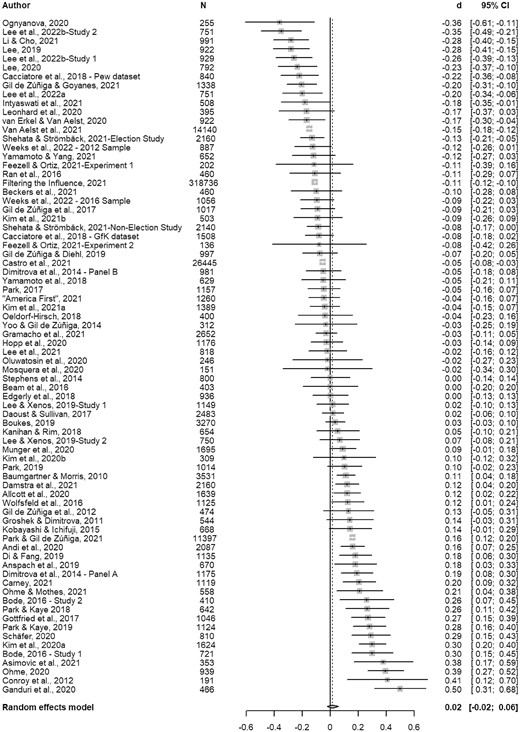
Abstract. Citizens turn increasingly to social media to get their political information. However, it is currently unclear whether using these platforms act
'No Politics' Rules | The Paper Pilot
The Paper Pilot's digital garden of thoughts on philosophy, politics, and sociology
The social media discourse of engaged partisans is toxic even when politics are irrelevant
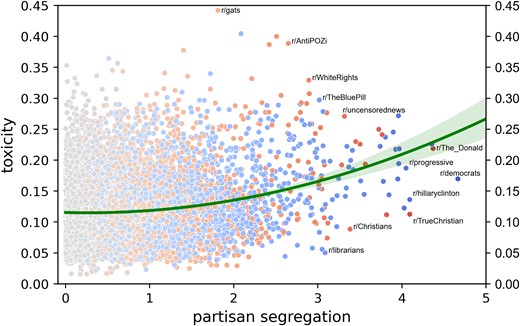
Abstract Prevailing theories of partisan incivility on social media suggest that it derives from disagreement about political issues or from status competition between groups. This study—which analyzes the commenting behavior of Reddit users across diverse cultural contexts (subreddits)—tests the alternative hypothesis that such incivility derives in large part from a selection effect: Toxic people are especially likely to opt into discourse in partisan contexts. First, we examined commenting behavior across over 9,000 unique cultural contexts (subreddits) and confirmed that discourse is indeed more toxic in partisan (e.g. r/progressive, r/conservatives) than in nonpartisan contexts (e.g. r/movies, r/programming). Next, we analyzed hundreds of millions of comments from over 6.3 million users and found robust evidence that: (i) the discourse of people whose behavior is especially toxic in partisan contexts is also especially toxic in nonpartisan contexts (i.e. people are not politics-only toxicity specialists); and (ii) when considering only nonpartisan contexts, the discourse of people who also comment in partisan contexts is more toxic than the discourse of people who do not. These effects were not driven by socialization processes whereby people overgeneralized toxic behavioral norms they had learned in partisan contexts. In contrast to speculation about the need for partisans to engage beyond their echo chambers, toxicity in nonpartisan contexts was higher among people who also comment in both left-wing and right-wing contexts (bilaterally engaged users) than among people who also comment in only left-wing or right-wing contexts (unilaterally engaged users). The discussion considers implications for democratic functioning and theories of polarization.
Who Participates in Politics on Social Media, and Why?
People really do learn about politcs on social media says a new study from Belgium, but the loudest voices are often not the most objective, writes Tim Bernard.
Two Parties, Two Internets
Republicans and Democrats aren’t just messaging differently, they’re talking in entirely different places

When moving fast, talking is the first thing to break
When you make speed and “moving fast” the biggest priority on a project or in an organization, the first thing to breakdown is talking to each other. Talking takes time. Consensus is expensive and slow. In a pressurized environment there’s no time to schedule calls, get input from subject matter experts, or resolve key differences of opinion. ASAP makes a big assumption that all relevant parties are already in the room.
Political Quizzes | The Paper Pilot
The Paper Pilot's digital garden of thoughts on philosophy, politics, and sociology
Why Don’t We Learn from Social Media? Studying Effects of and Mechanisms behind Social Media News Use on General Surveillance Political Knowledge
Does exposure to news affect what people know about politics? This old question attracted new scholarly interest as the political information environment is changing rapidly. In particular, since c...

Metaphor and the Political War
Metaphor and the Political War
Chat Glue | The Paper Pilot
The Paper Pilot's digital garden of thoughts on philosophy, politics, and sociology
My Political Journey | The Paper Pilot
The Paper Pilot's digital garden of thoughts on philosophy, politics, and sociology
The limits of social media as a source of political information during routine and crisis times across 17 countries
Recent studies on political knowledge suggest people learn little about political events and societal issues from social media. Potentially, social media are a more effective source of information ...