


A small, dependency-free paragraph justification engine for the web.

Documenting Large Webtext Corpora: A Case Study on the Colossal Clean Crawled Corpus
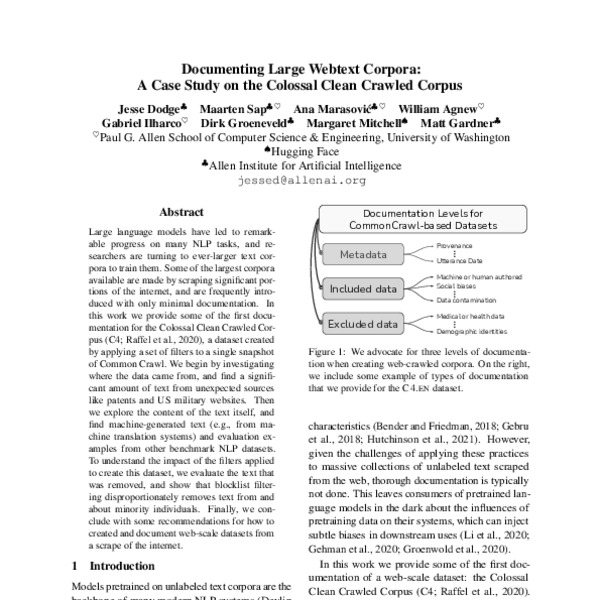
Large language models have led to remarkable progress on many NLP tasks, and researchers are turning to ever-larger text corpora to train them. Some of the largest corpora available are made by scraping significant portions of the internet, and are frequently introduced with only minimal documentation. In this work we provide some of the first documentation for the Colossal Clean Crawled Corpus (C4; Raffel et al., 2020), a dataset created by applying a set of filters to a single snapshot of Common Crawl. We begin by investigating where the data came from, and find a significant amount of text from unexpected sources like patents and US military websites. Then we explore the content of the text itself, and find machine-generated text (e.g., from machine translation systems) and evaluation examples from other benchmark NLP datasets. To understand the impact of the filters applied to create this dataset, we evaluate the text that was removed, and show that blocklist filtering disproportionately removes text from and about minority individuals. Finally, we conclude with some recommendations for how to created and document web-scale datasets from a scrape of the internet.

Standard.site: the Publishing Gateway
Another deep exploration into ATProto and implementing lexicons

Standard.site: the Publishing Gateway
Another deep exploration into ATProto and implementing lexicons
Words that Work: Using Large Language Models to Generate and Refine Hypotheses from Text
In this paper, we introduce a data-driven framework for generating and refining hypotheses from text. Our three-step approach–Hypothesize, Intervene, and Predic

Steps Towards an Infrastructure for Scholarly Synthesis
Sharing, reusing, and synthesizing knowledge is central to the research process, both individually, and with others. These core functions are not supported by our formal scholarly publishing infrastructure: instead of the smooth functioning of functional infrastructure, researchers resort to laborious ”hacks” and workarounds to ”mine” publications for what they need, and struggle to efficiently share the resulting information with others. Information scientists have proposed an alternative infrastructure based on the more appropriately granular model of a discourse graph of claims, and evidence, along with key rhetorical relationships between them. However, despite significant technical progress on standards and platforms, the predominant infrastructure remains steadfastly document-based. Drawing from infrastructure studies, we locate the current infrastructural bottlenecks in the lack of local systems that integrate discourse-centric models to augment synthesis work, from which an infrastructure for synthesis can be grown. Through 3 years of research through design and field deployment in a distributed community of hypertext notebook users, we elaborate a design vision of what can and should be built in order to grow a discourse-centric synthesis infrastructure: a thriving “installed base” of researchers authoring local, shareable discourse graphs to improve synthesis work, enhance primary research and research training, and augment collaborative research. We discuss how this design vision — and our empirical work — contributes steps towards a new infrastructure for synthesis, and increases HCI’s capacity to advance collective intelligence and solve infrastructure-level problems.
atproto made simple: publishing lexicons - underreacted
Steps Towards an Infrastructure for Scholarly Synthesis
Sharing, reusing, and synthesizing knowledge is central to the research process, both individually, and with others. These core functions are not supported by our formal scholarly publishing infrastructure: instead of the smooth functioning of functional infrastructure, researchers resort to laborious "hacks" and workarounds to "mine" publications for what they need, and struggle to efficiently share the resulting information with others. Information scientists have proposed an alternative infrastructure based on the more appropriately granular model of a discourse graph of claims, and evidence, along with key rhetorical relationships between them. However, despite significant technical progress on standards and platforms, the predominant infrastructure remains steadfastly document-based. Drawing from infrastructure studies, we locate the current infrastructural bottlenecks in the lack of local systems that integrate discourse-centric models to augment synthesis work, from which an infrastructure for synthesis can be grown. Through 3 years of research through design and field deployment in a distributed community of hypertext notebook users, we elaborate a design vision of what can and should be built in order to grow a discourse-centric synthesis infrastructure: a thriving "installed base" of researchers authoring local, shareable discourse graphs to improve synthesis work, enhance primary research and research training, and augment collaborative research. We discuss how this design vision -- and our empirical work -- contributes steps towards a new infrastructure for synthesis, and increases HCI's capacity to advance collective intelligence and solve infrastructure-level problems.

Maggie Appleton on Twitter / X
I've always wanted my own WYSIWYG editor for my website, and now I have one! Works locally, saves changes to MDX.But the better part is building semantic writing tools on top. Colour-coded sentence classification, flagging cliches, repetition, and claims that need citations pic.twitter.com/lvOMTZ4DUB— Maggie Appleton (@Mappletons) September 28, 2026

The Beginner’s Guide to Text Embeddings & Techniques | deepset Blog
Text embeddings represent human language to computers, enabling tasks like semantic search. Here, we introduce sparse and dense vectors in a non-technical way.

NLnet; Nanoarguments
Scientific knowledge is currently scattered across papers, repositories, and disconnected platforms, with no structured way to trace how claims connect to evidence or how arguments develop. Nanoarguments builds a framework and tools for creating, browsing, and contributing to a global, federated graph of scientific discourse and evidence. Researchers and their communities can collaboratively structure claims, evidence chains, and discussion as nanopublications, which are small, cryptographically signed Linked Data snippets with precise provenance and authorship, published to a decentralized peer-to-peer network. The project builds upon the Nanodash interface to help users browse, edit, and aggregate discourse and evidence graphs, and integrates with dokieli to enable in-context authoring of nanopublications as inline annotations while reading or writing a document. A bidirectional ActivityPub connector bridges the nanopublication network and the fediverse, allowing discourse threads to start as social exchanges and crystallize into persistent, machine-readable evidence records. The project will be piloted with early adopter research groups in discourse and evidence modeling. All components will be released as open-source modules that other systems can build upon.
Finding real, quotable examples is key to my blog writing workflow. Because Google and the default web search produce a lot of junk, I use Exa, HackerNews, web search, what I've already written, and internal company docs to do this, and I recently added @semble.so to this stack.
