

Kaitai Struct is a formal language for binary format specification that can be compiled into parser code
Engineering High-Performance Parsers with Data-Oriented Design
Notes from building Yuku: the AST is flat arrays of u32 indices instead of a pointer tree, and memory layout, allocation, strings, unicode, and serialization all follow from that one decision.
Concise Binary Object Representation (CBOR)
The Concise Binary Object Representation (CBOR) is a data format whose design goals include the possibility of extremely small code size, fairly small message size, and extensibility without the need for version negotiation. These design goals make it different from earlier binary serializations such as ASN.1 and MessagePack. This document obsoletes RFC 7049, providing editorial improvements, new details, and errata fixes while keeping full compatibility with the interchange format of RFC 7049. It does not create a new version of the format.
Resugaring | Proceedings of the 35th ACM SIGPLAN Conference on Programming Language Design and Implementation
Syntactic sugar plays a crucial role in engineering programming languages. It offers convenient syntax and higher-level of abstractions, as witnessed by its pervasive use in both general-purpose and domain-specific contexts. Unfortunately, the ...

Compiling Match Statements to Bytecode
Full pipeline deep dive for purple garden: AST, BB SSA IR, Bytecode, Optimisations
Packrat parsing: | Proceedings of the seventh ACM SIGPLAN international conference on Functional programming
For decades we have been using Chomsky's generative system of grammars, particularly context-free grammars (CFGs) and regular expressions (REs), to express the syntax of programming languages and protocols. The power of generative grammars to express ...

LLMs as Collaborators in Language Specification and Design (PLSS 2026) - SPLASH/ISSTA 2026
Workshop on Programming Language Standardization and Specification This workshop aims to foster cross-pollination between researchers and industry professionals with experience in programming language specification and standardization. It provides a forum where participants can share insights, case studies, and best practices, and collaboratively explore solutions to current challenges. The goal of the workshop is to improve the collective understanding of how programming languages are specified, standardized, and evolved in practice. The workshop examines specifications as the foundation ...

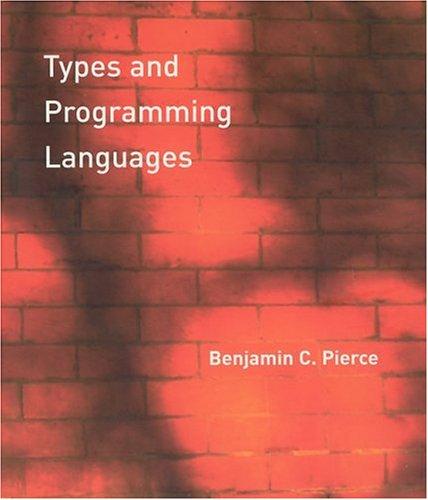
Types and Programming Languages
A type system is a syntactic method for automatically checking the absence of certain erroneous behaviors by classifying program phrases according to the kinds of values they compute. The study of type systems--and of programming languages from a type-theoretic perspective -- -has important applications in software engineering, language design, high-performance compilers, and security. This text provides a comprehensive introduction both to type systems in computer science and to the basic theory of programming languages. The approach is pragmatic and operational; each new concept is motivated by programming examples and the more theoretical sections are driven by the needs of implementations. Each chapter is accompanied by numerous exercises and solutions, as well as a running implementation, available via the Web. Dependencies between chapters are explicitly identified, allowing readers to choose a variety of paths through the material. The core topics include the untyped lambda-calculus, simple type systems, type reconstruction, universal and existential polymorphism, subtyping, bounded quantification, recursive types, kinds, and type operators. Extended case studies develop a variety of approaches to modeling the features of object-oriented languages.
A theory of type polymorphism in programming
The aim of this work is largely a practical one. A widely employed style of programming, particularly in structure-processing languages which impose n…
CBOR — Concise Binary Object Representation | Specification
CBOR is specified in an Internet Standard RFC. RFCs that serve as Internet Standards are generated by the IETF based on an extensive technical review and quality control process. These are meant to last.

Efficient and flexible incremental parsing | ACM Transactions on Programming Languages and Systems
Previously published algorithms for LR (k) incremental parsing are inefficient, unnecessarily restrictive, and in some cases incorrect. We present a simple algorithm based on parsing LR(k) sentential forms that can incrementally parse an arbitrary number ...

Gemma 4: Byte for byte, the most capable open models
Gemma 4: our most intelligent open models to date, purpose-built for advanced reasoning and agentic workflows.

Specification of graph translators with triple graph grammars
Data integration is a key issue for any integrated set of software tools. A typical CASE environment, for instance, offers tools for the manipulation of requirements and software design documents, and it provides more or less sophisticated assistance for keeping these documents in a consistent state. Up to now, almost all data consistency observing or preserving integration tools are hand-crafted due to the lack of generic implementation frameworks and the absence of adequate specification formalisms. Triple graph grammars are intended to fill this gap and to support the specification of interdependencies between graph-like data structures on a very high level. Furthermore, they are the fundamentals of a new machinery for the production of batch-oriented as well as incrementally working data integration tools.

quint-co/quint
An executable specification language with delightful tooling based on the temporal logic of actions (TLA)