Lazy access journalism is pathologically obsessed with helping unremarkable, unethical weirdos cultivate elaborate supergenius engineer mythologies while covertly undermining the public interest.
The Media Can't Stop Propping Up Elon Musk's Phony Supergenius Engineer Mythology
"CEO said a thing!" journalism is now utterly pervasive, and includes parroting billionaire and CEO claims with a total disregard for whether or not anything being said is actually true.

“CEO said a thing!”
A blistering guide to what lazy journalism too often looks like
Musk's Fake Flying Car And 'CEO Said A Thing!' Journalism
The U.S. consolidated press once again demonstrates its dedication to lazy "CEO said a thing!" pseudo-journalism.

Anthropic's Mythos is a wake up call, but experts say the era of AI-driven hacking is already here | Fortune
Anthropic is limiting access to Mythos, but experts say similar capabilities are already in reach.

Silicon Valley has a science fiction problem | Aeon Essays
Tech titans claim the genre inspired them. But all they’ve done is graft their politics onto stories of a better future

Refusing to accept an AI-poisoned future of journalism
Humans, however flawed, are
News Not Slop
Unionized journalists across North America have come together to sound the alarm: Media companies are implementing artificial intelligence in ways that damage the credibility of the journalism on which you rely.

Knowledge tech that's subtly wrong is more dangerous than tech that's obviously wrong. (Or, where I disagree with Robin Sloan.)
Writing at the end of the world, from Hveragerði, Iceland
AI skeptic Ed Zitron says Industry is scamming us into poverty
Ed Zitron joins The 1600 to bust the myths and fairy tales coming from our AI overlords.

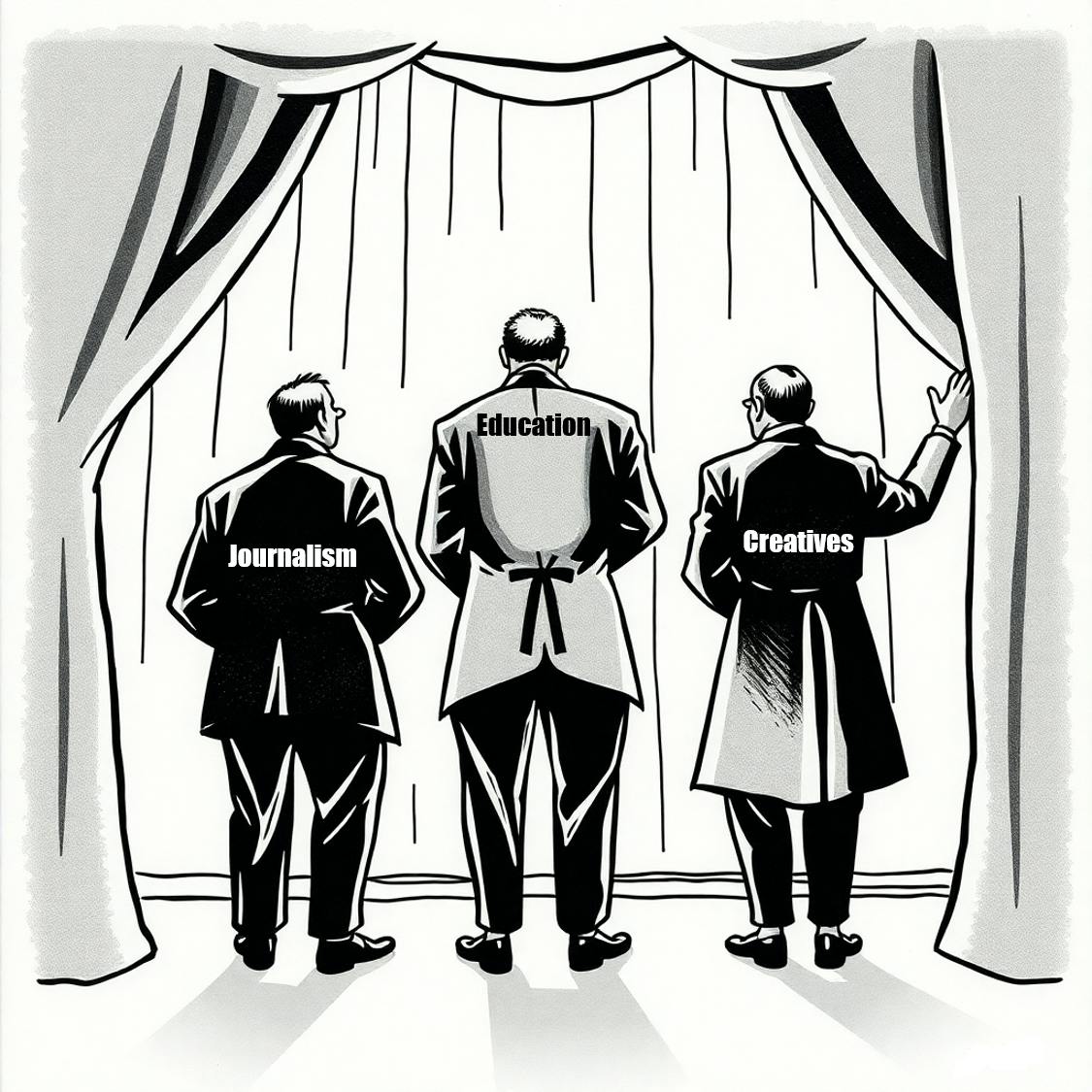
AI is Eating Journalism, Education, and Creatives | HackerNoon
Generative AI threatens journalism, education, and creativity by spreading misinformation, displacing jobs, and eroding quality.
So maybe now we can agree that having an unchecked research integrity militia who unfortunately has the ear of the press and increasingly that of the the publishers, but who fiercely rejects any… | Ioana A. Cristea
So maybe now we can agree that having an unchecked research integrity militia who unfortunately has the ear of the press and increasingly that of the the publishers, but who fiercely rejects any minimal ethics or code of conduct, is a (growing) problem? Also, that 1. problems have to be investigated before deciding they are are legitimate and serious; 2. this investigation is not social media, blogs and the press; 3. this investigation should not be on the front page of journals and Retraction Watch; 4. there are degrees of seriousness and some things can just be corrected or are simply not very consequential (no, it's not a house of bricks where we have to check every brick, that's a dumb analogy), so being absolutely hysterical and overdramatic about any lie, inaccuracy or mistake is purposeful at worse and should be ignored at best and 5. it is not only unnecessary, but harmful, to also go into other, non-academic things the person did or does to complete "investigations" that you (press, sleuth, blogger, etc) do not have the tools and information to do completely and accurately (this fixation would be called harassment in the before times). Others will justly write about what the institutions did or did not do, but what I want to say is that we really should end it with the blank credit we give to any and all allegations that come from the establish research integrity truth fighters.

"CEO Said A Thing!" Journalism
"CEO said a thing!" journalism involves parroting the claims of a business leader or executive with absolutely no context, correction, or challenge whatsoever, no matter how elaborate the delusion.

NewsGuild president writes to ProPublica management: Get serious on AI — ProPublica Guild
Artificial intelligence is guaranteed to shake up journalism in varied and unexpected ways. This could be a moment in which experienced journalists leverage a powerful new tool to produce even bigger and better investigations. Or it could be one in which management pivots to yet another new technolo

How People Weave Online Information Into Pseudoknowledge
Misinformation has found a new natural habitat in the digital age. Thousands of forums, blogs, and alternative news sources amplify fake news and inaccurate information to such a degree that it impacts our collective intelligence. Researchers and policy makers are troubled by misinformation because it is presumed to energize or even carry false narratives that can motivate poor decision-making and dangerous behaviors. Yet, while a growing body of research has focused on how viral misinformation spreads, little work has examined how false narratives are in fact constructed. In this study, we move beyond contagion inspired approaches to examine how people construct a false narrative. We apply prior work in cognitive science on narrative understanding to illustrate how the narrative changes over time and in response to social dynamics, and examine how forum participants draw upon a diverse set of online sources to substantiate the narrative. We find that the narrative is based primarily on reinterpretations of conventional and scholarly sources, and then used to provide an alternate account of unfolding events. We conclude that the link between misinformation, conventional knowledge, and false narratives is more complex than is often presumed, and advocate for a more direct study of this relationship.

Sort By Controversial
[Epistemic status: fiction] Thanks for letting me put my story on your blog. Mainstream media is crap and no one would have believed me anyway. This starts in September 2017. I was working for a sm…

America’s Right-Wing Propaganda Problem Might Be Terminal - Dame Magazine
America’s descent into mass delusion isn’t happenstance. The demise of courageous journalism isn’t a happy accident. Its replacement with engagement-chasing infotainment and propaganda isn’t an error. It’s a global assault on reason and informed consensus, and corporations and authoritarian bullies like Donald Trump are both architects and benefactors. For decades, academics warned anybody who’d listen