Better tools make it possible to build more alone. That doesn’t make a good partnership less worth finding.
Building what customers need, not just what they ask for - Linear
Notes from our product team on building the tools we use every day.

Making and Tool-Making
Bad tools as the main source of friction for Citybound development - and what I'm going to do about it.


With Assembly, anyone can contribute to open-source software and actually get paid
A new startup wants to evolve open-source methods, adding a wide range of skills and profit sharing

Introducing Solo, an AI website builder for solopreneurs | The Mozilla Blog
39% of workers in the US are freelancers. This isn’t necessarily your full time job, but can also be your passion project, your hobby, your second job, y

I bought a house with another single mom to share costs and maintenance. Now we have a kid paradise, with built-in babysitting, car-sharing, and a craft studio.
A single mom bought a four-unit apartment building with another single mom to build equity and share the burdens of homeownership.
Contribution, Let’s use the power of our tools …
Do we have the resources? Yes Are we exploiting those resources thoroughly? A big NO! We are trying to change strategies, products, managers and partners but we never ask what is really going wron…

New tools for building agents
How to set up a new Programme | The Commons Conservancy
So you are responsible for some ‘free and open’ project or effort that is in the public interest. This could be free software/open source, open hardware, open science, open content, etcetera. With open, we mean that you are sharing not just the final end result as something immutable, but you’ve made it part of the ‘Commons’ by explicitly allowing anyone to build and extend on what you’ve created. In legal terms this is normally done through a ’license’, and each incremental author actually needs to license his or her part. However, once different people start contributing, managing who can license what becomes cumbersome - especially if you need to make upgrades to a license. Mix in the need to collectively raise funds for promotion, development and maintenance, and you’ve just experienced why people that are involved with larger projects sometimes feel victim to their own success. None of this matters when a project is young, but as soon as it is about to outgrow the original creator it becomes urgent - there is a window of opportunity for quick and effective repair which slowly starts to close once you’ve passed a certain scale, The critical fase of scale up is where we aim to help out.

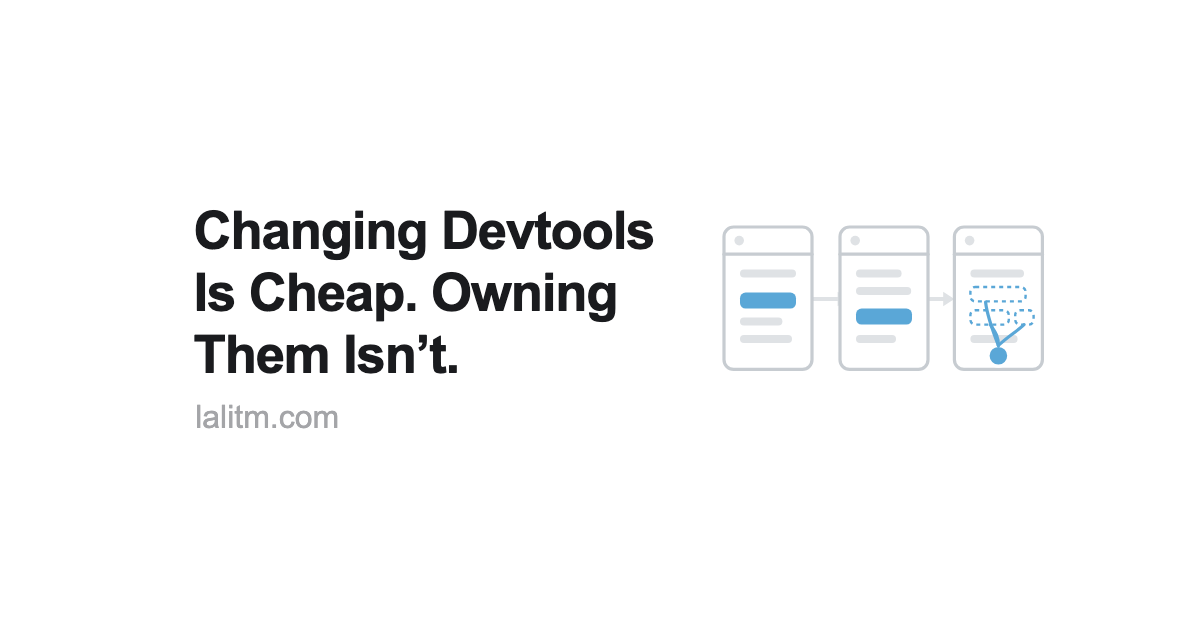
Changing Devtools Is Cheap. Owning Them Isn’t.
AI makes devtools cheap to customize, but personalized forks still demand ongoing attention and ownership.
10x Devs Don't Exist, But 10x Organisations Do
How to make better software with systems-thinking

Why It’s So Hard to Actually Work in Shared Offices | The Walrus
WeWork offers freelancers a chic workspace and beer on tap—but are people productive?

Aaron Boodman on Twitter / X
There is this tension in dev tooling right now: Lots of people want to self-host, and not depend on a service. Lots of people also want the vibes of open source - being part of an open development community, having the code, etc.But builders still need to make a living...— Aaron Boodman (@aboodman) January 23, 2024
Composability with other tools
Interoperability, exchange, and composition are some of my primary motivations for building Subconscious. Why isn’t interoperability more common between tools for thought? Why is it that most of our tools are silos? How did we get here?