

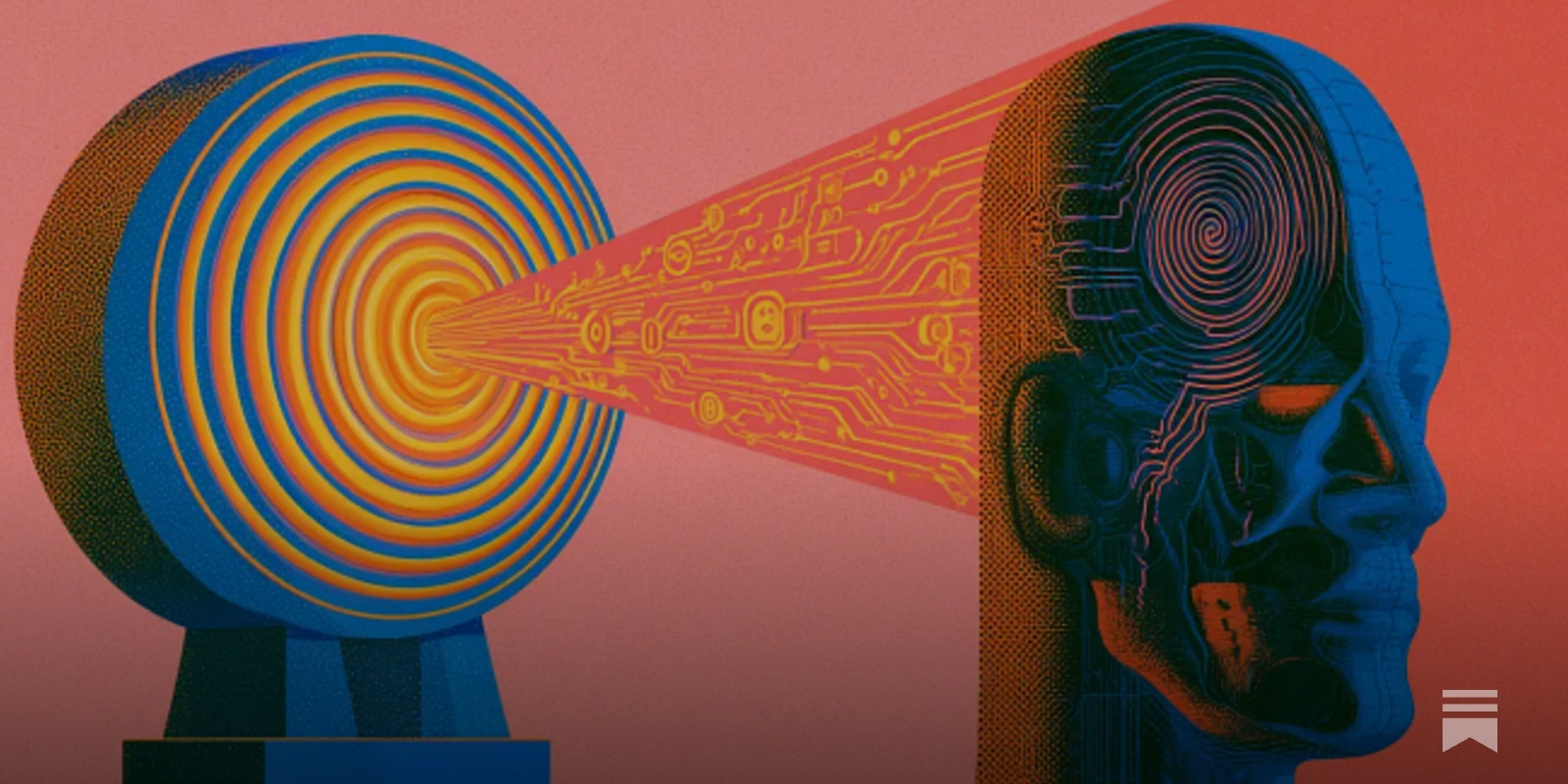
The history of science — and of progress — is a series of benefits that are direct results of new tools.
What stories should we tell about scientific progress now?
In search of the mysterious fruits of basic science

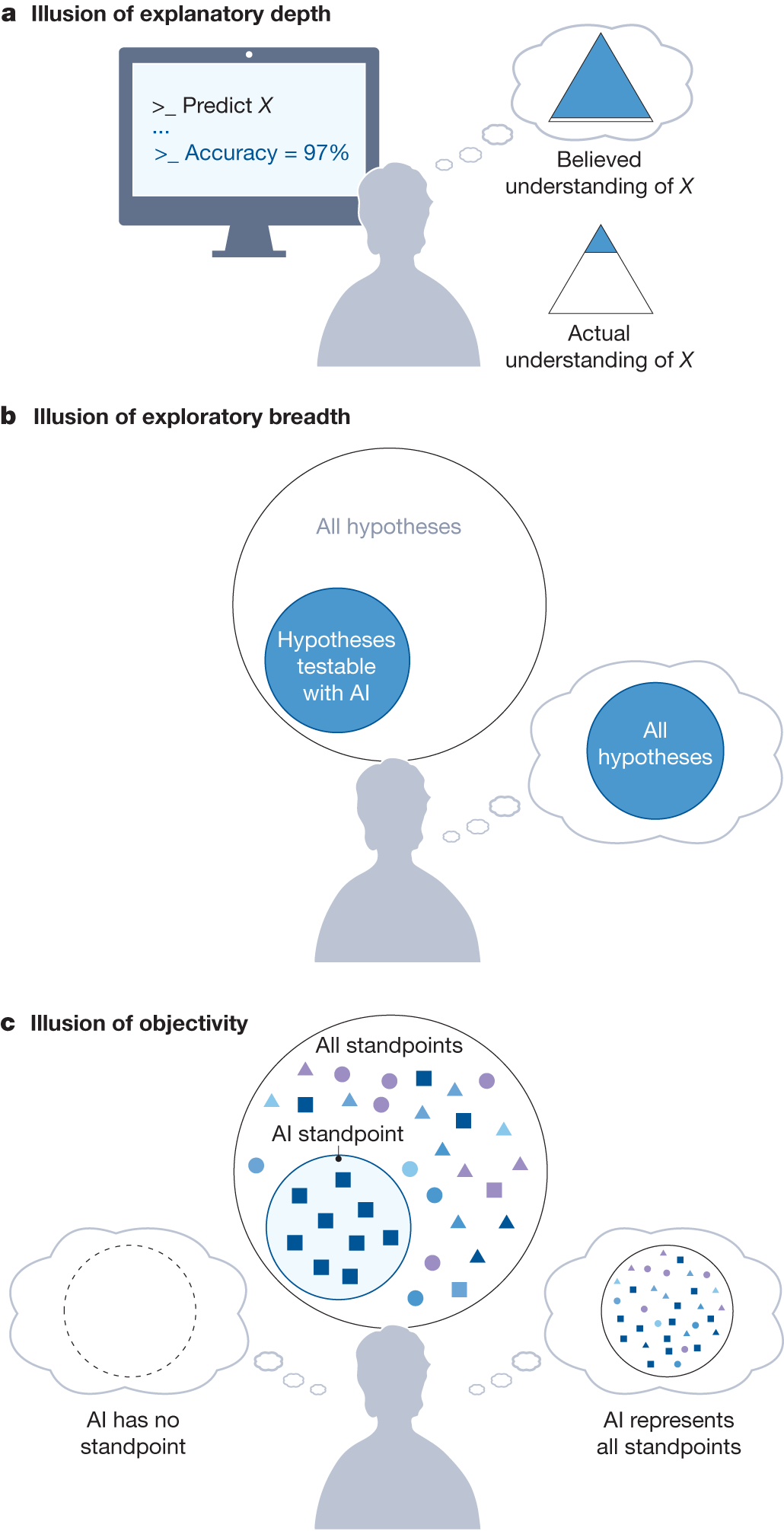
Artificial intelligence and illusions of understanding in scientific research
Scientists are enthusiastically imagining ways in which artificial intelligence (AI) tools might improve research. Why are AI tools so attractive and what are the risks of implementing them across the research pipeline? Here we develop a taxonomy of scientists’ visions for AI, observing that their appeal comes from promises to improve productivity and objectivity by overcoming human shortcomings. But proposed AI solutions can also exploit our cognitive limitations, making us vulnerable to illusions of understanding in which we believe we understand more about the world than we actually do. Such illusions obscure the scientific community’s ability to see the formation of scientific monocultures, in which some types of methods, questions and viewpoints come to dominate alternative approaches, making science less innovative and more vulnerable to errors. The proliferation of AI tools in science risks introducing a phase of scientific enquiry in which we produce more but understand less. By analysing the appeal of these tools, we provide a framework for advancing discussions of responsible knowledge production in the age of AI.
Will AI spark a scientific renaissance — or a diffuse monoculture?
Artificial intelligence’s ability to enrich science will depend not only on model capability, but also on whether researchers, reviewers and funders reward originality over speed.

From Genius Science to Scenius Science - Cosmik Labs
Why personal AI tools might not be all we need to revolutionize science
What Is Intelligence? Lessons from AI About Evolution, Computing, and Minds | Blaise Agüera y Arcas
AI as the Catalyst of the New Paradigm of Science? | Cadmus Journal
The rapid advancement of Artificial Intelligence (AI) is reshaping the landscape of scientific inquiry. This article examines the challenges confronting modern science, including knowledge fragmentation, diminishing returns of current paradigms, and the disconnect between science and society. It explores how AI offers solutions enhancing collaboration and integrating knowledge—as well as considers the possible “darker side” of using AI in research. However, the advent of AI in science not only enhances scientific research but also redefines the role of human researchers and fosters a new paradigm of human understanding. By embracing these transformations, a more cohesive and responsive scientific enterprise can emerge.
AI for science needs reasoning, not just data
AI agents that can model the human process of research will accelerate discoveries in science.

The Fork in the Road: AI Horseless Carriages or Collective Intelligence for Science - Cosmik Labs
The Engine of Scientific Discovery: How New Methods and Tools Spark Major Breakthroughs
Abstract. How do we spark new scientific discoveries? Why do some breakthroughs seem even accidental? And most importantly, how can we accelerate them and
Guest post: If you’re going to critique science, be scientific about it
Loren K. Mell Editor’s note: This post responds to a Feb. 13 article in The Atlantic, “The Scientific Literature Can’t Save Us Now,” written by Retraction Watch cofounders Adam Marcus and Ivan Oran…

AI in Science: Boosting Productivity and Innovation | Arthur Turrell posted on the topic | LinkedIn
Today at Google & Google DeepMind, we published work led by Mihai Codreanu on AI in Science, drawing on 15 million Gemini interactions, 2,600 specialised AI models & a 600-scientist survey. What did we find about how AI is changing science? Read on... First, why does this matter? If AI is a tech boost we get a one-off economic growth boost. But if AI is an "innovation in the method of innovation", we get long run higher expected future growth rates! Compound interest makes those scenarios very different for future prosperity. Where might we see innovation in the method of innovation first? Well, science of course—the engine of innovation and one of the main drivers behind the huge increase in prosperity over the last 200 years. So what do we find? 1) In our data, scientists are about 2.7x overrepresented in AI use compared to what you'd expect from employment share. Scientists are using AI a lot! 2) Science convos are longer (tokens), more multimodal, and involve more domain expertise 3) Computer science has highest use 4) specialised models and LLMs are complements: LLMs do code, stats, literature, drafting, teaching, admin while specialised models predict, generate, classify — eg protein structures, weather. 5) within LLMs, analysis & modelling + communicating research findings are top 2 tasks But are we getting *improvements*? 6) 74% of scientists surveyed report net time savings; (6% report losses). Average saving of ~7 hours/week. This is mostly going back into more research. 47% report an increase in outputs of 10% or more. There's another effect too though—as some things (hypothesis generation, modelling) become 'cheap', science gets bottlenecked by other tasks... 7) 89% of those who save time spend more than a tenth of it checking AI outputs & 41% report a growing backlog of untested hypotheses Looking a bit beyond, we expect time spent on bottleneck tasks to grow as a %, more papers that recombine ideas from across disciplines, & publication volume increases for fields that don't need wet lab work. Unfortunately, not all of this volume may be high quality ("sci-slop") So what's our early take on AI as an innovation in the method of innovation? There's significant potential to increase scientific productivity, & 7 hours/week (big!) is *already* being saved. But it's early days & bottlenecks (inc. verification) limit sci-productivity take off Huge team involved in this work, as you can imagine—see the paper for more! https://lnkd.in/g55s4MtC | 38 comments on LinkedIn

Jon Barron on Twitter / X
This idea that intelligence is solely a function of what you've observed since birth and not also a function of the 500 million years of evolution that preceded your birth is surprisingly sticky despite being demonstrably untrue. https://t.co/m2z5cN8Byb— Jon Barron (@jon_barron) January 28, 2026
A more interesting upside of AI
Does AI provide anything to look forward to, if “super-intelligence” sounds boring?

