

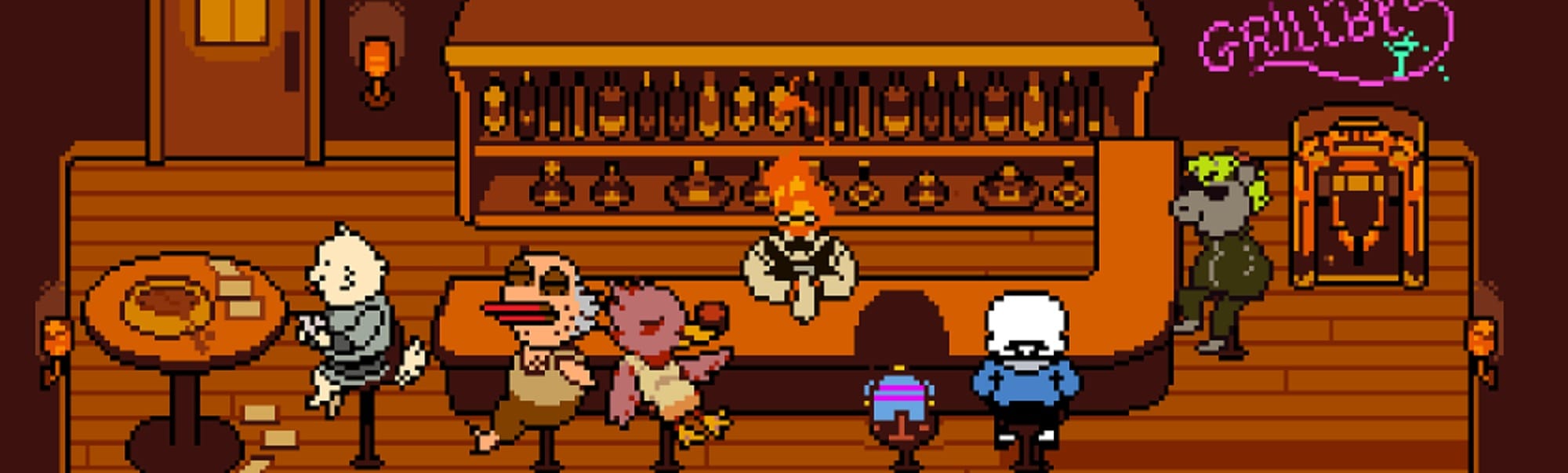
September 15th marks a full year since the arrival of Undertale, Toby Fox’s 16 bit-style role-playing game for PC. Its auspicious reception, which even delivered the game into the Pope’s hands, seems now more than ever to have been a flashpoint in current debates as to what constitutes excellence in
The Rise and Fall of the Lone Game Developer – Holy Ghost Stories
In the early 80s, all it took to make a game was a computer, some graph paper, and a lot of determination.
How ‘Baldur’s Gate’ Saved the Computer RPG
The genre-stretching game broke new narrative, technical, and gameplay ground and established the identity of one of the past two decades’ most storied video game studios

Game Platforms | Game Developer
Explore the latest news and expert commentary on Game Platforms, brought to you by the editors of Game Developer

Game Platforms | Game Developer
Explore the latest news and expert commentary on Game Platforms, brought to you by the editors of Game Developer
» The CRPG Renaissance, Part 4: …Long Live Dungeons & Dragons! The Digital Antiquarian
In December of 1997, Interplay Entertainment released Descent to Undermountain, the latest licensed Dungeons & Dragons computer game. It’s remembered today, to whatever extent it’s remembered at all, as one of the more infamous turkeys of an era with more than its share of over-hyped and half-baked creations, a fiasco almost on par with Battlecruiser 3000AD or Daikatana. The game was predicated on the dodgy premise that Dungeons & Dragons would make a good fit with the engine from Descent, Interplay’s last world-beating hit — and also a hit that was, rather distressingly for Brian Fargo and his colleagues, more than two years in the past by this point.
cataclysm: The zombie apocalypse starts now
I love it when people suggest console games for Linux are a joke. I can think of three or four games offhand — crawl is one, taipan and gearhead are others — with more depth and intelli…

Dev Blog — Tick's Tales: Up All Knight
It's now been six months since I've released my first adventure game. Now that the development effort is over, I've spent some time considering, "What next?", and, even more importantly, "What would make it better?". Ron Gilbert, creator of Monkey Island, famously wrote the article, "Why Adventure Games Suck." It's an excellent read. Believe it or not, this article heavily affected the design of Tick's Tales, and I'm happy for it. However, I spent so much time emphasizing what not to do -- dead ends, death, mind-bending logic. I wish I spent as much time thinking about what to do. And that is the subject of this research.
Davey Wreden: Playing Stories - Aalto University Games Now! -lecture series
The CRPG Project
I’ve been thinking about computer RPGs a lot recently, and trying to play a bunch. There’s a quality that I’ve always loved about especially older computer RPGs: you really felt t…
Interactive Fiction
Interactive fiction was the first great computer-game craze. Through the early 1980s, the most sophisticated, complex, involving games available were the text adventures. Everyone agreed. Go look up up old videogame rating charts; Infocom was always on the list — with several games.
Fun Tabletop Games? - Slashdot
Mr. Ghost asks: "My friends and I have recently been in the market for a good new boardgame or other tabletop game. We have worked through the gamut of games like Axis & Allies, Supremacy, and War! Age of Imperialism. More recently we have been playing tile based games like Carcasonne and Settle...

» Outcast The Digital Antiquarian
The Outcast box was styled to look like a movie poster. Riffing on the same theme, Infogrames’s head Bruno Bonnell called it “the first videogame that really tries to be an interactive movie,” leaving one to wonder whether he had somehow missed the first nine years of the 1990s, during which countless games tried desperately to be just that. Ironically, Outcast actually has very few of the characteristics that had become associated with the phrase: no rigidly linear plot, no digitized human actors, no out-of-engine cutscenes after the obligatory opening one. It’s a game rather than a movie through and through, and all the better for it.
Dungeons & Dragons
» Half-Life The Digital Antiquarian
Around twenty years ago, people would have laughed if you told them that videogames would end up at the Smithsonian, but the Half-Life team really did want to make games that were more than just throwaway toys. The rule against cinematics — which made our jobs much harder and also ended up leaving a lot of my favorite work out of the game — was a kind of ideological stake in the ground: we really did want the game and the story to be the same thing. It was far from flawless, but it was really trying to push the boundaries of a young medium.
Kittens Game - a Dark Souls of incremental gaming
» How Jordan Mechner Made a Different Sort of Interactive Movie (or, The Virtues of Restraint) The Digital Antiquarian
One can learn much about the state of computer gaming in any given period by looking to the metaphors its practitioners are embracing. In the early 1980s, when interfaces were entirely textual and graphics crude or nonexistent, text adventures like those of Infocom were heralded as the vanguard of a new interactive literature destined to augment or entirely supersede non-interactive books. That idea peaked with the mid-decade bookware boom, when just about every entertainment-software publisher (and a few traditional book publishers) were rushing to sign established authors and books to interactive projects. It then proceeded to collapse just as quickly under the weight of its own self-importance when the games proved less compelling and the public less interested than anticipated.