


the term 'alterhuman' has recently been replaced with 'kin', and therefore erased large preexisting communities. this carrd intends to help correct misinformation and spread a better understanding of what it means to be under the alterhuman umbrella
EsDictionary - The EsDeeKid Translator
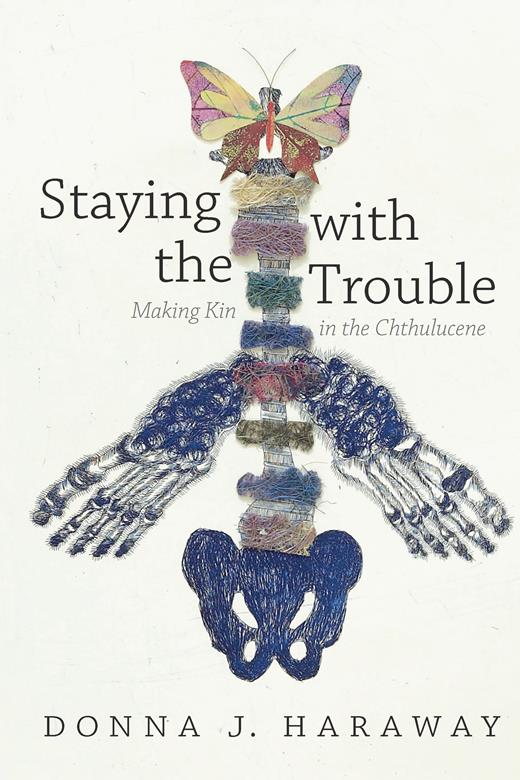
Staying with the Trouble: Making Kin in the Chthulucene
In the midst of spiraling ecological devastation, multispecies feminist theorist Donna J. Haraway offers provocative new ways to reconfigure our relations
The Depths of Wikipedians—Asterisk
A conversation about yogurt wars, German hymns, tropical cyclones, and the people who make Wikipedia function.

Symbolic Manipulation: an Anthropological Perspective
The aim of this article is to elucidate the anthropological conditions of possibility for computing. I will first show how symbolic manipulation is constitutive of hominization. Secondly, I will ex…

on place and person - encyclopedia eidolica
In several conversations with a friend I was invited to revisit some prior beliefs I had posited on the relationship between the environment and the self; at various times in my life this position has reversed, then reversed again, but I think it’s reaching a more nuanced, unified position.
The Power of Alter Egos
As part of my Wisdom Hackers dispatch, I spent 8-weeks exploring the philosophy and intentions behind alter egos. Outlined below are…

The Death of DeviantArt and the art-site shaped hole haunting the Internet - Multi-hyphenate
Why every new "Art Community" fails. Equal parts eulogy, condemnation, and mourning.
Online Etymology Dictionary
The online etymology dictionary (etymonline) is the internet's go-to source for quick and reliable accounts of the origin and history of English words, phrases, and idioms.


Transhumanism in EA and beyond | Elise Bohan | EAGxAustralia 2022
Road to a book lexicon (Part 2) - Nick The Sick
The one where I actually define a lexicon

A [White] Cyborg’s Manifesto: the overwhelmingly Western ideology driving technofeminist theory
‘A Cyborg Manifesto’ is a required reading in many graduate programs to explore technofeminism, transhumanism, and studies of science and technology to explore notions of gender, race, and other minoritized identities. However, in this essay, I note the ways that Haraway’s piece still exacerbates categories of difference, and my own difficulties and critiques of the cyborg identity. I encourage readers to not only consider its importance, but also the limits of the cyborg identity, and how the concept of cyborg itself is fraught with a Western, patriarchal violence that cannot be ignored in the greater context of technology and technological innovation. Although useful in imagining a departure from traditional categories of difference, I inquire as to whether it upholds the very things it purported to dismantle, and explore other scholars’ works in challenging the concept. Ultimately, ‘cyborgs’ are not outside of the politics within which they exist, and must be interpreted in relation to other identity categories without upholding whiteness and Western epistemologies as the center.

Übermensch | Social Sciences and Humanities | Research Starters | EBSCO Research
<p>The concept of "Übermensch," introduced by German philosopher Friedrich Nietzsche in his 1880s work "Thus Spoke Zarathustra," describes an evolved form of humanity that transcends conventional human limitations and societal norms, particularly those imposed by religious structures. Translated as "overman" or "superman," the term represents an ideal that Nietzsche believed humanity should strive toward, emphasizing self-overcoming and the rejection of outdated moral frameworks. The Übermensch is often illustrated through metaphorical transformations, such as that of a camel, which bears the weight of traditional values, into a lion, which challenges those values, and ultimately into a child, symbolizing new beginnings and creativity.</p> <p>Interpretations of the Übermensch vary significantly—some view it as a physical evolution, while others see it as a mental or philosophical transformation. The concept has also been misappropriated in modern contexts; notably, the Nazis distorted Nietzsche’s ideas to justify their racial superiority agenda, despite Nietzsche himself being a critic of nationalism and anti-Semitism. The ambiguity in translation and interpretation has led to ongoing debates about the true meaning and implications of Nietzsche's Übermensch, with scholars exploring its relevance in discussions of personal autonomy, artistic freedom, and the potential for human evolution.</p>

No title
The next time you call someone (or something) your "spirit animal," consider this. The phrase became common only recently, and it went from Indian myth to

“To add insult to injury, many metaphorical … phrases (especially used to describe ANNs; see Table 1) — like train, learn, hallucinate, reason — are applied to machines and result in distorting how we perceive these machines: humanising them while dehumanising us” zenodo.org/records/17065099 14/🧵
