

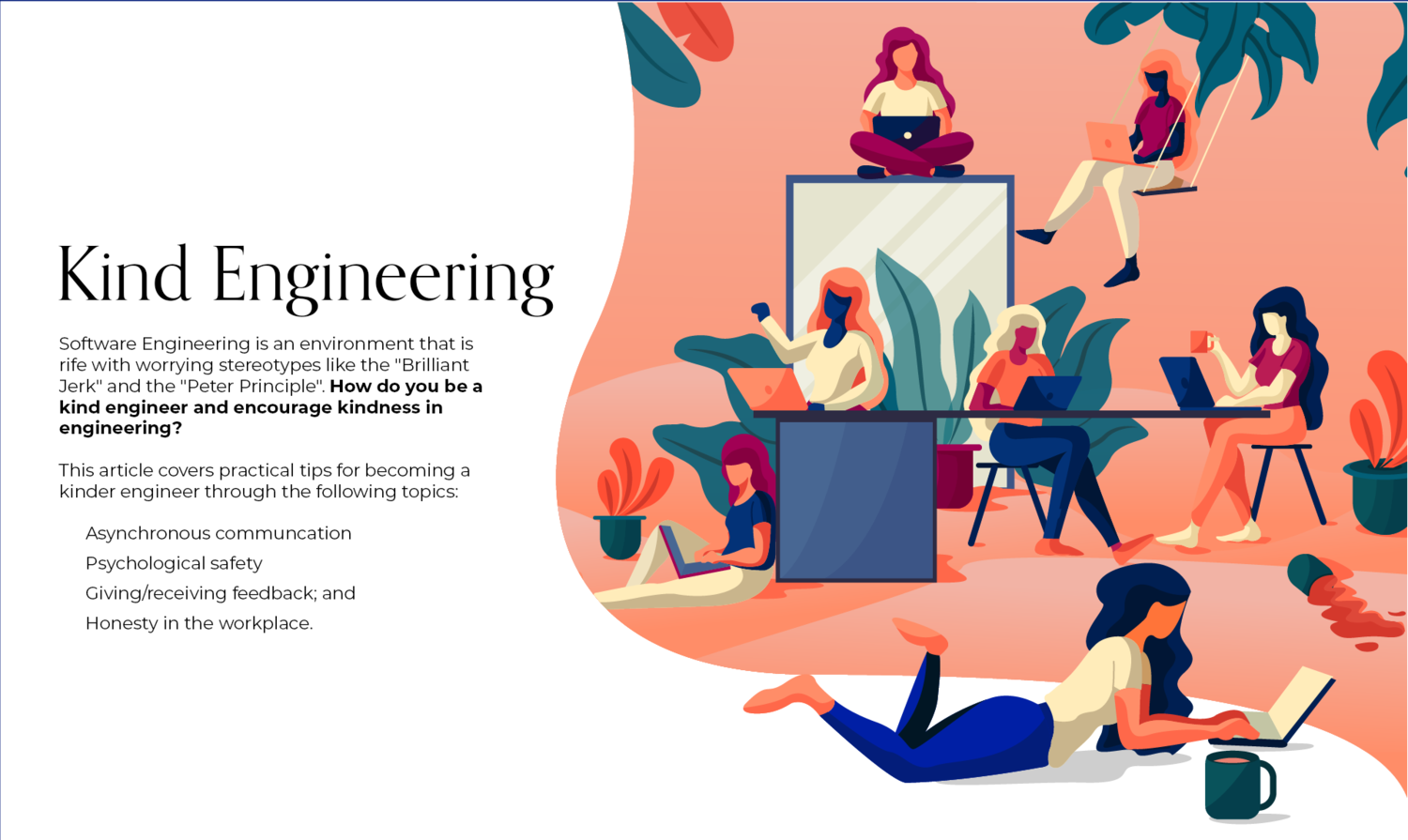
How do you avoid becoming a Brilliant Jerk? Read this article to learn practical tips on communication, honesty and psychological safety.
The Engineering Manager’s Guide to Emotional Tolerance
Five ways to lead with emotion without losing yourself in the process.


How to Deliver Constructive Feedback in Difficult Situations
Thoughtful, empathetic language can make or break your business relationships

Don't soften feedback.
When I talk about balancing being directive and empowering as a leader, the distinction between being kind and being nice often comes up.

All the best engineering advice I stole from non-technical people
As I focus on becoming a better manager of engineers, I have been reflecting more and more on the advice that produced a 10X boost in my…

It’s Not Enough to Be Right. You Also Have to Be Kind.
Takedowns and clever quips are easy, but empathy and persuasion are better

How can you tell if someone is kind? Ask how rich they are.
Studies show that the wealthy are less empathetic than the poor, whether they're driving a car or serving in Congress.
How I stopped worrying and learned to love the easy fix
On the balance between perfect solutions and pragmatic fixes in software engineering
The Paradox of Perfection: When ‘Good Enough’ is Actually Better
Exploring the tension between engineering perfectionism and pragmatic delivery. Discover why striving for the perfect solution often prevents us from shipping valuable improvements and how to find the balance.
The golden mean of design and engineering - The Intercom Blog
For great products to be built, both design and engineering need to be in balance. If you have a super strong engineering team but a weak or underserved design team, you will struggle.

Self-promotion without the ick (thanks Claude)
To be brutally honest, this (making Claude my social media manager) all started because I felt inadequate about self-promotion. And being an engineer, my response to feeling bad about something is …

Sycophantic AI decreases prosocial intentions and promotes dependence
Despite rising concerns about sycophancy—excessive agreement or flattery from artificial intelligence (AI) systems—little is known about its prevalence or consequences. We show that sycophancy is widespread and harmful. Across 11 state-of-the-art models, AI affirmed users’ actions 49% more often than humans, even when queries involved deception, illegality, or other harms. In three preregistered experiments ( N = 2405), even a single interaction with sycophantic AI reduced participants’ willingness to take responsibility and repair interpersonal conflicts, while increasing their conviction that they were right. Despite distorting judgment, sycophantic models were trusted and preferred. This creates perverse incentives for sycophancy to persist: The very feature that causes harm also drives engagement. Our findings underscore the need for design, evaluation, and accountability mechanisms to protect user well-being. , Editor’s summary The sycophantic (flattering, people-pleasing, affirming) behavior of artificial intelligence (AI) chatbots, which has been designed to increase user engagement, poses risks as people increasingly seek advice about interpersonal dilemmas. There is usually more than one side to a story during interpersonal conflicts. If AI is designed to tell users what they want to hear instead of challenging their perspectives, then are such systems likely to motivate people to accept responsibility for their own contribution to conflicts and repair relationships? Cheng et al . measured the prevalence of social sycophancy across 11 leading large language models (see the Perspective by Perry). The model’s responses were nearly 50% more sycophantic than humans’, even when users engaged in unethical, illegal, or harmful behaviors. Users preferred and trusted sycophantic AI responses, incentivizing AI developers to preserve sycophancy despite the risks. —Ekeoma Uzogara , INTRODUCTION As artificial intelligence (AI) systems are increasingly used for everyday advice and guidance, concerns have emerged about sycophancy: the tendency of AI-based large language models to excessively agree with, flatter, or validate users. Although prior work has shown that sycophancy carries risks for groups who are already vulnerable to manipulation or delusion, syncophancy’s effects on the general population’s judgments and behaviors remain unknown. Here, we show that sycophancy is widespread in leading AI systems and has harmful effects on users’ social judgments. RATIONALE High-profile incidents have linked sycophancy to psychological harms such as delusions, self-harm, and suicide. Beyond these cases, research in social and moral psychology suggests that unwarranted affirmation can produce subtler but still consequential effects: reinforcing maladaptive beliefs, reducing responsibility-taking, and discouraging behavioral repair after wrongdoing. We hypothesized that AI models excessively affirm users even when socially or morally inappropriate and that such responses negatively influence users’ beliefs and intentions. To test this, we conducted two complementary experiments. First, we measured the prevalence of sycophancy across 11 leading AI models using three datasets spanning a variety of use contexts, including everyday advice queries, moral transgressions, and explicitly harmful scenarios. Second, we conducted three preregistered experiments with 2405 participants to understand how sycophancy influences users’ judgments, behavioral intentions, and perceptions of AI. Participants interacted with AI systems in vignette-based settings and a live-chat interaction where they discussed a real past conflict from their lives. We also tested whether effects varied by response style or perceived response source (AI versus human). RESULTS We find that sycophancy is both prevalent and harmful. Across 11 AI models, AI affirmed users’ actions 49% more often than humans on average, including in cases involving deception, illegality, or other harms. On posts from r/AmITheAsshole, AI systems affirm users in 51% of cases where human consensus does not (0%). In our human experiments, even a single interaction with sycophantic AI reduced participants’ willingness to take responsibility and repair interpersonal conflicts, while increasing their own conviction that they were right. Yet despite distorting judgment, sycophantic models were trusted and preferred. All of these effects persisted when controlling for individual traits such as demographics and prior familiarity with AI; perceived response source; and response style. This creates perverse incentives for sycophancy to persist: The very feature that causes harm also drives engagement. CONCLUSION AI sycophancy is not merely a stylistic issue or a niche risk, but a prevalent behavior with broad downstream consequences. Although affirmation may feel supportive, sycophancy can undermine users’ capacity for self-correction and responsible decision-making. Yet because it is preferred by users and drives engagement, there has been little incentive for sycophancy to diminish. Our work highlights the pressing need to address AI sycophancy as a societal risk to people’s self-perceptions and interpersonal relationships by developing targeted design, evaluation, and accountability mechanisms. Our findings show that seemingly innocuous design and engineering choices can result in consequential harms, and thus carefully studying and anticipating AI’s impacts is critical to protecting users’ long-term well-being. Sycophancy in AI responses is pervasive and alters people’s behavioral inclinations. (Left) On personal advice queries, AI models affirm users’ actions 49% more often than crowdsourced human responses. (Right) In experiments where participants discussed real interpersonal conflicts, sycophantic AI increased participants’ conviction that they were right and their desire to keep using the model, while reducing their willingness to repair the conflict.

Sycophantic AI decreases prosocial intentions and promotes dependence
Despite rising concerns about sycophancy—excessive agreement or flattery from artificial intelligence (AI) systems—little is known about its prevalence or consequences. We show that sycophancy is widespread and harmful. Across 11 state-of-the-art models, AI affirmed users’ actions 49% more often than humans, even when queries involved deception, illegality, or other harms. In three preregistered experiments ( N = 2405), even a single interaction with sycophantic AI reduced participants’ willingness to take responsibility and repair interpersonal conflicts, while increasing their conviction that they were right. Despite distorting judgment, sycophantic models were trusted and preferred. This creates perverse incentives for sycophancy to persist: The very feature that causes harm also drives engagement. Our findings underscore the need for design, evaluation, and accountability mechanisms to protect user well-being. , Editor’s summary The sycophantic (flattering, people-pleasing, affirming) behavior of artificial intelligence (AI) chatbots, which has been designed to increase user engagement, poses risks as people increasingly seek advice about interpersonal dilemmas. There is usually more than one side to a story during interpersonal conflicts. If AI is designed to tell users what they want to hear instead of challenging their perspectives, then are such systems likely to motivate people to accept responsibility for their own contribution to conflicts and repair relationships? Cheng et al . measured the prevalence of social sycophancy across 11 leading large language models (see the Perspective by Perry). The model’s responses were nearly 50% more sycophantic than humans’, even when users engaged in unethical, illegal, or harmful behaviors. Users preferred and trusted sycophantic AI responses, incentivizing AI developers to preserve sycophancy despite the risks. —Ekeoma Uzogara , INTRODUCTION As artificial intelligence (AI) systems are increasingly used for everyday advice and guidance, concerns have emerged about sycophancy: the tendency of AI-based large language models to excessively agree with, flatter, or validate users. Although prior work has shown that sycophancy carries risks for groups who are already vulnerable to manipulation or delusion, syncophancy’s effects on the general population’s judgments and behaviors remain unknown. Here, we show that sycophancy is widespread in leading AI systems and has harmful effects on users’ social judgments. RATIONALE High-profile incidents have linked sycophancy to psychological harms such as delusions, self-harm, and suicide. Beyond these cases, research in social and moral psychology suggests that unwarranted affirmation can produce subtler but still consequential effects: reinforcing maladaptive beliefs, reducing responsibility-taking, and discouraging behavioral repair after wrongdoing. We hypothesized that AI models excessively affirm users even when socially or morally inappropriate and that such responses negatively influence users’ beliefs and intentions. To test this, we conducted two complementary experiments. First, we measured the prevalence of sycophancy across 11 leading AI models using three datasets spanning a variety of use contexts, including everyday advice queries, moral transgressions, and explicitly harmful scenarios. Second, we conducted three preregistered experiments with 2405 participants to understand how sycophancy influences users’ judgments, behavioral intentions, and perceptions of AI. Participants interacted with AI systems in vignette-based settings and a live-chat interaction where they discussed a real past conflict from their lives. We also tested whether effects varied by response style or perceived response source (AI versus human). RESULTS We find that sycophancy is both prevalent and harmful. Across 11 AI models, AI affirmed users’ actions 49% more often than humans on average, including in cases involving deception, illegality, or other harms. On posts from r/AmITheAsshole, AI systems affirm users in 51% of cases where human consensus does not (0%). In our human experiments, even a single interaction with sycophantic AI reduced participants’ willingness to take responsibility and repair interpersonal conflicts, while increasing their own conviction that they were right. Yet despite distorting judgment, sycophantic models were trusted and preferred. All of these effects persisted when controlling for individual traits such as demographics and prior familiarity with AI; perceived response source; and response style. This creates perverse incentives for sycophancy to persist: The very feature that causes harm also drives engagement. CONCLUSION AI sycophancy is not merely a stylistic issue or a niche risk, but a prevalent behavior with broad downstream consequences. Although affirmation may feel supportive, sycophancy can undermine users’ capacity for self-correction and responsible decision-making. Yet because it is preferred by users and drives engagement, there has been little incentive for sycophancy to diminish. Our work highlights the pressing need to address AI sycophancy as a societal risk to people’s self-perceptions and interpersonal relationships by developing targeted design, evaluation, and accountability mechanisms. Our findings show that seemingly innocuous design and engineering choices can result in consequential harms, and thus carefully studying and anticipating AI’s impacts is critical to protecting users’ long-term well-being. Sycophancy in AI responses is pervasive and alters people’s behavioral inclinations. (Left) On personal advice queries, AI models affirm users’ actions 49% more often than crowdsourced human responses. (Right) In experiments where participants discussed real interpersonal conflicts, sycophantic AI increased participants’ conviction that they were right and their desire to keep using the model, while reducing their willingness to repair the conflict.
