

LAION-5B is an open-source foundation dataset. It contains 5.8 billion image and text pairs—a size too large to make sense of. We follow the construction of the dataset to better understand its contents, implications and entanglements.
LAION-5B: An open large-scale dataset for training next generation image-text models
Groundbreaking language-vision architectures like CLIP and DALL-E proved the utility of training on large amounts of noisy image-text data, without relying on expensive accurate labels used in standard vision unimodal supervised learning. The resulting models showed capabilities of strong text-guided image generation and transfer to downstream tasks, while performing remarkably at zero-shot classification with noteworthy out-of-distribution robustness. Since then, large-scale language-vision models like ALIGN, BASIC, GLIDE, Flamingo and Imagen made further improvements. Studying the training and capabilities of such models requires datasets containing billions of image-text pairs. Until now, no datasets of this size have been made openly available for the broader research community. To address this problem and democratize research on large-scale multi-modal models, we present LAION-5B - a dataset consisting of 5.85 billion CLIP-filtered image-text pairs, of which 2.32B contain English language. We show successful replication and fine-tuning of foundational models like CLIP, GLIDE and Stable Diffusion using the dataset, and discuss further experiments enabled with an openly available dataset of this scale. Additionally we provide several nearest neighbor indices, an improved web-interface for dataset exploration and subset generation, and detection scores for watermark, NSFW, and toxic content detection.
👉Today we're launching this investigation into LAION-5B, the blockbuster dataset behind Midjourney and Stable Diffusion. It's a deep dive into how the dataset was made, and where the images come from. The brilliant @christo_buschek & @blprnt follow the models all the way down.
👉Today we're launching this investigation into LAION-5B, the blockbuster dataset behind Midjourney and Stable Diffusion. It's a deep dive into how the dataset was made, and where the images come from. The brilliant @christo_buschek & @blprnt follow the models all the way down. https://t.co/jaWMoc29WD— Kate Crawford (@katecrawford) March 26, 2024
I really hope that these recent findings about LAION will be the catalyst for changing the way we collect, curate and use datasets in AI. It's going to take more than a technological fix, we need a fundamental paradigm shift for all stages of the life cycle. A 🧵:
I really hope that these recent findings about LAION will be the catalyst for changing the way we collect, curate and use datasets in AI. It's going to take more than a technological fix, we need a fundamental paradigm shift for all stages of the life cycle. A 🧵:— Sasha Luccioni, PhD 🦋🌎✨🤗 (@SashaMTL) December 20, 2023
MiniMaxAI/OctoCodingBench · Datasets at Hugging Face
We’re on a journey to advance and democratize artificial intelligence through open source and open science.

The Curse of Recursion: Training on Generated Data Makes Models Forget
Stable Diffusion revolutionised image creation from descriptive text. GPT-2, GPT-3(.5) and GPT-4 demonstrated astonishing performance across a variety of language tasks. ChatGPT introduced such language models to the general public. It is now clear that large language models (LLMs) are here to stay, and will bring about drastic change in the whole ecosystem of online text and images. In this paper we consider what the future might hold. What will happen to GPT-{n} once LLMs contribute much of the language found online? We find that use of model-generated content in training causes irreversible defects in the resulting models, where tails of the original content distribution disappear. We refer to this effect as Model Collapse and show that it can occur in Variational Autoencoders, Gaussian Mixture Models and LLMs. We build theoretical intuition behind the phenomenon and portray its ubiquity amongst all learned generative models. We demonstrate that it has to be taken seriously if we are to sustain the benefits of training from large-scale data scraped from the web. Indeed, the value of data collected about genuine human interactions with systems will be increasingly valuable in the presence of content generated by LLMs in data crawled from the Internet.
tufazip: Learning to Compress a Billion Bytes of Wikipedia
Compressing one billion bytes of Wikipedia into 105.39 MB with a Transformer that learns online and an offline trained initialization.
Beyond Model Collapse: Scaling Up with Synthesized Data Requires...
Large Language Models (LLM) are increasingly trained on data generated by other LLM, either because generated text and images become part of the pre-training corpus, or because synthetized data is...
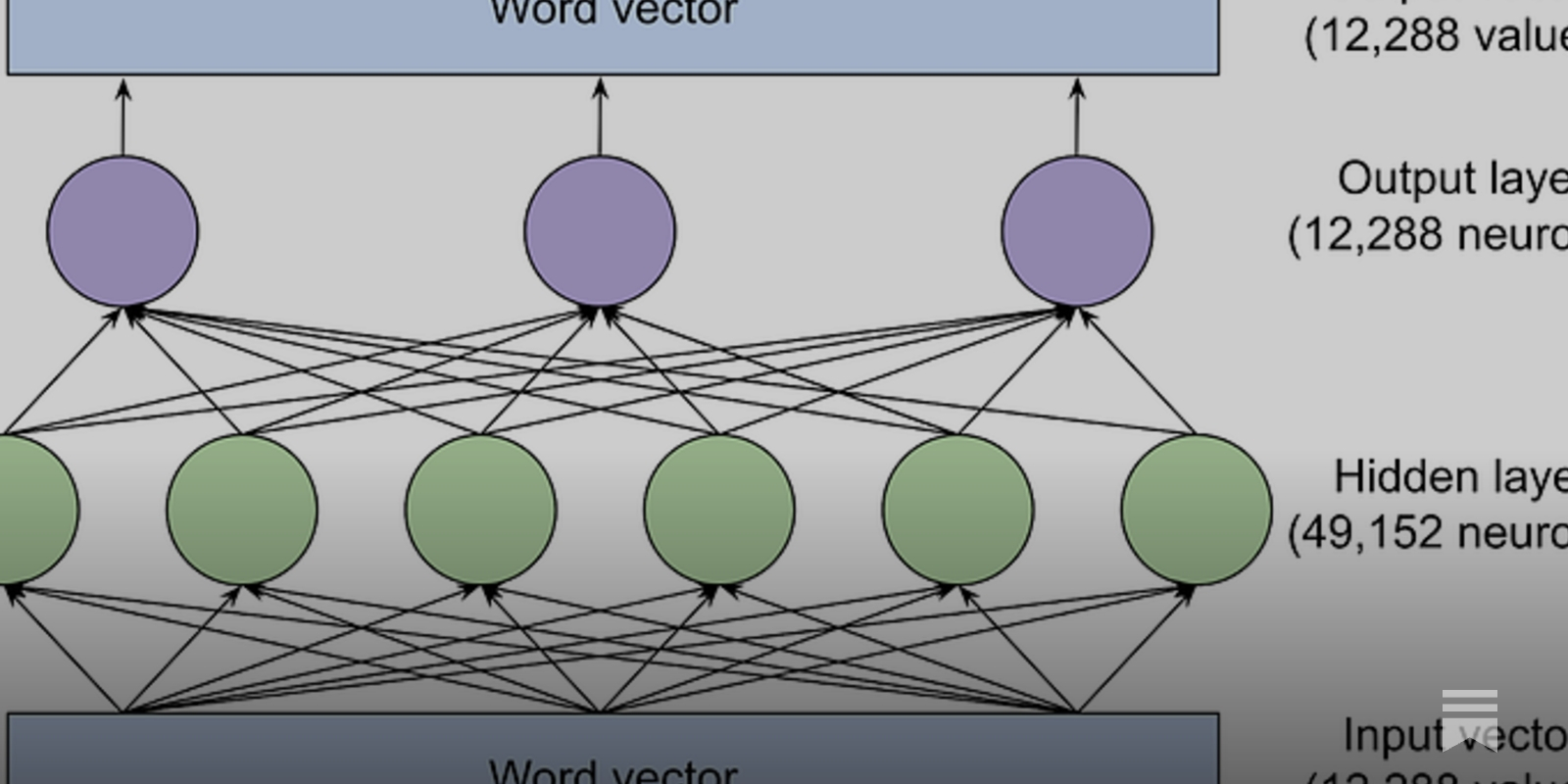
How Large Language Models Actually Work
Large language models, explained with a minimum of math and jargon
Want to really understand how large language models work? Here’s a gentle primer.
The Ins and Outs of the Yahoo Flickr Creative Commons 100 Million Dataset | code.flickr.com
This past summer we (Yahoo Labs and Flickr) released the YFCC100M dataset that is the largest and most ambitious collection of Flickr photos and videos ever, containing 99,206,564 photos and 793,436 videos from 581,099 different photographers. We’re super excited about the dataset, because it is a reflection of how Flickr and photography have evolved over the past 10 years. And it contains photos and videos of almost everything under the sun (and yes, loads of cats).
chenxiachan/textfold
Fold papers, web pages, files, and AI replies into five levels of detail. Zoom from an overview to the original text.
Model Collapse Ends AI Hype
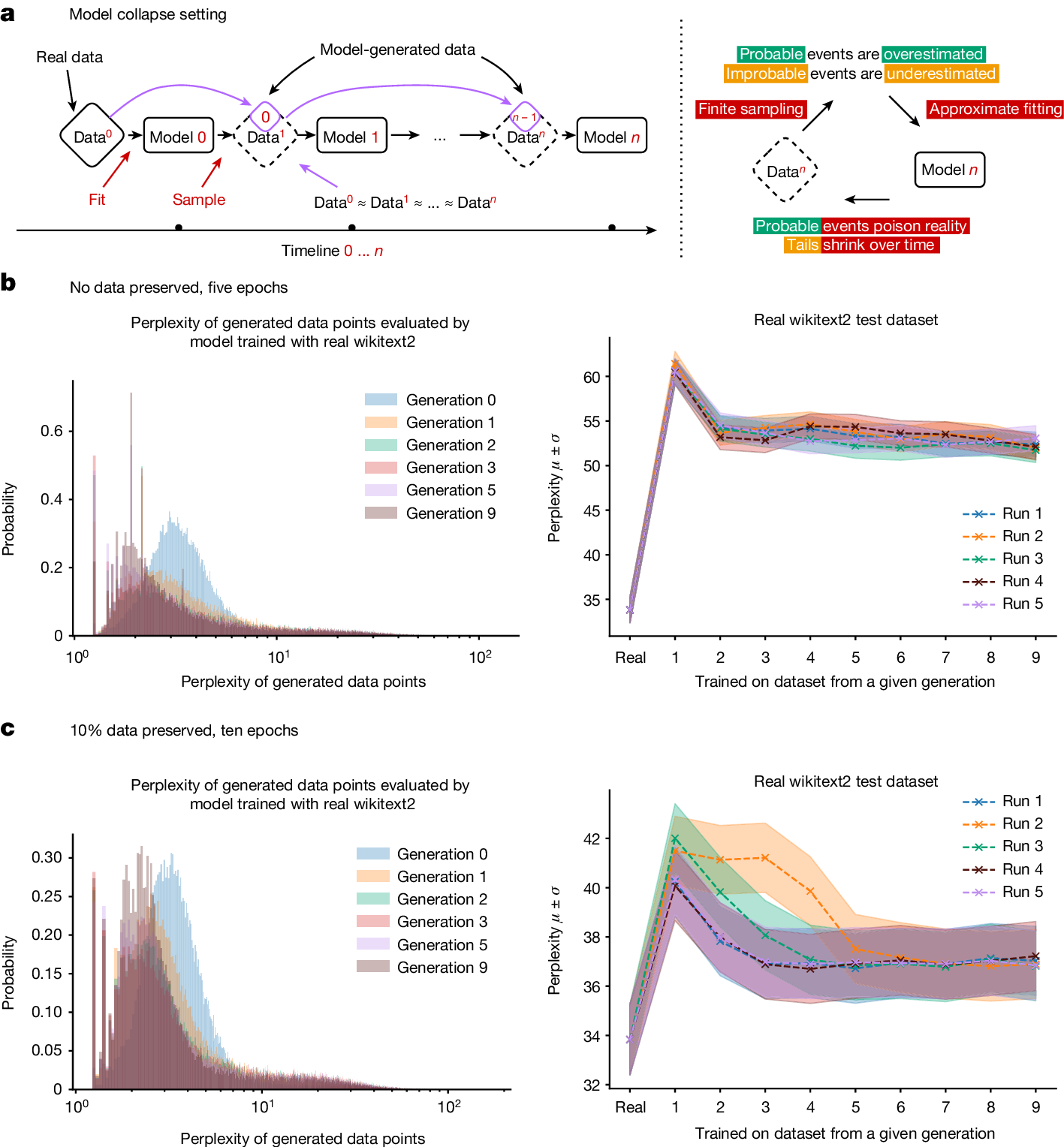
AI models collapse when trained on recursively generated data
Stable diffusion revolutionized image creation from descriptive text. GPT-2 (ref. 1), GPT-3(.5) (ref. 2) and GPT-4 (ref. 3) demonstrated high performance across a variety of language tasks. ChatGPT introduced such language models to the public. It is now clear that generative artificial intelligence (AI) such as large language models (LLMs) is here to stay and will substantially change the ecosystem of online text and images. Here we consider what may happen to GPT-{n} once LLMs contribute much of the text found online. We find that indiscriminate use of model-generated content in training causes irreversible defects in the resulting models, in which tails of the original content distribution disappear. We refer to this effect as ‘model collapse’ and show that it can occur in LLMs as well as in variational autoencoders (VAEs) and Gaussian mixture models (GMMs). We build theoretical intuition behind the phenomenon and portray its ubiquity among all learned generative models. We demonstrate that it must be taken seriously if we are to sustain the benefits of training from large-scale data scraped from the web. Indeed, the value of data collected about genuine human interactions with systems will be increasingly valuable in the presence of LLM-generated content in data crawled from the Internet.
AI models collapse when trained on recursively generated data
Stable diffusion revolutionized image creation from descriptive text. GPT-2 (ref. 1), GPT-3(.5) (ref. 2) and GPT-4 (ref. 3) demonstrated high performance across a variety of language tasks. ChatGPT introduced such language models to the public. It is now clear that generative artificial intelligence (AI) such as large language models (LLMs) is here to stay and will substantially change the ecosystem of online text and images. Here we consider what may happen to GPT-{n} once LLMs contribute much of the text found online. We find that indiscriminate use of model-generated content in training causes irreversible defects in the resulting models, in which tails of the original content distribution disappear. We refer to this effect as ‘model collapse’ and show that it can occur in LLMs as well as in variational autoencoders (VAEs) and Gaussian mixture models (GMMs). We build theoretical intuition behind the phenomenon and portray its ubiquity among all learned generative models. We demonstrate that it must be taken seriously if we are to sustain the benefits of training from large-scale data scraped from the web. Indeed, the value of data collected about genuine human interactions with systems will be increasingly valuable in the presence of LLM-generated content in data crawled from the Internet.
devs working with bsky image embeds: we are planning to bump the image embed blob max size from 1 MByte to 2 MByte. first in the lexicon schema, and then in the Bluesky Social app. more about impacts, and what this means in terms of lexicon evolution, in this github discussion
Increasing Bluesky Post Image Size Limit · bluesky-social atproto · Discussion #4832
github.com