

Semantic technologies and models have matured and become very powerful tools to increase the power and accuracy of recent AI approaches. However, we currently lack channels where semantically structured knowledge can be reliably published and queried, both by humans as well as AI agents. Here we show how this gap can be filled by a global ecosystem that aligns with the original Semantic Web vision with respect to openness, decentralization, and formal semantics, but also targets trust and redundancy. Our approach is based on the concept and technology of nanopublications with content-addressed identifiers and a layered peer-to-peer network of publishing services, query services, and user applications. It applies a trust algorithm from links that are published as nanopublications themselves. We present a novel trust propagation algorithm IDEBT and prove its properties of being robust, efficient to compute, and reproducible. We evaluate the ecosystem on a multi-node test deployment running a synthetic publish/query workload under two coverage configurations, complemented by a descriptive analysis of the live deployed trust network. Our positive results show that a such a decentralized network of services based on nanopublications has the capacity and potential to serve as a universal and globally integrated knowledge sharing platform.
Evolution of AI Agent Registry Solutions: Centralized, Enterprise, and Distributed Approaches
Autonomous AI agents now operate across cloud, enterprise, and decentralized domains, creating demand for registry infrastructures that enable trustworthy discovery, capability negotiation, and identity assurance. We analyze five prominent approaches: (1) MCP Registry (centralized publication of mcp.json descriptors), (2) A2A Agent Cards (decentralized self-describing JSON capability manifests), (3) AGNTCY Agent Directory Service (IPFS Kademlia DHT content routing extended for semantic taxonomy-based content discovery, OCI artifact storage, and Sigstore-backed integrity), (4) Microsoft Entra Agent ID (enterprise SaaS directory with policy and zero-trust integration), and (5) NANDA Index AgentFacts (cryptographically verifiable, privacy-preserving fact model with credentialed assertions). Using four evaluation dimensions: security, authentication, scalability, and maintainability, we surface architectural trade-offs between centralized control, enterprise governance, and distributed resilience. We conclude with design recommendations for an emerging Internet of AI Agents requiring verifiable identity, adaptive discovery flows, and interoperable capability semantics.

The Trust Fabric: Decentralized Interoperability and Economic Coordination for the Agentic Web
The fragmentation of AI agent ecosystems has created urgent demands for interoperability, trust, and economic coordination that current protocols (MCP Hou et al. (2025); Desai (2025), A2A Habler et al. (2025), ACP Liu et al. (2025), and Cisco’s AGP Edwards (2025)) cannot address at scale. We present the Nanda Unified Architecture, a decentralized framework built around three core innovations: fast DID-based agent discovery through distributed registries enables efficient lookup across decentralized networks, while semantic agent cards with verifiable credentials and composability profiles provide rich, machine-readable descriptions of capabilities. At the heart of the system, a dynamic trust layer integrates behavioral attestations with policy compliance mechanisms to create verifiable reputation signals. The architecture introduces X42/H42 micropayments for economic coordination and MAESTRO, a comprehensive security framework incorporating Synergetics’ patented AgentTalk protocol (US 12,244,584 B1) and secure containerization. Real-world implementations demonstrate 99.9% compliance in healthcare applications and significant monthly transaction volumes while maintaining strong privacy guarantees. Our federated registry system enables efficient agent discovery while supporting high-performance autonomous systems. By unifying MIT’s trust research with production systems from Cisco’s Agency Framework and Synergetics’ commercial deployments, we demonstrate how cryptographic proofs and policy-as-code transform agents into trust-anchored participants in a decentralized economy Lakshmanan (2025); Sha (2025). The result enables a globally interoperable Internet of Agents where trust becomes the native currency of collaboration across both enterprise and Web3 ecosystems.
Beyond DNS: Unlocking the Internet of AI Agents via the NANDA Index and Verified AgentFacts
The Internet is poised to host billions to trillions of autonomous AI agents that negotiate, delegate, and migrate in milliseconds and workloads that will strain DNS-centred identity and discovery. In this paper, we describe the NANDA index architecture, which we envision as a means for discoverability, identifiability and authentication in the internet of AI agents. We present an architecture where a minimal lean index resolves to dynamic, cryptographically verifiable AgentFacts that supports multi-endpoint routing, load balancing, privacy-preserving access, and credentialed capability assertions. Our architecture design delivers five concrete guarantees: (1) A quilt-like index proposal that supports both NANDA-native agents as well as third party agents being discoverable via the index, (2) rapid global resolution for newly spawned AI agents, (3) sub-second revocation and key rotation, (4) schema-validated capability assertions, and (5) privacy-preserving discovery across organisational boundaries via verifiable, least-disclosure queries. We formalize the AgentFacts schema, specify a CRDT-based update protocol, and prototype adaptive resolvers. The result is a lightweight, horizontally scalable foundation that unlocks secure, trust-aware collaboration for the next generation of the Internet of AI agents, without abandoning existing web infrastructure.
AI proxy: fostering a more open ecosystem - Blog - Braintrust
Introducing Braintrust's latest feature: an AI proxy that lets you use open source models like LLaMa 2 and Mistral, as well as all of OpenAI's and Anthropic's models, behind a single interface with caching, security, and API key management built in.
Intelligent AI Delegation
AI agents are able to tackle increasingly complex tasks. To achieve more ambitious goals, AI agents need to be able to meaningfully decompose problems into manageable sub-components, and safely delegate their completion across to other AI agents and humans alike. Yet, existing task decomposition and delegation methods rely on simple heuristics, and are not able to dynamically adapt to environmental changes and robustly handle unexpected failures. Here we propose an adaptive framework for intelligent AI delegation - a sequence of decisions involving task allocation, that also incorporates transfer of authority, responsibility, accountability, clear specifications regarding roles and boundaries, clarity of intent, and mechanisms for establishing trust between the two (or more) parties. The proposed framework is applicable to both human and AI delegators and delegatees in complex delegation networks, aiming to inform the development of protocols in the emerging agentic web.
Scaling trust on the web
The Task Force for a Trustworthy Future Web's report on gaps and opportunities for how the next generation of online spaces will be built.
LinkedTrust — Deep Tech. Human Trust.
Verified trust systems, civic tech platforms, and AI-powered tools. Real projects, real impact.
Vertex
Web of Trust as a Service. Vertex has 7 repositories available. Follow their code on GitHub.

Models for Trust Inference in Social Networks
Interpersonal trust between any two people in social networks is hard to gauge, and even harder to infer, given that these two people are not connected by an immediate social link, such as friendship or acquaintanceship. In order to be able to make accurate inferences for an arbitrary tuple of people in a given social environment, we present an approach, named Appleseed, that is based on mechanics taken from neuropsychology, known as spreading activation models. Compelling in its simplicity, we relate the concept to trust propagation and evaluation in an intuitive fashion. While Appleseed works very well when paths between two arbitrary people in the network can be established, no inference of trust is possible when this is not the case. To this end, we present several algorithms for inferring trust that go beyond network structure and demonstrate their accuracy in real social networks. We also show how these algorithms can be augmented with additional data that may be available in some contexts.

NLnet; Nanoarguments
Scientific knowledge is currently scattered across papers, repositories, and disconnected platforms, with no structured way to trace how claims connect to evidence or how arguments develop. Nanoarguments builds a framework and tools for creating, browsing, and contributing to a global, federated graph of scientific discourse and evidence. Researchers and their communities can collaboratively structure claims, evidence chains, and discussion as nanopublications, which are small, cryptographically signed Linked Data snippets with precise provenance and authorship, published to a decentralized peer-to-peer network. The project builds upon the Nanodash interface to help users browse, edit, and aggregate discourse and evidence graphs, and integrates with dokieli to enable in-context authoring of nanopublications as inline annotations while reading or writing a document. A bidirectional ActivityPub connector bridges the nanopublication network and the fediverse, allowing discourse threads to start as social exchanges and crystallize into persistent, machine-readable evidence records. The project will be piloted with early adopter research groups in discourse and evidence modeling. All components will be released as open-source modules that other systems can build upon.
WikiKV: Schema-Evolving Path-Indexed Storage for Hierarchical Knowledge Navigation
LLM-curated hierarchical knowledge bases, namely a tree-structured wiki whose nodes summarize an underlying corpus, have become a dominant substrate for retrieval-augmented applications, yet their storage layer is still treated as an implementation detail. This workload is hierarchical, query-intensive, and continuously evolving, and no existing storage model natively captures all three properties at once. We present WikiKV, a path-indexed key-value storage model purpose-built for this workload, comprising three components: (i) a data-driven schema that bootstraps the hierarchy via Intent-Anchored Schema Induction and refines it through Continuous Evolution Operators; (ii) a consistency protocol for the path-indexed storage model that precludes partial-read observations under concurrent offline rewrites without read-path locking; and (iii) a budgeted navigation operator whose search-accelerated routing reduces the expected number of LLM-assisted descent steps from d to O(1) while preserving anytime semantics with progressively refined answers. We evaluate WikiKV through real-world deployment for the WeChat Official Account AI Assistant and benchmark it against diverse baselines on the AuthTrace dataset, where it achieves balanced low per-operator latency across four query operators against relational, graph, and FS backends, and reaches 63.2% end-to-end answer correctness, exceeding multiple RAG baselines, with the gap widening on low- and high-fan-in multi-document questions. Ablation study further confirms the effectiveness of WikiKV's components.
Building Unforgeable Professional Endorsements with ATProtocol - Nick's Blog
Traditional professional endorsements on platforms like LinkedIn lack cryptographic proof—anyone could forge them, and the platform controls the truth. This article introduces a two-record architecture using ATProtocol's Content Identifiers (CIDs) and Decentralized Identifiers (DIDs) to create mathematically unforgeable mutual attestations. By separating proof creation from endorsement acceptance and leveraging the firehose for distributed validation, we build a system where both parties cryptographically consent and no central authority can manipulate the record.
WillSearch – GuardianDB. A peer-to-peer database for the Decentralized Web.
A High-performance, local-first decentralized database built on Rust and Iroh
Bulletin Board: Cloud Atlas, Portland, and Small AI
Links and updates from New_ Public
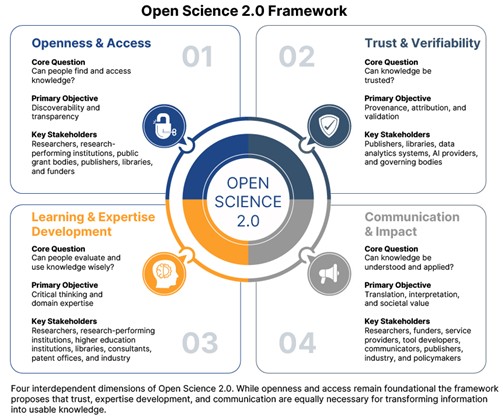
Open Science 2.0: Building Understanding in an AI-Mediated World - The Scholarly Kitchen
Open Science 2.0 must focus not only on access, but also on trust, interpretation, learning, and effective communication. The challenge facing the scholarly publishing ecosystem is ensuring that what is open is also trustworthy, understandable, and genuinely useful.
Google, Microsoft, and OpenAI join forces to help create AI's missing trust layer
With 13 founding members, the all-new Appia Foundation wants to help make AI safety claims verifiable.
