

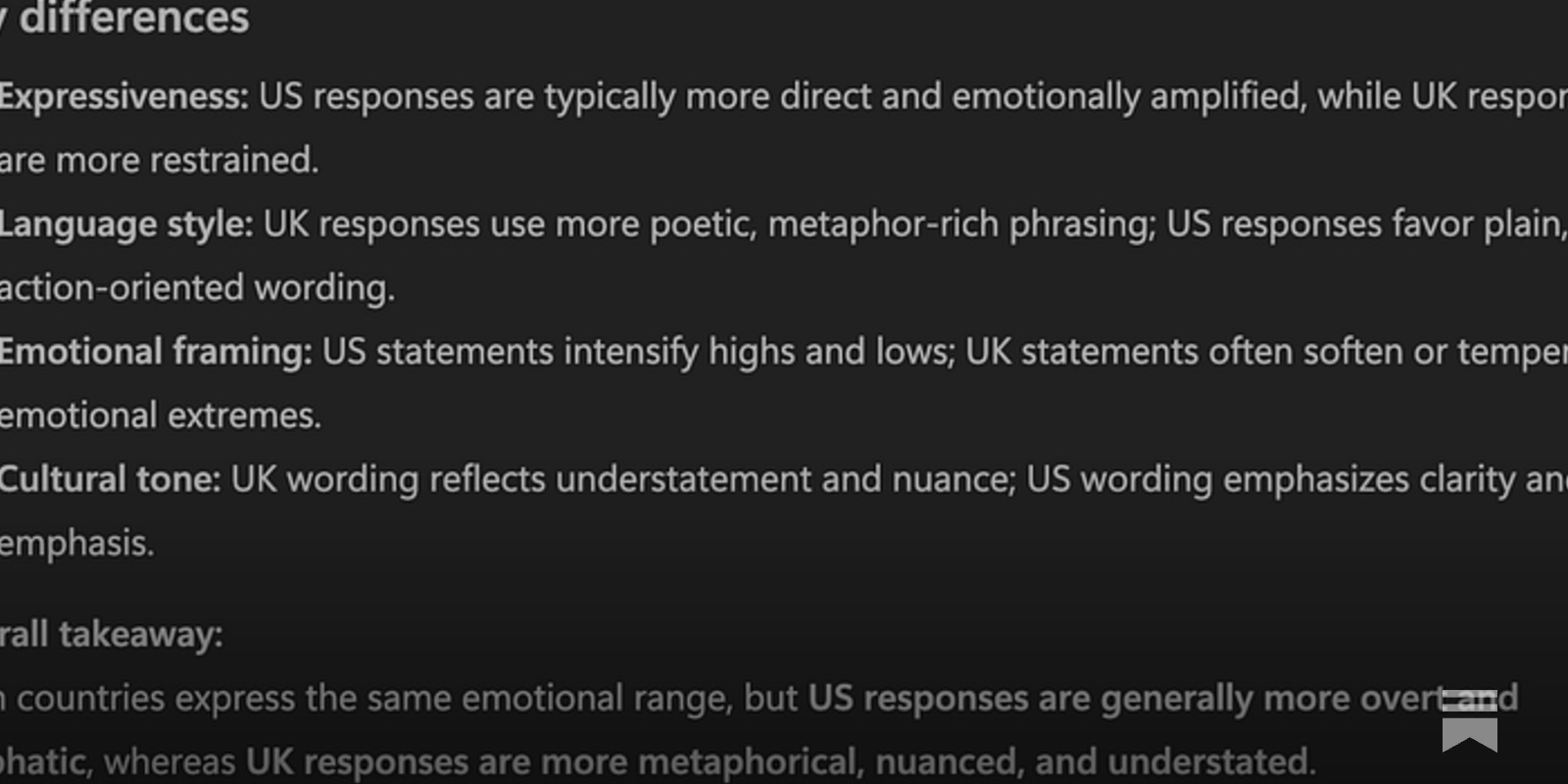
Adventures with a cultural Copilot

Is AI Creating a Culture of Avoidance?
As chatbots and AI companions emerge as communication tools of choice for humans, a new and unsettling dynamic is taking shape. Tools that can smooth over difficult communication between friends and coworkers—reducing misunderstandings, hurt feelings, or social discomfort—also have a downside. Left unchecked, they may erode human intuition and sabotage empathy.

A bias for social information in human cultural transmission
Evolutionary theories concerning the origins of human intelligence suggest that cultural transmission might be biased toward social over non‐social information. This was tested by passing social and non‐social information along multiple chains of participants. Experiment 1 found that gossip, defined as information about intense third‐party social relationships, was transmitted with siginificantly greater accuracy and in significantly greater quantity than equivalent non‐social information concerning individual behaviour or the physical environment. Experiment 2 replicated this finding controlling for narrative coherence, and additionally found that information concerning everyday non‐gossip social interactions was transmitted just as well as the intense gossip interactions. It was therefore concluded that human cultural transmission is biased toward information concerning social interactions over equivalent non‐social information.

Covert Racism in AI: How Language Models Are Reinforcing Outdated Stereotypes | Stanford HAI
Despite advancements in AI, new research reveals that large language models continue to perpetuate harmful racial biases, particularly against speakers of African American English.

AI-induced cultural stagnation is here - Fast Company
AI-mediated culture is already being filtered in ways that favor the familiar, the describable, and the conventional.

Differences Between Tight and Loose Cultures: A 33-Nation Study
The differences across cultures in the enforcement of conformity may reflect their specific histories. , With data from 33 nations, we illustrate the differences between cultures that are tight (have many strong norms and a low tolerance of deviant behavior) versus loose (have weak social norms and a high tolerance of deviant behavior). Tightness-looseness is part of a complex, loosely integrated multilevel system that comprises distal ecological and historical threats (e.g., high population density, resource scarcity, a history of territorial conflict, and disease and environmental threats), broad versus narrow socialization in societal institutions (e.g., autocracy, media regulations), the strength of everyday recurring situations, and micro-level psychological affordances (e.g., prevention self-guides, high regulatory strength, need for structure). This research advances knowledge that can foster cross-cultural understanding in a world of increasing global interdependence and has implications for modeling cultural change.
A revolution in our sense of self | Nick Chater
Psychologists have tried to plumb the depths of human motivation to make sense of our behaviour. But our inner mental world is a fiction, sustained by constant improvisation
TV Tropes
TV Tropes, the all-devouring pop-culture wiki, catalogs and cross-references recurrent plot devices, archetypes, and tropes in all forms of media.

Geeks, MOPs, and sociopaths in subculture evolution | Meaningness
How muggles and sociopaths invade and undermine creative subcultures; and how to stop them.

Fascist femboys, autogynephilia, and flattering narratives
Among those who believe [autogynephilia](https://en.wikipedia.org/wiki/Blanchard'stranssexualismtypology) is real and the primary explanation for many or mo...

Technopoly: The Surrender of Culture to Technology
A witty, often terrifying that chronicles our transform…

Will AI shape the way we speak? The emerging sociolinguistic influence of synthetic voices
The growing prevalence of conversational voice interfaces, powered by developments in both speech and language technologies, raises important questions about their influence on human communication. While written communication can signal identity through lexical and stylistic choices, voice-based interactions inherently amplify socioindexical elements - such as accent, intonation, and speech style - which more prominently convey social identity and group affiliation. There is evidence that even passive media such as television is likely to influence the audience's linguistic patterns. Unlike passive media, conversational AI is interactive, creating a more immersive and reciprocal dynamic that holds a greater potential to impact how individuals speak in everyday interactions. Such heightened influence can be expected to arise from phenomena such as acoustic-prosodic entrainment and linguistic accommodation, which occur naturally during interaction and enable users to adapt their speech patterns in response to the system. While this phenomenon is still emerging, its potential societal impact could provide organisations, movements, and brands with a subtle yet powerful avenue for shaping and controlling public perception and social identity. We argue that the socioindexical influence of AI-generated speech warrants attention and should become a focus of interdisciplinary research, leveraging new and existing methodologies and technologies to better understand its implications.

Will AI shape the way we speak? The emerging sociolinguistic influence of synthetic voices
The growing prevalence of conversational voice interfaces, powered by developments in both speech and language technologies, raises important questions about their influence on human communication. While written communication can signal identity through lexical and stylistic choices, voice-based interactions inherently amplify socioindexical elements - such as accent, intonation, and speech style - which more prominently convey social identity and group affiliation. There is evidence that even passive media such as television is likely to influence the audience's linguistic patterns. Unlike passive media, conversational AI is interactive, creating a more immersive and reciprocal dynamic that holds a greater potential to impact how individuals speak in everyday interactions. Such heightened influence can be expected to arise from phenomena such as acoustic-prosodic entrainment and linguistic accommodation, which occur naturally during interaction and enable users to adapt their speech patterns in response to the system. While this phenomenon is still emerging, its potential societal impact could provide organisations, movements, and brands with a subtle yet powerful avenue for shaping and controlling public perception and social identity. We argue that the socioindexical influence of AI-generated speech warrants attention and should become a focus of interdisciplinary research, leveraging new and existing methodologies and technologies to better understand its implications.
Vibe Coding: The Final Form of Hyper-Individualism
A few days ago, I had to deal with the first "vibe coded" PR to my software. In this article, I reflect on this encounter, and analyze the social …
Leading the Herd Astray: An Experimental Study of Self-fulfilling Prophecies in an Artificial Cultural Market
Individuals influence each others' decisions about cultural products such as songs, books, and movies; but to what extent can the perception of success become a “self-fulfilling prophecy”? We have explored this question experimentally by artificially inverting the true popularity of songs in an online “music market,” in which 12,207 participants listened to and downloaded songs by unknown bands. We found that most songs experienced self-ful- filling prophecies, in which perceived—but initially false—popularity became real over time. We also found, however, that the inversion was not self-fulfilling for the market as a whole, in part because the very best songs recovered their popularity in the long run. Moreover, the distortion of market information reduced the correlation between appeal and popularity, and led to fewer overall downloads. These results, although partial and speculative, suggest a new approach to the study of cultural markets, and indicate the potential of web-based experiments to explore the social psychological origin of other macrosocio- logical phenomena.
