


Working to advance and democratize open-source intelligence.

Turn 10,994 Notes Into Memory - Paul Iusztin, Decoding AI & Louis-François Bouchard, Towards AI
An Internet for the KV Cache: Rethinking Classical Infrastructure Boundaries in the LLM Inference Age
LLM inference has become a global-scale, heterogeneous workload spanning agents, retrieval, tool-use, code execution and multi-modal reasoning. These workloads naturally enable context reuse from overlapping inputs, creating a major opportunity to store and reuse the contexts' KV Caches instead of recomputing them. However, model-side advances that shrink the KV Cache and system-side advances that reduce compute, storage, and transfer costs are evolve independently within legacy cloud boundaries. We argue that future inference infrastructure should allow decoupling of compute and KV Cache storage across cloud and datacenters. The network becomes an active distribution channel; bandwidth, latency and pricing directly determines how the KV Cache should be managed. We propose a vision for an Internet for the KV Cache, with KV Cache management working as a content-distribution system. In this view, KV Cache storage and recompute decisions are driven by model, infrastructure, and application metrics, to enable adaptive, content-driven decisions for minimizing latency and cost.

NeuralBench: A Unifying Framework to Benchmark NeuroAI Models | Hubert Banville
🧠 NeuralBench is now open source. Today we're releasing NeuralBench, a unified framework for benchmarking foundation models of brain activity, developed by the Brain & AI team at FAIR, Meta. 💻 Code: https://lnkd.in/dNJsgBgM 📄 White paper: https://lnkd.in/dvWMg7rx Brain foundation models are starting to show positive transfer to a range of downstream tasks, from brain-computer interfacing to clinical classification. But systematically evaluating them is hard: heterogeneous preprocessing pipelines, input structures, and adaptation methodologies make results difficult to compare. Most prior work also focuses on a narrow set of downstream tasks. NeuralBench addresses this by defining each task end-to-end with config files (data source, preprocessing, splits, optimiser, metrics, architecture) so all models can be evaluated on the same footing. What's in our first release, NeuralBench-EEG v1.0: ⚡ 36 EEG tasks across 94 public datasets, spanning motor imagery, clinical classification, cognitive decoding, and phenotype prediction. 🤖 Task-specific deep learning architectures (EEGNet, Deep4, EEGConformer, CTNet, ...) benchmarked side-by-side with recent EEG foundation models (BENDR, LaBraM, BIOT, CBraMod, LUNA, REVE). 🧩 Extensible to other neuroimaging modalities: the framework already runs MEG and fMRI tasks, leveraging our NeuralSet ecosystem for accessing brain imaging data and the broader neuroscientific software stack. 📜 Released under the MIT license. Help us make it better. Through our white paper, we invite the community to contribute new tasks, datasets, and models, especially for fMRI, MEG, and iEEG. The long-term goal is a fully unified benchmark across neuroimaging tasks and modalities. 🙏🙏🙏 This was a big team effort with Stéphane d'Ascoli, Simon Dahan, Jérémy RAPIN, Marlène Careil, Yohann Benchetrit, Jarod Lévy, Saarang P., Antoine Ratouchniak, Lucy (Mingfang) Zhang, Elisa Cascardi, Katie Begany, Teon Brooks, and Jean-Rémi King. Special thanks to Alexandre Gramfort, Thomas Moreau, Arnaud Delorme, Bruno A. and Pierre Guetschel for feedback and support. #Neuroscience #AI #NeuroAI #Python #OpenSource

Supermemory
The memory layer for AI agents. Context engineering platform powering enterprise APIs, developer plugins, and a personal app that remembers everything.
The Future of Meta Superintelligence: A 1 Year Progress Update
A top tier RL environment startup spawns out of thin air, the most aggressive compute ramp we've ever seen, 2000km+ scale-across, and some advice for Google DeepMind

jedisct1/Qwen3.6-35B-rust.mlx · Hugging Face
We’re on a journey to advance and democratize artificial intelligence through open source and open science.

project-you-apps/vector-plus-studio
Semantic search via 16M-neuron CUDA lattice. Content-addressable memory with noise tolerance.
OpenThoughts: Data Recipes for Reasoning Models — Ryan Marten, Bespoke Labs
WiCER: Wiki-memory Compile, Evaluate, Refine Iterative Knowledge Compilation for LLM Wiki Systems
The LLM Wiki pattern, to compile and provide domain knowledge into a persistent artifact and serve it to LLMs via KV cache inference, promises context access at sub-second latency with zero retrieval failure. Realizing this requires solving the compilation gap: LLM compilation distilling raw documents into a wiki without catastrophically discarding critical facts. We characterize this gap across 17 RepLiQA domains (6,800 questions): we observe that full context KV cache inference outperforms RAG on curated knowledge (4.38 vs. 4.08 out of 5, 7.3 faster TTFT) but degrades below RAG at scale due to attention dilution, and blind compilation fails entirely (2.14 to 2.32 vs. 3.46, 53 to 60% catastrophic failure rate). To address the compilation gap, we propose WiCER (Wiki-memory Compile, Evaluate, Refine), an iterative algorithm inspired by counterexample-guided abstraction refinement (CEGAR) that closes this gap. WiCER evaluates compiled wikis against diagnostic probes, identifies dropped facts, and forces their preservation in subsequent compilations. One to two iterations recover 80% of lost quality (mean 3.24 vs. 3.47 for raw full-context across the 15 topics with baselines), reducing catastrophic failures by 55% relative. An ablation across all 17 topics confirms that targeted diagnosis (+0.95), not generic pinning (+0.16), drives the gains. All code and benchmarks are released for reproducible research.
DeepSeek-V4: Towards Highly Efficient Million-Token Context Intelligence
We present a preview version of DeepSeek-V4 series, including two strong Mixture-of-Experts (MoE) language models -- DeepSeek-V4-Pro with 1.6T parameters (49B activated) and DeepSeek-V4-Flash with 284B parameters (13B activated) -- both supporting a context length of one million tokens. DeepSeek-V4 series incorporate several key upgrades in architecture and optimization: (1) a hybrid attention architecture that combines Compressed Sparse Attention (CSA) and Heavily Compressed Attention (HCA) to improve long-context efficiency; (2) Manifold-Constrained Hyper-Connections (mHC) that enhance conventional residual connections; (3) and the Muon optimizer for faster convergence and greater training stability. We pre-train both models on more than 32T diverse and high-quality tokens, followed by a comprehensive post-training pipeline that unlocks and further enhances their capabilities. DeepSeek-V4-Pro-Max, the maximum reasoning effort mode of DeepSeek-V4-Pro, redefines the state-of-the-art for open models, outperforming its predecessors in core tasks. Meanwhile, DeepSeek-V4 series are highly efficient in long-context scenarios. In the one-million-token context setting, DeepSeek-V4-Pro requires only 27% of single-token inference FLOPs and 10% of KV cache compared with DeepSeek-V3.2. This enables us to routinely support one-million-token contexts, thereby making long-horizon tasks and further test-time scaling more feasible. The model checkpoints are available at https://huggingface.co/collections/deepseek-ai/deepseek-v4.
Massively Scalable Neurotechnologies
Backed by £50m, this programme sits within the Scalable Neural Interfaces opportunity space and is seeking radically new ways to deliver responsive neurotechnologies to the brain without brain surgery.
Awni Hannun on Twitter / X
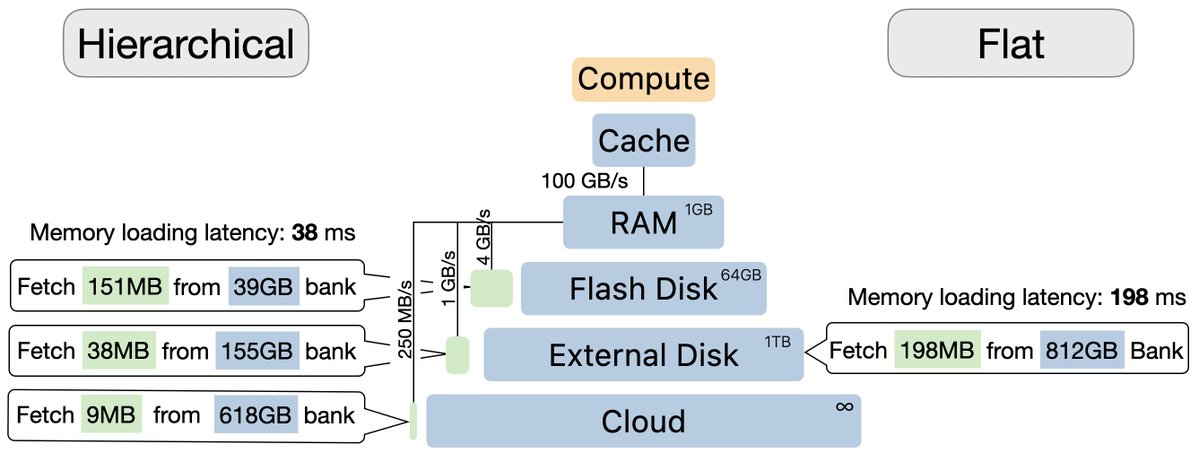
I love this line of research from my colleagues at Apple:Augmenting a language model with a hierarchical memory makes perfect sense for several reasons:- Intuitively the memory parameters should be accessed much less frequently than the weights responsible for reasoning. You… https://t.co/q7HQnYmdR4 pic.twitter.com/38b9q7YKCe— Awni Hannun (@awnihannun) October 6, 2025
tinygrad: A simple and powerful neural network framework
We write and maintain tinygrad, the fastest growing neural network framework
The full stack behind abundant intelligence
OpenAI CFO Sarah Friar explains how advances across chips, compute, models, and products compound to deliver more useful intelligence at greater scale and lower cost.

INTELLECT-2: The First Globally Distributed Reinforcement Learning Training of a 32B Parameter Model
Today we are launching INTELLECT-2: the first 32B parameter globally decentralized Reinforcement Learning training run where anyone can permissionlessly contribute their heterogeneous compute resources.
.png?v=intellect-2)