


When I talk about balancing being directive and empowering as a leader, the distinction between being kind and being nice often comes up.

Kind Engineering: How To Engineer Kindness
How do you avoid becoming a Brilliant Jerk? Read this article to learn practical tips on communication, honesty and psychological safety.
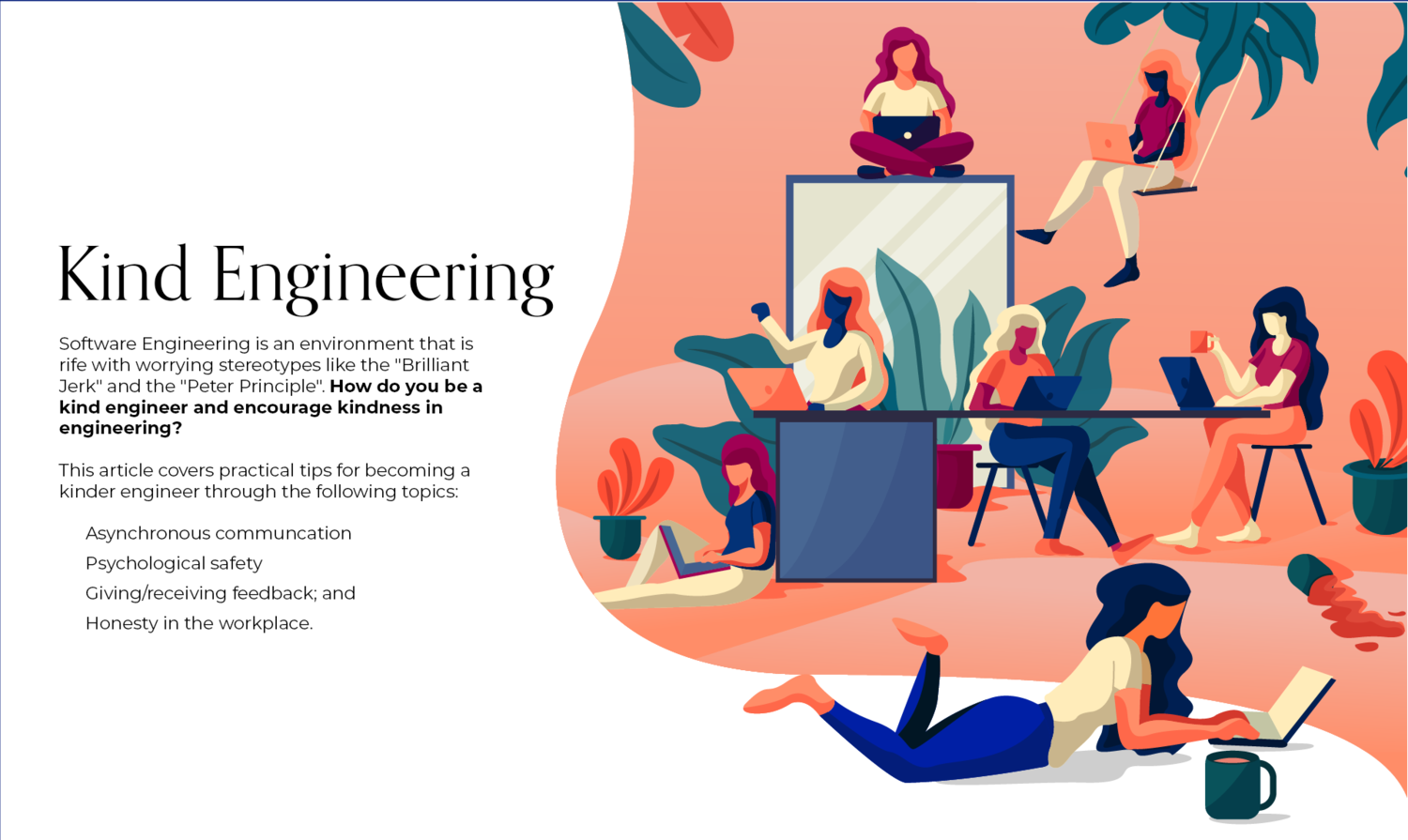
Autonomy and Clarity in Leadership Styles
There’s no one right style of leadership. Use the right style of at the right time.
How to Deliver Constructive Feedback in Difficult Situations
Thoughtful, empathetic language can make or break your business relationships
It’s Not Enough to Be Right. You Also Have to Be Kind.
Takedowns and clever quips are easy, but empathy and persuasion are better

What Not to Do When You’re Trying to Motivate Your Team
People ultimately choose to be motivated — when to give their best, go the extra mile, and offer radical ideas. The only thing leaders can do is shape the conditions under which others do, or don’t, choose to be motivated. Unfortunately, too few managers understand this, and so there is a gap between managers’ efforts and the results they’re getting. Three of the most offensive forms of “motivating” — drive-by praise, making stuff up, and guilt gratitude — can actually make employees feel less appreciated and erode their trust in a leader. The common shortfall among these approaches is that they all serve the leader giving the praise, not the recipient. If you want to direct your good intentions into more-meaningful expressions of recognition, consider these alternatives: Ask your employee how they accomplished their goal, explain how their efforts are contributing to the broader organization, and acknowledge the challenges they overcame to make such a valuable contribution.

The surprising traits of good remote leaders
Strong in-person leadership skills don’t necessarily translate to being a good virtual leader. Instead, organisation and competency reign supreme.

Influence without authority — Gabriel Valdivia
Some of the most influential designers I’ve worked with had no direct reports. They didn't spend their days assigning work, running performance reviews, or deciding who got promoted. Yet they could change the direction of a project, raise the quality bar of a team, and sometimes change the strategy for the entire company. Individual contributors can develop influence by giving people reasons to trust their judgment, then finding ways for that judgment to travel beyond the things they personally make.
Being a curious leader
Being a curious leader, by Emma Wilson, explores how curiosity can reshape leadership in research environments. Drawing on personal experience, this piece highlights the value of listening, asking questions, and embracing uncertainty as strengths rather than weaknesses. It reflects on how curiosity, reflexivity, and openness to different perspectives can foster more inclusive, collaborative, and supportive research cultures.
Refusing to Be the Victim – How to Adopt a “Player” Mindset at Work
You can’t expect others to fix your problems. When you take responsibility for making the best of any situation, you have the power to make things better.

Leadership: Values
A question I get quite frequently is “What makes a good leader?” One of the most important aspects of a good leader is that they have values. This may at first sound noncontroversial, but we are surrounded today by leaders who do not have values or whose only values are to get rich personally or to be powerful (or both). Tech investors have been especially guilty of enabling charismatic leaders, and sometimes even non-charismatic but wildly successful ones, who are fundamentally hollow and wi...
The 5% Rule
...I learned a lot from that period, but one of the things I learned that I did not expect was what I now call my '5% rule.' No matter how kind, warm, thoughtful, amazing, cheerful, consistent, and perfect I treated people roughly 5% of them would just be terrible (yes, I have the numbers to back this)...
Fairness is what the powerful ‘can get away with’ study shows
The willingness of those in power to act fairly depends on how easily others can collectively push back against unfair treatment

How can you tell if someone is kind? Ask how rich they are.
Studies show that the wealthy are less empathetic than the poor, whether they're driving a car or serving in Congress.
one of the clearest gaps in the ecosystem - working against the lofty decentralisation goals - is how power concentrates in tools: lists/feeds/labellers the implicit decision by bsky rn is "don't let these things become powerful", which also means "don't let these things become *too* useful"

Baldemoto🇵🇸
Moderating @furryli.st always made me feel that something was missing from atproto. If we disappeared, so too would the community we built This feeling’s finally crystallized into this proposal: Composable Trust We created identities that survive platform failure. Lets do the same for communities!
humble opinon: it's hard to be taken seriously when you tell everyone about respecting users' agency and then force a change of *their content presentation* with no controls in other words: why do y'all have so much care at the protocol level and seems to have so little on everything user facing?!

