


In the fifth essay of the Legacies of Eugenics series, Ruha Benjamin explores how AI evangelists wrap their self-interest in a cloak of humanistic concern.
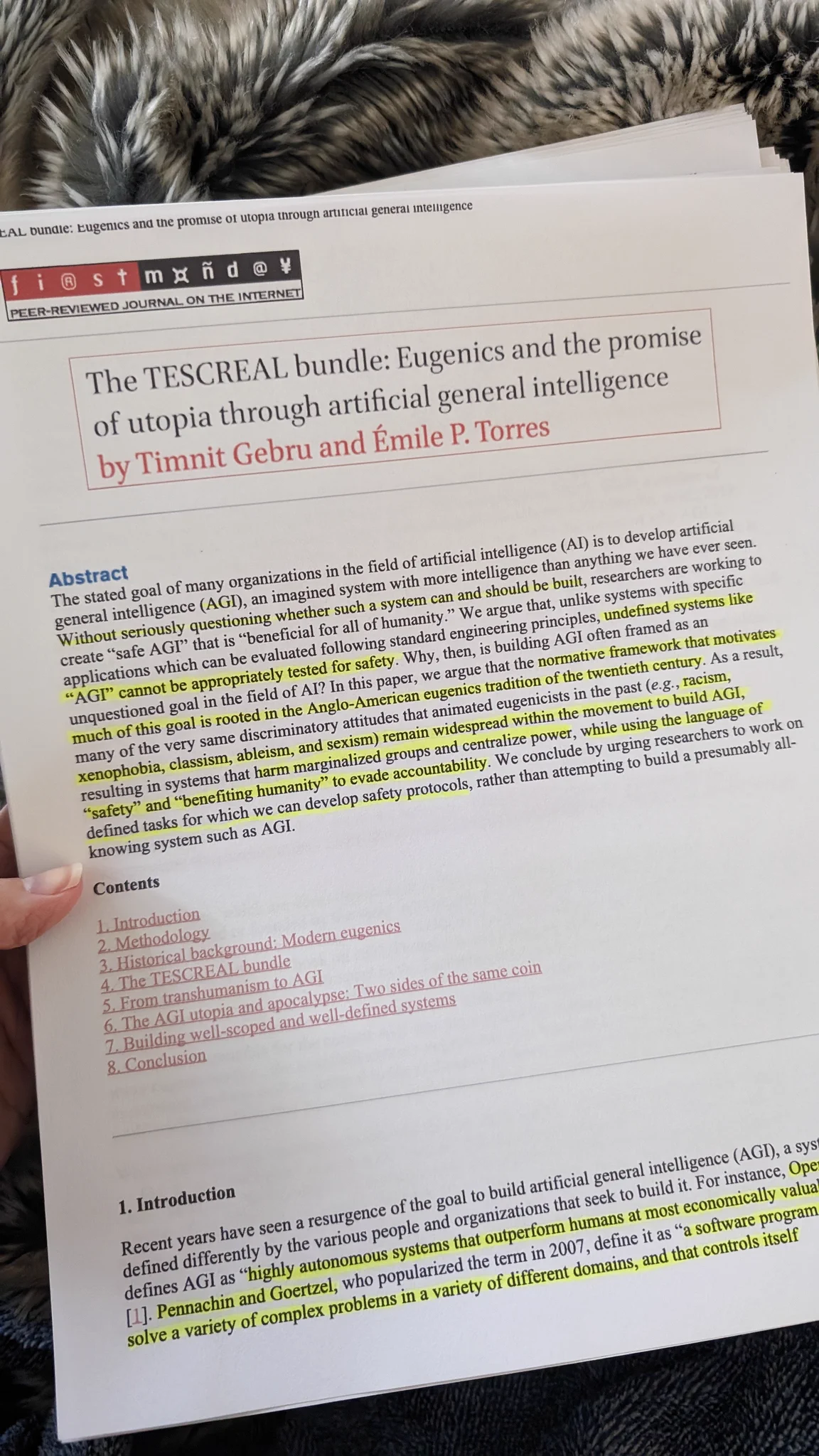
The TESCREAL bundle: Eugenics and the promise of utopia through artificial general intelligence
The stated goal of many organizations in the field of artificial intelligence (AI) is to develop artificial general intelligence (AGI), an imagined system with more intelligence than anything we have ever seen. Without seriously questioning whether such a system can and should be built, researchers are working to create “safe AGI” that is “beneficial for all of humanity.” We argue that, unlike systems with specific applications which can be evaluated following standard engineering principles, undefined systems like “AGI” cannot be appropriately tested for safety. Why, then, is building AGI often framed as an unquestioned goal in the field of AI? In this paper, we argue that the normative framework that motivates much of this goal is rooted in the Anglo-American eugenics tradition of the twentieth century. As a result, many of the very same discriminatory attitudes that animated eugenicists in the past (e.g., racism, xenophobia, classism, ableism, and sexism) remain widespread within the movement to build AGI, resulting in systems that harm marginalized groups and centralize power, while using the language of “safety” and “benefiting humanity” to evade accountability. We conclude by urging researchers to work on defined tasks for which we can develop safety protocols, rather than attempting to build a presumably all-knowing system such as AGI.
The TESCREAL bundle: Eugenics and the promise of utopia through artificial general intelligence by Timnit Gebru (@timnitGebru) & Émile P. Torres (@xriskology) is a must read! 🧵The amount of second-wave eugenic rhetoric right under all of our noses via AGI + AI Hype framing i
The TESCREAL bundle: Eugenics and the promise of utopia through artificial general intelligence by Timnit Gebru (@timnitGebru) & Émile P. Torres (@xriskology) is a must read!🧵The amount of second-wave eugenic rhetoric right under all of our noses via AGI + AI Hype framing is… pic.twitter.com/h1QJiiiReX— Britney Muller (@BritneyMuller) April 22, 2024
Digital Eugenics and the Extinction of Humanity
If we are to combat the AI industry’s push to build digital gods, we have to understand the ideology of the antihumanist project, writes Dr. Émile P. Torres.
AI, Ethics, and Society — Home
The Impact of Artificial Intelligence on Human Thought
This research paper examines, from a multidimensional perspective (cognitive, social, ethical, and philosophical), how AI is transforming human thought. It highlights a cognitive offloading effect: the externalization of mental functions to AI can reduce intellectual engagement and weaken critical thinking. On the social level, algorithmic personalization creates filter bubbles that limit the diversity of opinions and can lead to the homogenization of thought and polarization. This research also describes the mechanisms of algorithmic manipulation (exploitation of cognitive biases, automated disinformation, etc.) that amplify AI's power of influence. Finally, the question of potential artificial consciousness is discussed, along with its ethical implications. The report as a whole underscores the risks that AI poses to human intellectual autonomy and creativity, while proposing avenues (education, transparency, governance) to align AI development with the interests of humanity.

2026 Cosmos HAI Lab Lecture with Jack Clark, Co-founder of Anthropic
The stupidity of AI
The long read: Artificial intelligence in its current form is based on the wholesale appropriation of existing culture, and the notion that it is actually intelligent could be actively dangerous

The Same Old Fantasies Behind AI and New Technology
A review of Adam Becker, “More Everything Forever: AI Overlords, Space Empires, and Silicon Valley’s Crusade to Control the Fate of Humanity” (Basic Books, 2025).

Exploring the Impact of Artificial Intelligence on Social Justice
OHF WEEKLY Is AI humanity’s Prometheus moment?

AI as Christian Heresy
A pocket history of the rise of artificial intelligence, and some strategies for resistance.

No. 010: AutoScientists governance, AI-agent monoculture, nonsense-term retractions - The Hallway Track
The Hallway Track No. 010 - How AI is affecting the practice of science
My Objections to "We’re All Gonna Die with Eliezer Yudkowsky" — AI Alignment Forum
Introduction I recently watched Eliezer Yudkowsky's appearance on the Bankless podcast, where he argued that AI was nigh-certain to end humanity. Sin…
Ghost in the Machine | Full Documentary
Nassim Nicholas Taleb on Twitter / X
The problem isn’t that AI is intelligent. It isn’t. The problem is that too many adults (but not all) are at once mechanistic, imitative, unimaginative, stupid, formulaic, influenceable, & gullible, arrogant beyond their skill set, & too expensive to maintain.— Nassim Nicholas Taleb (@nntaleb) October 24, 2026
Resisting AI
Resisting AI - An Anti-fascist Approach to Artificial Intelligence; Artificial Intelligence (AI) is everywhere, yet it causes damage to society in ways that can’t be fixed. Calling for the restructuring of AI, Dan McQuillan sets out an anti-fascist approach that replaces exclusions with caring and outlines new mechanisms that support collective freedom.
