

Latent Spacecraft combines computational linguistics, neuroscience, and literary analysis to investigate latent space, i.e. the hidden internal structure that enables both humans and machines to produce language. Peeking into AI’s hidden interiority, we parallel speech generation in humans and speech-trained generative adversarial networks (GANs), as well as in the language of Joyce’s Finnegans Wake and the GAN model trained on the novel, FinneGAN.
Latent Space as a New Medium
Lately I’ve been asking myself: what might artificial intelligence be good for besides answering questions and writing code?

Language Machines
How generative AI systems capture a core function of language Looking at the emergence of generative AI, Language Machines presents a new theory of meaning i...
51 Ways to Spell the Image Giraffe: The Hidden Politics of Token Languages in Generative AI
Generative AI models don't operate on human languages – they speak in **tokens**. Tokens are computational fragments that deconstruct lan...

How memory augmentation can improve large language models
Generative AI models struggle to handle long context, but memory augmentation can reduce their memory footprint, making them more accurate and lightweight

The Dark Forest and Generative AI
Proving you're a human on a web flooded with generative AI content
Generative artificial intelligence: The Times and Sunday Times editorial guidelines
As we explore the potential of generative artificial intelligence our commitment is to uphold our high editorial standards.
The Philosophy of Language Models
ABSTRACT The success of large language models (LLMs) across many domains of AI research has generated intense debate. Some attribute their impressive performance on complex tasks to human‐like linguistic and cognitive capacities, whereas others ascribe it to shallow pattern matching. These disputes stem from deep‐seated philosophical disagreements about the nature of language and cognition. We provide an opinionated survey of these disagreements across core topics in the philosophy of mind and language, including syntactic competence, compositionality, linguistic meaning, representation, attitudes, reasoning, agency, and consciousness. We contend that progress on these issues requires not only clarity about background philosophical commitments but also, in many cases, close engagement with emerging empirical evidence.

Literature fans should welcome AI as a fellow wordsmith | Aeon Essays
Strong resistance to AI among writers is understandable. But it obscures what we share with the machines: language itself

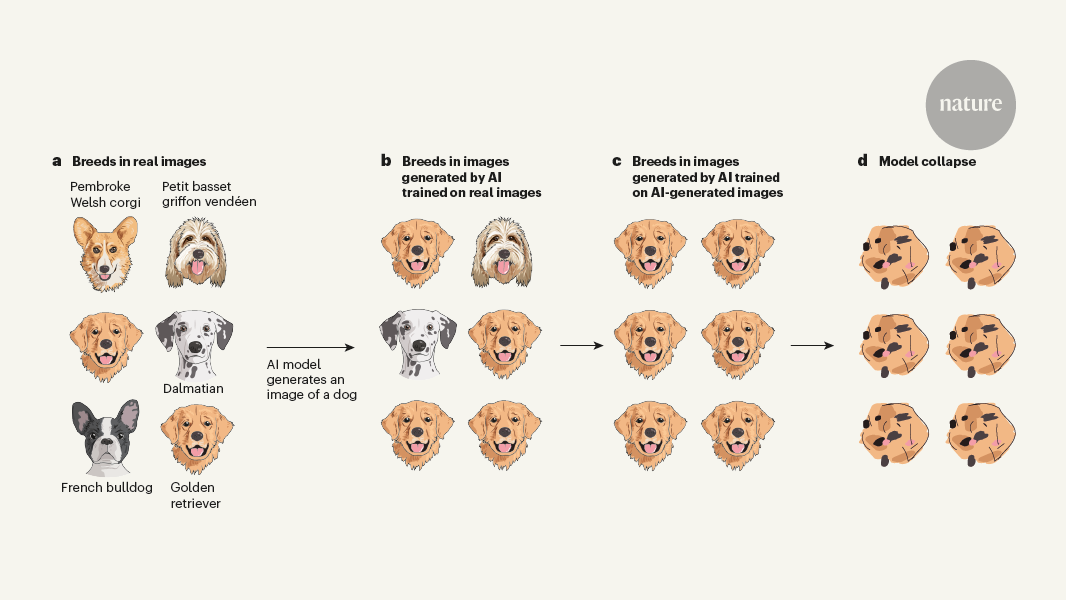
AI produces gibberish when trained on too much AI-generated data
Generative-AI models collapse when trained recursively.

Exploring Generative AI
Notes from my Thoughtworks colleagues on AI-assisted software delivery
Exploring Generative AI
Notes from my Thoughtworks colleagues on AI-assisted software delivery
Artificial intelligences and human scientists exhibit...
We investigate the effectiveness of artificial intelligences (AI)-specifically large language models (LLMs)-relative to human scientists at high-level cognitive tasks in social science such as...

OpenAI admits AI hallucinations are mathematically inevitable, not just engineering flaws
In a landmark study, OpenAI researchers reveal that large language models will always produce plausible but false outputs, even with perfect data, due to fundamental statistical and computational limits.

We Don't Understand Neural Networks At The Algorithmic Level
The largest ongoing debate about AI is “Are Large Language Models (LLMs) intelligent?” That makes sense, at least: the evidence is ambiguous and the stakes a...
Empirical evidence of Large Language Model's influence on human spoken communication
From the printing press to social media, innovations in communication technology have repeatedly reshaped how ideas spread through human culture. Chatbots powered by generative artificial intelligence constitute a new medium, encoding cultural patterns in their neural representations and disseminating them in conversations with hundreds of millions of people. Whether these patterns transmit into human language, and ultimately shape human culture, is a fundamental question. While fully quantifying the causal impact of a chatbot like ChatGPT on human culture is challenging, lexical shifts in human spoken communication may offer an early indicator. Here we show that words preferentially generated by ChatGPT, such as delve, showcase, boast, intricacies and meticulous, increased abruptly in spontaneous human speech. A synthetic-control analysis of 737,083 hours of conversation from 824,634 podcast episodes, screened for unscripted speech, causally links this shift to ChatGPT's release. The measurable influence on spontaneous speech suggests that humans internalize the lexical choices of large language models (LLMs). A preregistered experiment (N = 496) confirms they do, as a brief chatbot interaction led participants to adopt its words as their own, persisting past a distractor task and confirmed in forced lexical choice, indicating entrenchment in the active vocabulary. Together these results show that machines trained on human data now feed their own traits back into human language, integrating LLMs into the ongoing processes of cultural evolution.. This coupling raises concerns about linguistic homogenization and the capacity of a few major AI providers for latent cultural influence at scale.